
Edição Temática - Gp 2026
November 27, 2026
Evaluating the Evaluation: Collaborators’ Perspective on Performance Evaluation in Organizations
Allan Madson Alves Barbosa; Ana Paula Pereira dos Passos
DOI: 10.22167/2675-6528-202603680
Article derived from a Final Course Work (TCC), with content based on the student’s original work and adapted to the editorial format of the E&S Magazine with the support of the ResumeAI tool, an artificial intelligence solution developed by Instituto Pecege for textual synthesis and organization.
Summary
Performance evaluation is crucial for measuring employee performance, identifying areas for improvement, and aligning individual objectives with the company’s strategic goals. However, this process often fails in clarity and feedback communication, which can lead to insecurity and lack of guidance. This study aimed to verify employees’ perception of performance evaluation in their organizations. A descriptive and quantitative approach was adopted, applying a validated questionnaire via Google Forms to 165 professionals. Factors such as results, behavior, communication, and “feedback” were measured. The results indicated that 56.3% of respondents were evaluated frequently or very frequently based on results. However, 52.2% reported that a performance evaluation form was never or rarely used, and 51.23% said they never or rarely received praise from superiors. Furthermore, 27.8% stated they never or rarely received useful “feedback”. Although men had slightly higher averages, there were no statistically significant differences between genders or age groups in the analyzed factors. It was concluded that clear and objective communication about performance, accompanied by constructive “feedback”, is fundamental to increasing employee engagement and supporting the achievement of organizational objectives.
Keywords: Behavior; “feedback”; Outcome.
1. Introduction
Performance appraisal is a continuous and strategic organizational process, fundamental for aligning employees with the results expected by the organization. This process allows for the correction of deviations, verification of strategic planning compliance, and constant implementation of solutions, contributing to the continuous improvement of business practices (Pontes, 2021). Furthermore, performance appraisal acts as an effective method for motivating employees, encouraging them to seek improvement and development, and assisting in the identification of problems in activities, which generates valuable information for new directions and opportunities (Morais; Pereira, 2016).
It is important to distinguish performance appraisal from competency appraisal. While competency appraisal focuses on an individual’s knowledge, skills, and attitudes (Leme, 2006), performance appraisal focuses on the employee’s tasks, duties, and obligations. Additionally, aspects such as citizenship and counterproductivity, which relate to the employee’s attitudes, are also considered in the context of performance appraisal (Judge et al., 2014). Organizations constantly seek methods to develop their employees more effectively, enhancing their skills and fostering job performance (Pontes, 2008).
Professional development is intrinsically linked to the acquisition of knowledge, skills, and attitudes that drive performance and growth in work activities (Mourão et al., 2014). Employees who receive more stimuli from organizations to engage in work tend to show greater professional development throughout their careers in the company (Monteiro et al., 2019). The way performance appraisal is applied can positively or negatively influence professional development, depending on the interpretation of the information obtained (Monteiro et al., 2019; Brito, 2011). Human resources professionals, therefore, need to review their appraisal strategies and development programs to encourage employee engagement and the improvement of their skills and attitudes (Monteiro et al., 2019). Studies corroborate this relevance, with 90% of participants believing that performance appraisal improves corporate performance (Morais; Pereira, 2016), and employees recognizing its importance for engagement (Silva, 2019) and competence development (Silva, 2014).
Despite the recognized importance of performance evaluation, the process is often unclear to employees, due to flaws in the evaluation and feedback communication. This lack of clarity can generate insecurity and a lack of guidance for professionals. A deep understanding of the performance evaluation process and acceptance of feedback directly impact company results and professional performance (Rodrigues, 2017). Feedback, understood as the retrofeeding of information about performance (Moscovici, 1997), is an integral part of the evaluation, providing periodic returns and increasing employees’ awareness of their performances (Esteves, 2020). However, when this feedback is deficient or poorly communicated, the effectiveness of the process is compromised.
Given the problem of lack of clarity and ineffective communication of feedback, which can negatively affect employee engagement and motivation, it becomes fundamental to investigate professionals’ perspectives on this process. Clear and objective communication about performance, accompanied by constructive feedback, is essential for professional development and for achieving organizational goals. Thus, this study is justified by the need to understand employees’ perceptions to improve people management practices. Therefore, the objective of this work was to verify employees’ perceptions of performance appraisal in their organizations.
2. Material and Methods
This work adopted a quantitative approach, with a descriptive character. The research involved the application of a questionnaire to professionals over 18 years of age, working in formal and informal jobs, in various regions of the country and business segments, using a non-probabilistic sampling.
The instrument was developed and validated by Rodrigues et al. (2017), based on Stathakopoulos (1997) and Steelman et al. (2004). It consisted of two blocks: the first with seven questions to collect sociodemographic data (region, age, sex, education level, hierarchical level, company branch, and area of operation) and the second with 18 questions to investigate participants’ perception of performance evaluation, using a five-point Likert scale (from “very frequent” to “never”).
For ethical purposes, the questionnaire included the Informed Consent Form (ICF), with data protection guidelines (LGPD), whose authorization was necessary for proceeding. A pre-test with five people was conducted to verify the clarity of the instrument, resulting in adjustments such as the inclusion of the objective in the questionnaire and the replacement of terms in questions 4 and 17. The average completion time was 4 to 6 minutes.
Data collection was carried out online, via the Google Forms platform, with the link shared on social media in the period from May 7 to 11, 2024, and had the participation of 165 respondents. The data were processed with the help of Microsoft Excel software. The reliability and consistency of the research were evaluated by Cronbach’s Alpha. Data analysis used descriptive statistics (relative frequency, mean, and standard deviation) and the Mann-Whitney U and Kruskal-Wallis tests for comparing medians between groups.
3. Results and Discussion
In this section, the data collected from 165 professionals who participated in the survey are presented. Initially, the sociodemographic profile of the participants is described, followed by their perception of performance appraisal in their organizations. Finally, the differences in perception among the groups of respondents are highlighted.
Characterization of participants
The collection of sociodemographic data identified information on gender, age, education level, region of operation, hierarchical level, and business sector of the participants. According to Table 1, most participants are between 31 and 40 years old (36.4%), followed by 26 to 30 years old (33.3%). The female sex represents 50.9% of the sample, while the male corresponds to 49.1%. In terms of region of operation, 73.3% of respondents are in the Southeast, with lower representation in the North (1.2%).
Table 1. Participant profile
| Category 1 | First Item | Percentage 1 | Category 2 | Item 2 | Percentage 2 |
| Sex | Female | 50,9% | Region | Midwest | 5,5% |
| Male | 49,1% | Northeast | 13,9% | ||
| Age | 18 to 25 years | 12,10% | North | 1,2% | |
| 26 to 30 years | 33,30% | South | 6,1% | ||
| 31 to 40 years | 36,4% | Southeast | 73,3% | ||
| 41 to 50 years | 17% | ||||
| 51 years or older | 1,2% | ||||
| Trade | 11,5% | High School Diploma | 9,1% | ||
| Company’s business sector | Industry | 19,4% | Academic training | Completed Higher Education | 24,2% |
| Service | 45,40% | Incomplete postgraduate studies | 35,8% | ||
| Others | 23,7% | Complete graduate course | 29,1% | ||
| Assistant | 8,5% | Others | 1,8% | ||
| Hierarchical Level | Assistant | 10,30% | Analyst | 29,7% | |
| Coordinator | 21,8% | Director | 4,2% | ||
| Analyst | 29,7% | Others | 25,5% | ||
| Director | 4,2% | ||||
| Others | 25,5% | ||||
Source: Original research results
Regarding the business sector, 45.50% work in services, 23.7% in other segments, 19.4% in industry, and 11.5% in commerce. Concerning the professional profile, 29.7% are analysts, 25.5% in other areas, 21.8% coordinators, 10.3% assistants, 8.5% auxiliaries, and 4.2% in management. Regarding academic background, 35.8% have incomplete postgraduate studies/MBA, 29.1% complete postgraduate studies, 24.2% complete higher education, and 9.1% complete high school, with 1.8% not fitting any option.
Subordinates’ perception of performance evaluation
The analysis of the eighteen questions about performance evaluation was organized into four factors: results, behavior, manager communication, and feedback on the evaluation, according to the grouping by Rodrigues et al. (2017).
Results-based performance evaluation
The results-based performance evaluation showed an overall average of 3.48. Table 2 shows that most participants are evaluated based on results, with the sum of the “frequent” and “very frequent” responses being predominant in all questions of this factor. Specifically, 56.3% of respondents indicated that results-based evaluation occurs frequently or very frequently. On the other hand, between 8.5% and 15.8% of organizations never or rarely evaluate employees based on the achievement of specific objectives or goals. Monitoring of procedures established by the supervisor was perceived as frequent or very frequent by 58.2% of participants. The averages of the questions ranged from 3.41 to 3.53, with standard deviations between 1.22 and 1.30, indicating some dispersion in the data.
Table 2. Performance Evaluation based on Results
| Questions | Never | Rarely | Occasionally | Current Attendance | Very frequent | Mean | Standard deviation |
| 1.Am I evaluated based on the achievement of results? | 10,9% | 7,3% | 25,5% | 29,6% | 26,7% | 3,53 | 1,26 |
| 2. Does the organization monitor the extent to which I achieve the objectives? | 8,5% | 15,8% | 23,6% | 30,9% | 21,2% | 3,41 | 1,22 |
| 3. Am I evaluated based on the specific performance goals of my job? | 10,90% | 14,5% | 16,4% | 33,4% | 24,8% | 3,46 | 1,30 |
| 4. Does my supervisor monitor the extent to which I follow established procedures? | 7,9% | 14,5% | 19,4% | 32,7% | 25,5% | 3,52 | 1,53 |
| General Average | 3,48 |
Source: Original research results
The importance of a clear and measurable performance evaluation is highlighted by Albuquerque and Amorim (2011), who observed the negative impact of a lack of focus on indicators. Oliveira et al. (2018) also emphasize the need for a well-defined structure for evaluation. Pontes (2021) and Urnau (2014) reinforce that aligning individual objectives with organizational ones and monitoring with measurable metrics are crucial to ensure assertive results and increase engagement.
Behavior-based performance appraisal
Table 3 presents the results of the behavior-based performance evaluation, with an overall average of 3.23. In question 5, 68.5% of participants indicated that their organizations frequently or very frequently care about how work is performed. In contrast, 29.7% of participants pointed out that formal evaluations never hinder work, suggesting a practical approach. The supervisor’s concern with the correct execution of tasks was perceived as frequent or very frequent by 72.7% of participants, with an average of 3.97. However, 52.2% of participants never or rarely had access to a performance evaluation form (question 8), indicating a lack of standardization in evaluation methods in many organizations.
Table 3. Performance Evaluation Based on Behaviors
| Questions | Never | Rarely | Occasionally | Current Attendance | Very frequent | Mean | Standard deviation |
| 5. Does this organization care about how the work is done? | 4,2% | 5,5% | 21,8% | 38,2% | 30,3% | 3,84 | 1,05 |
| 6.Do formal evaluations of my work hinder the way my work is done? | 29,7% | 25,5% | 23,6% | 13,3% | 7,9% | 2,42 | 1,24 |
| 7.Does my supervisor worry that I perform the tasks correctly? | 5,5% | 7,3% | 14,5% | 29,1% | 43,6% | 3,97 | 1,17 |
| 8. Does my supervisor use an evaluation form to assess their subordinates? | 35,2% | 17% | 12,7% | 13,3% | 21,8% | 2,70 | 1,58 |
| General Average | 3,23 |
Source: Original research results
Albuquerque and Amorim (2011) identified that managers tend to focus more on processes than on People Management, highlighting the need to improve the evaluation of behaviors. Leme (2006) argues that competency assessment should encompass knowledge, skills, and attitudes. Grillo (1982) complements that performance appraisal is fundamental to obtaining information about employee behavior.
Communication in the performance evaluation process
The global average for the communication factor in the performance evaluation process was 3.26. Table 4 shows that 39.4% of participants never or rarely meet with the supervisor to discuss performance (question 9), while 44.8% do so frequently or very frequently. In question 10, 30.3% of participants indicated that they receive communication from the manager about individual performance very frequently. However, 20.60% of participants were never communicated about performance below expectations (question 11), and 26.1% indicated very frequent communication about errors (question 12). The highest average in this factor was for communication about errors (3.56), and the lowest for communication about performance below expectations (2.95).
Table 4. Communication in the performance evaluation process
| Questions | Never | Rarely | Occasionally | Current Attendance | Very frequent | Mean | Standard deviation |
| 9. Do I meet with my supervisor to discuss my performance? | 19,4% | 20% | 15,8% | 20,6% | 24,2% | 3,10 | 1,47 |
| 10. Does my supervisor allow me to know my performance? | 13,9% | 14,5% | 15,8% | 25,5% | 30,3% | 3,43 | 1,41 |
| 11. Does my supervisor tell me the situations in which my performance falls short of what is expected? | 20,6% | 18,8% | 21,2% | 24,2% | 15,2% | 2,95 | 1,36 |
| 12. Does my supervisor tell me the situations in which I made a mistake at work? | 6,1% | 15,8% | 19,9% | 32,1% | 26,1% | 3,56 | 1,20 |
| General Average | 3,26 |
Source: Original research results
This data suggests that, although there is communication, it is not always clear or comprehensive, especially regarding areas for improvement. Barros and Matos (2015) demonstrated that the lack of clear and constant communication negatively impacts motivation and performance. Santos (2018) reinforces the importance of communicating expectations and results clearly and objectively so that employees can identify their areas of strength and development.
Comments
The “feedback” factor presented an overall average of 3.45. Table 5 indicates that 27.9% of participants receive performance feedback very frequently, and 23% frequently, totaling over 50%. In question 15, 78.20% of participants value the feedback received. Furthermore, 37.2% stated that feedback helps in work development (question 16). However, 10.3% of participants never receive praise (question 17), and 8.5% rarely receive it (question 18). The highest average was in question 15 (4.05), and the lowest in question 18 (2.46).
Table 5. Feedback
| Questions | Never | Rarely | Occasionally | Current Attendance | Very frequent | Mean | Standard deviation |
| 13. Does my supervisor give me feedback on my performance? | 12,1% | 16,4% | 20,6% | 23% | 27,9% | 3,38 | 1,36 |
| 14. Does my supervisor give me useful feedback on my job performance? | 14,5% | 13,3% | 21,3% | 21,8% | 29,1% | 3,38 | 1,40 |
| 15. Do I value the feedback I receive from my supervisor? | 6,7% | 4,8% | 10,3% | 32,7% | 45,5% | 4,05 | 1,16 |
| 16. Does the feedback I receive from my supervisor help me in my work? | 9,2% | 7,3% | 15,2% | 31,1% | 37,2% | 3,79 | 1,26 |
| 17. When I do a good job, am I praised by my supervisor? | 10,3% | 12,1% | 15,2% | 29,7% | 32,7% | 3,62 | 1,33 |
| 18. Do I rarely receive praise from my supervisor? | 30,3% | 21,8% | 26,1% | 13,3% | 8,5% | 2,46 | 1,26 |
| General Average | 3,45 |
Source: Original research results
Despite the appreciation of feedback, 27.80% of respondents never or rarely receive useful feedback (question 14), which suggests that the return is not always favorable or constructive. Steelman (2004) and Castro (2022) observed that unfavorable or negative feedbacks are more common. Santos (2018) emphasizes the importance of regular and constructive feedback for development and achievement of goals, while Barros and Matos (2015) warn that the absence of continuous and objective feedback can demotivate and compromise performance.
Data Intersection
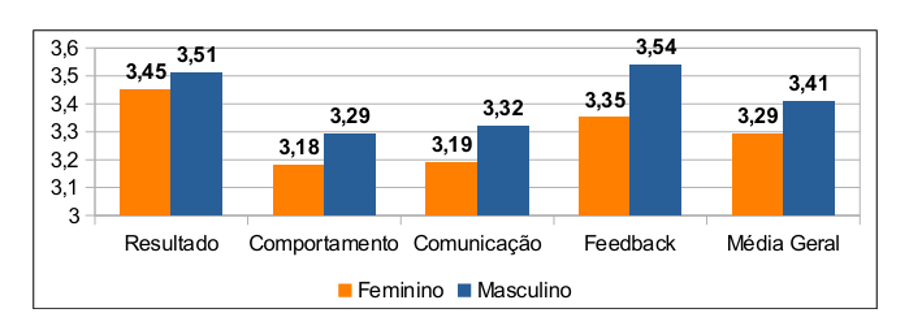
To explore the data, the information was cross-referenced by sex and age group. Figure 1 compares the general averages of the factors between men and women. It was observed that men obtained a slightly higher average (3.41) than women (3.29) in the general average of the factors, and presented higher averages in all analyzed factors (outcome, behavior, feedback, and communication).
Figure 1. Graph of the overall average by sex
Source: Original research results
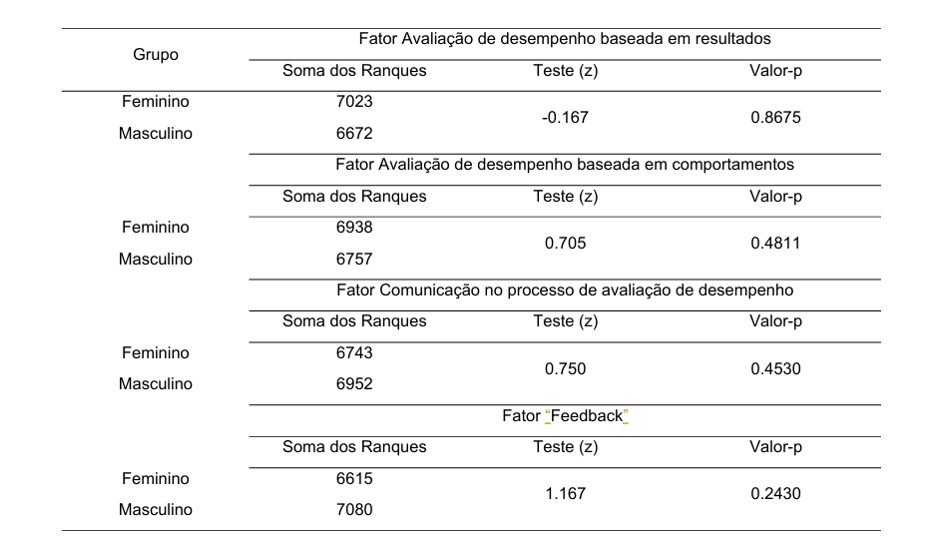
However, the Mann-Whitney U Test (Table 6) indicated that there is no statistically significant difference between the distributions of the female and male groups in any of the performance evaluation factors (results: z = -0.167, p = 0.8675; behaviors: z = 0.705, p = 0.4811; communication: z = 0.750, p = 0.4530; feedback: z = 1.167, p = 0.2430). This suggests that, statistically, the distributions are equal between the groups. Moller and Gomes (2010) also found no results favoring leadership practices by gender, but pointed out that the work environment can replicate gender stereotypes (Keer, 2023).
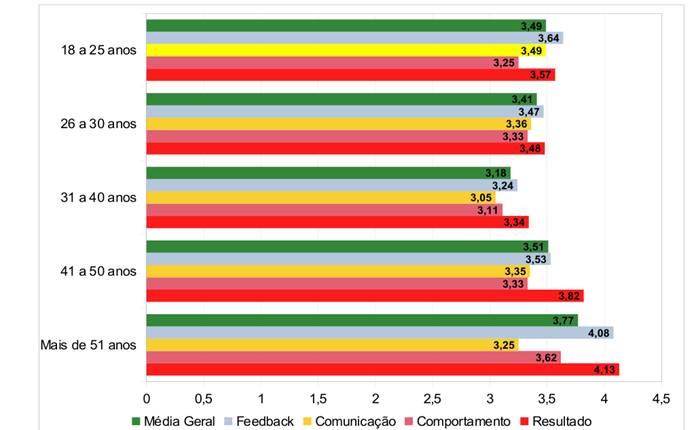
Figure 2 shows the overall averages by age group. The 31 to 40 age group presented the lowest averages across all factors, suggesting lower frequency in performance evaluation, lower satisfaction with feedback, and perception of less effective communication. In contrast, the age group above 51 years presented the highest averages, indicating that these individuals are evaluated more frequently and receive more assertive feedback. These values may reflect trends in the perception of evaluation and feedback among different age groups.
Figure 2. Graph of the overall average by age group
Source: Original research results
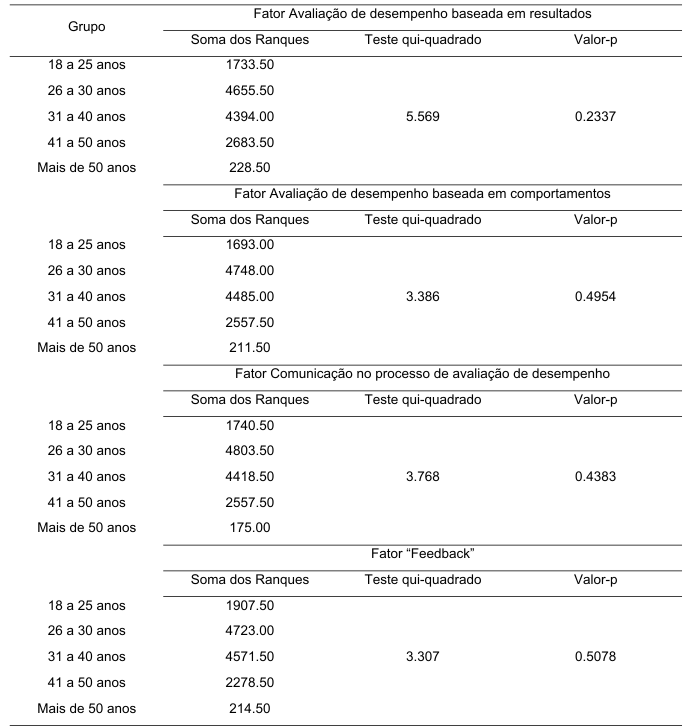
The Kruskal-Wallis Test (Table 7) was applied to compare groups by age range. There was no statistically significant difference between the distributions of the groups in any of the factors (results: chi-squared = 5.569, p = 0.2337; behaviors: chi-squared = 3.386, p = 0.4954; communication: chi-squared = 3.768, p = 0.4383; feedback: chi-squared = 3.307, p = 0.5078). Murphy and Cleveland (1995) and Costa (2024) identified that the valuation of performance evaluation and feedback varies between generations, with “baby boomers” and “millennials” prioritizing feedback and personal growth, while generation Z considers evaluation essential for identifying development opportunities.
Table 6. Mann-Whitney U Test Result
Source: Original research results
Table 7. Kruskal-Wallis Test Result
Source: Original research results
Managerial applications
The main research results indicate that, although there is a performance evaluation focused on results, the feedback and application method still present flaws or are not sufficiently clear. Table 8 summarizes the main findings and suggested managerial strategies. It was noted that 52.20% of respondents indicated that their superiors never or rarely use an evaluation form, and 27.80% never or rarely receive useful feedback. Furthermore, 52.10% reported never or rarely receiving praise, and 39.40% are never or rarely informed about performance below expectations. These data suggest the need to implement training focused on feedback and responses, ensure impartiality in the evaluation process, structure the evaluation method with pre-established criteria, and create a direct and effective communication channel.
Table 8. Main results and suggested managerial strategies
| Main results | Management strategies |
| 52.10% of respondents reported that they never or rarely receive praise from their superiors. | Implement training focused on “feedback” and evaluations, integrated into the organizational culture. “Feedback” should include both praise and suggestions for improvement, to create a more positive and motivating work environment. |
| 27.8% say they never or rarely receive useful “feedback”. | Ensure that the evaluation process is impartial and free of biases, ensuring that the “feedback” is original and effective. The “feedback” should be constructive, even when addressing negative aspects, to promote continuous development. |
| 52.20% reported that a performance evaluation form is never or rarely used. | Structure the evaluation method with pre-established criteria, allowing for an assessment based on concrete and objective results. The consistent use of evaluation forms can formalize and standardize the process. |
| 39.40% are never or rarely informed when performance falls short of expectations. | Create a direct and effective communication channel to provide clear and timely “feedback”. This will help employees understand what needs to be developed and improved, thus promoting more effective alignment with organizational expectations. |
Source: Original research results
Organizations must establish impartial evaluation criteria and foster a culture that promotes equity. The implementation of a frequent and constructive feedback system, with individual meetings and detailed written feedback, can encourage the continuous development of employees. The adoption of online tools for monitoring and recording feedback can make the process more systematic. Therefore, it is recommended that organizations review their performance appraisal practices, ensuring the standardization of methods and clarity in the communication of results, in order to optimize organizational and individual development. The data analysis revealed that employees perceive an organizational concern with how work is performed, indicating attention to both results and behaviors. However, communication about performance and feedback still presents inconsistencies, requiring greater effort to ensure that all employees understand their evaluations and receive clear guidance for improvement. Nascimento et al. (2008) observed that 89% of the surveyed companies establish goals and indicators to measure the performance and results of employees, recognizing evaluation as an important tool for measuring individual performance.
In summary, the research revealed that employees’ perception of performance evaluation is influenced by the clarity of objectives, the consistency in applying methods, and the quality of feedback. Although results-based evaluation and concern for behavior are evident, communication and feedback remain critical areas that need improvement to ensure greater engagement and professional development. Differences in perception between genders and age groups, although not statistically significant, indicate nuances in employees’ experience with the evaluation process.
4. Conclusion
This study aimed to verify employees’ perception of performance evaluation in their organizations. It was found that, although most participants were evaluated based on results and there was an organizational concern with the execution of work, the evaluation process presented significant inconsistencies. It was identified that more than half of the respondents never or rarely had access to a performance evaluation form, indicating a lack of standardization in methods. It was also observed that communication about individual performance was deficient, with many employees reporting that they never or rarely met with their supervisor to discuss the topic or received useful feedback, and that praise was infrequent. However, communication about errors was more present. The main contribution of this work lies in elucidating these gaps in communication and feedback structuring, providing subsidies for organizations to improve their people management practices, promoting greater clarity, engagement, and alignment with strategic objectives.
As a limitation, the study had a restricted number of 165 participants, predominantly from the Southeast region, which may not reflect the country’s regional and sectoral diversity. For future studies, it is suggested to expand the sample and conduct an in-depth investigation of performance evaluation practices, focusing on the standardization of tools and the clarity of feedback. It is also recommended to examine how the frequency and usefulness of feedback, especially regarding praise and areas for improvement, directly impact employee engagement and satisfaction, seeking to establish the relationship between work recognition and productivity.
Bibliographic References
Albuquerque, C. C. P., & Amorim, T. N. G. F. (2011). Desempenho por competências: Um estudo de caso no âmbito de uma empresa de fruticultura utilizando o modelo de Leme. Custos e Agronegócio Online, 7, 115–132.
Barros, D. M. L., & Matos, N. S. (2015). A importância da comunicação organizacional interna e dos feedbacks gerenciais. Revista de Administração, 13, 3–20.
Brito, S. F. (2011). A influência da avaliação de desempenho para o desenvolvimento profissional dos colaboradores: Um estudo de multicasos na Amazônia. Revista de Administração de Roraima, 1, 67–83.
Castro, M. P. A. (2022). Sobrevalorização corporativa da inteligência emocional [Dissertação de mestrado, Universidade Católica Portuguesa]. http://hdl.handle.net/10400.14/41440
Costa, M. M., et al. (2024). Práticas de gestão de recursos humanos e intenção de turnover: A diferenciação entre gerações [Dissertação de mestrado, Instituto Politécnico de Castelo Branco].
Cruz, C. A. B., Araújo, A. S., & Oliveira, I. J. (2014). Avaliação de desempenho como ferramenta de apoio ao desenvolvimento profissional dos colaboradores nas organizações. Revista Científica do ITPAC, 7(3).
Esteves, M. (2020). A importância do feedback na avaliação de desempenho dos oficiais e graduados de uma determinada força armada [Monografia de especialização, Escola Nacional de Administração Pública]. http://repositorio.enap.gov.br/handle/1/5138
Freitas, A. L. P., & Rodrigues, S. G. (2005). A avaliação da confiabilidade de questionário: Uma análise utilizando o coeficiente alfa de Cronbach. Anais do XII Simpósio de Engenharia de Produção (SIMPEP), 1–12.
Grillo, A. N. (1982). Avaliação de desempenho: A experiência brasileira na administração pública. Revista de Administração, 17, 24–38.
Judge, A. S., & Robbins, S. (2014). Comportamento organizacional: Teoria e prática no contexto brasileiro (14ª ed.). Pearson Education do Brasil.
Kerr, C. (2023). O impacto dos estereótipos na carreira das mulheres. GV-executivo, 22(1), 11–17.
Leme, R. (2006). Avaliação de desempenho com foco em competência. Qualitymark.
Michailidis, M. P., Morphitou, R. N., & Theophylatou, I. (2012). Women at work: Equality versus inequality: Barriers for advancing in the workplace. The International Journal of Human Resource Management, 23, 4231–4245.
Moller, M. A. B., & Gomes, J. F. da S. (2010). Quid vincit: O impacto da liderança feminina na implicação organizacional. Análise Psicológica, 28, 1–30.
Monteiro, A. C. F., Mourão, L., & Freitas, C. P. P. de. (2019). Impacto das políticas de gestão de pessoas sobre o desenvolvimento profissional dos trabalhadores. Psico, 50(4), 1–15.
Morais, R. E., & Pereira, G. Q. (2016). Avaliação de desempenho como método de desenvolvimento profissional. Faculdade São Geraldo Multivix. https://multivix.edu.br/wp-content/uploads/2018/12/avaliacao-de-desempenho-como-metodo-de-desenvolvimento-profissional.pdf
Moscovici, F. (1997). Desenvolvimento interpessoal: Treinamento em grupo (7ª ed.). José Olympio.
Mourão, L., Porto, J. B., & Puente-Palácios, K. (2014). Construção e evidências de validade de duas escalas de percepção de desenvolvimento profissional. Psico-USF, 19(1), 73–85.
Murphy, R., & Cleveland, J. (1995). Understanding performance appraisal: Social, organizational and goal-based perspectives. Sage Publications.
Nascimento, A. M., Reginato, L., & Lerner, D. F. (2008). A influência da avaliação de desempenho operacional e de gestores no resultado das empresas. Anais do VIII Congresso USP, 1–16.
Oliveira, F. H. D., Junior, F. A. C., Correia, P. M. A. R., Silva, P. M. Q. F., & Gomes, C. J. V. (2018). Evidências de validade para uma medida de percepção de efetividade da avaliação de desempenho. Revista Eletrônica de Administração, 24, 77–101.
Pontes, B. R. (2008). Avaliação de desempenho: Métodos clássicos e contemporâneos, avaliação por objetivos, competências e equipes (10ª ed.). LTr.
Pontes, B. R. (2021). Avaliação de desempenho (14ª ed.). LTr.
Richardson, R. J. (1999). Pesquisa social: Métodos e técnicas (3ª ed.). Atlas.
Rodrigues, A., Cesário, F., Castanheira, F., & Chambel, M. J. (2017). Gestão de desempenho: Validação de um instrumento de medida. Ciências da Administração, 19, 57–74.
Santos, M. S. A. (2018). Avaliação de competências e feedback: Um estudo acerca do processo de feedback numa instituição financeira [Monografia de especialização, Escola Nacional de Administração Pública].
Silva, Â. (2014). Avaliação de desempenho: Estudo exploratório nos setores da banca e vitivinicultura [Dissertação de mestrado, Instituto Universitário da Maia].
Silva, V. S. da. (2019). Avaliação de desempenho: Implicações para os colaboradores: Estudo exploratório numa empresa do setor alimentar [Dissertação de mestrado, Universidade do Porto]. https://hdl.handle.net/10216/124465
Stathakopoulos, V. (1997). Performance appraisal systems on marketing managers: A conceptual framework and empirical evidence [Dissertação, Universidade do Arizona].
Steelman, L. A., Levy, P. E., & Snell, A. F. (2004). The feedback environment scale: Construct definition, measurement, and validation. Educational and Psychological Measurement, 64, 165–184.
Sustenes, M. (2018). Avaliação de competências e feedback: Um estudo acerca do processo de feedback numa instituição financeira [Monografia de especialização, Escola Nacional de Administração Pública]. http://repositorio.enap.gov.br/handle/1/3435
Urnau, A. M. (2014). O processo de avaliação de desempenho da Unijuí-Câmpus Panambi: Um estudo do ponto de vista dos seus colaboradores. Universidade Regional do Noroeste do Estado do Rio Grande do Sul. https://bibliodigital.unijui.edu.br/items/eec6997a-1a76-4fd6-8692-7c1b27e6c447
Article originating from the Final Course Work of the Specialization in People Management of the MBA USP/Esalq
To learn more about the course, click here and access the MBX Academy platform