
Edição Temática - Gp 2026
November 27, 2026
Retention of People Through Non-Monetary Initiatives: What Makes an Employee Stay?
Anelise Veçoso da Cruz; Cibele Coury
DOI: 10.22167/2675-6528-202603745
Article derived from a Final Course Work (TCC), with content based on the student’s original work and adapted to the editorial format of the E&S Magazine with the support of the ResumeAI tool, an artificial intelligence solution developed by Instituto Pecege for textual synthesis and organization.
Summary
The retention of professionals with diverse socioeconomic profiles, especially in contexts of crisis or the pursuit of work-life quality, demands knowledge of non-exclusively financial incentives and rewards. The study aimed to identify strategic non-monetary incentives for employee retention. A field survey was conducted, employing a quantitative descriptive research design with probabilistic sampling and no researcher interference. A questionnaire was administered to 103 Brazilian professionals (active or former CLT employees) via LinkedIn and WhatsApp between 01/23/2025 and 02/23/2025. The socioeconomic profile of the participants revealed a predominance of Millennials, women, married individuals, those with postgraduate degrees, and those working at operational and tactical levels in the secondary market. Although salary and monetary benefits were decisive for over 90% of respondents, organizational culture and values, job satisfaction and activities, and relationships with managers and colleagues proved crucial for retention. Factors such as flexible hours, extended leave and vacation periods, hybrid work, and extended maternity/paternity leave were also important for retention. It was concluded that, although remuneration is fundamental, investing in non-monetary factors, such as those identified, is strategic for talent retention, especially when basic financial needs are met or when monetary improvements are not feasible. Future studies are suggested to expand and deepen the sample.
Keywords: Non-monetary benefits; Incentives; Rewards.
1. Introduction
In the current context of the economy and employment relations, there has been a growing exploration of alternative and non-monetary strategies and rewards. These initiatives complement traditional salaries and benefits, aiming at employee retention and motivation, and are intrinsically linked to the quality of work life.
High employee turnover can negatively impact organizational performance (Boas and Morin, 2021). Additionally, the post-Covid-19 pandemic economic situation, which has affected the global market since 2020 with increased debt and economic contraction (CEPAL, 2020), has made it difficult to implement salary increases and purely monetary rewards. This reinforces the need for parameters related to quality of life and alternative rewards from an organizational perspective.
From a motivational standpoint, Maslow’s Hierarchy of Needs theory (1970) organizes human needs into a pyramid, starting with physiological and safety needs (including economic), followed by social, belonging, esteem, and self-actualization needs. Non-monetary values, such as socialization and work environment, become decisive for the continuity of the employee-institution contract when basic needs are met (Pinto, 2011). However, if monetary rewards are insufficient, non-monetary strategies may lose their effect (Pinto, 2011).
Along the same lines, Herzberg’s Theory (1993) postulates that business motivation is influenced by hygienic factors (monetary and social benefits) and emotional factors (functions, tasks, job content). Both aspects connect to non-monetary initiatives, as they consider interpersonal relationships, working conditions, recognition, responsibilities, and challenges as motivational elements (Pinto, 2011).
In this scenario, the rationalization of non-monetary proposals for attracting and retaining talent becomes fundamental. Rewards linked to quality of life and personal values aligned with the organization should be integrated into the benefits policy. Examples include extended maternity and paternity leave, international travel opportunities, workation, possibility of studies during work hours, hybrid or non-presential work, four-day week, flexible hours, and extension of days off and vacations (Góes et al., 2021; Pendell, 2023). Such benefits promote greater autonomy and flexibility.
Emotional factors, such as the compatibility between organizational culture and values and those of the individual, the quality of interpersonal relationships, and satisfaction with the position and daily activities, are components of Quality of Work Life (QWL). They are crucial for engagement and a sense of belonging, influencing the professional’s decision to remain in the organization (Herzberg, 1993). The implementation of these initiatives should consider factors such as gender, age, education level, hierarchical level, and family structure.
Thus, this work aimed to identify, across a range of labor market sectors and a diversity of individual profiles (with different genders, age groups, education levels, positions and occupied hierarchies, current salaries, active markets, marital statuses, and affiliations), how relevant salary and monetary benefits are for a professional’s retention in an organization, and which non-monetary initiatives could assist in attracting and retaining employees.
2. Material and Methods
The present work utilized a Field Survey, with a Quantitative Descriptive Research methodology. The results were statistically measured and evaluated, allowing for the establishment of causes, consequences, and patterns, and the generalization of data (Wolffenbüttel, 2023). The research employed probabilistic sampling, where the studied population was selected randomly and unintentionally, ensuring that all members had the same chance of being evaluated (Esteves et al., 2024). This method aimed to identify non-monetary benefits suitable for different groups of people.
The research content was submitted to the Ethics Committee via the Ethical Considerations Form (ECF), resulting in the identifier 8830769184. There was no need for submission to the Research Ethics Committee (CEP), as the research is quantitative and anonymous in nature.
The research was applied through a quantitative questionnaire, made available on a professional social network (LinkedIn) and in WhatsApp groups, allowing a diverse audience to be reached. The questionnaire (Annex 1) was available for completion between 01/23/2025 and 02/23/2025, totaling 103 responses.
Questions 1 to 9 of the questionnaire collected the socioeconomic and professional profile of the individuals, including gender, age, education level, hierarchical level, salary range, marital status, existence and age of children, and market of operation. The objective was to segregate and justify behavioral patterns in different groups of professionals, identifying what most attracts and retains them.
Question 10 used a 5-point Likert scale (Bertram, 2007), ranging from “no importance” to “much importance”, to assess the exclusive relevance of monetary benefits, including salary, in retaining professionals when faced with new external opportunities, disregarding non-monetary factors and the work environment.
Question 11, also with a 5-point Likert scale, investigated the relevance of non-monetary incentives for employee retention, even with non-ideal monetary benefits. It was subdivided into sub-items: 11.1 to 11.11 addressed current non-monetary benefits (extended maternity/paternity leave, international travel/workation, low-load studies, hybrid/100% remote work, flexible hours, 4-day work week, extended days off/vacation, birthday day-off, and unpaid leave); and 11.12 to 11.17 focused on emotional factors, according to Herzberg’s theory (1993) (organizational culture, organizational values, quality of interpersonal relationships with management and colleagues, satisfaction with position and activities).
With the 103 responses collected, the general socioeconomic profile of the population was evaluated, the percentage that considers salary and monetary benefits decisive for retention, and the non-monetary benefits and factors that would lead an employee to reconsider their permanence (considering responses of “important” and “very important” for 75% or more of respondents). Subsequently, the data were analyzed for individual socioeconomic groups, excluding those with less than 5% of respondents due to lack of representativeness. This analysis allowed the identification of non-monetary benefits and factors with the greatest potential for talent retention for specific groups and profiles.
3. Results and Discussion
General socioeconomic profile of the respondent population
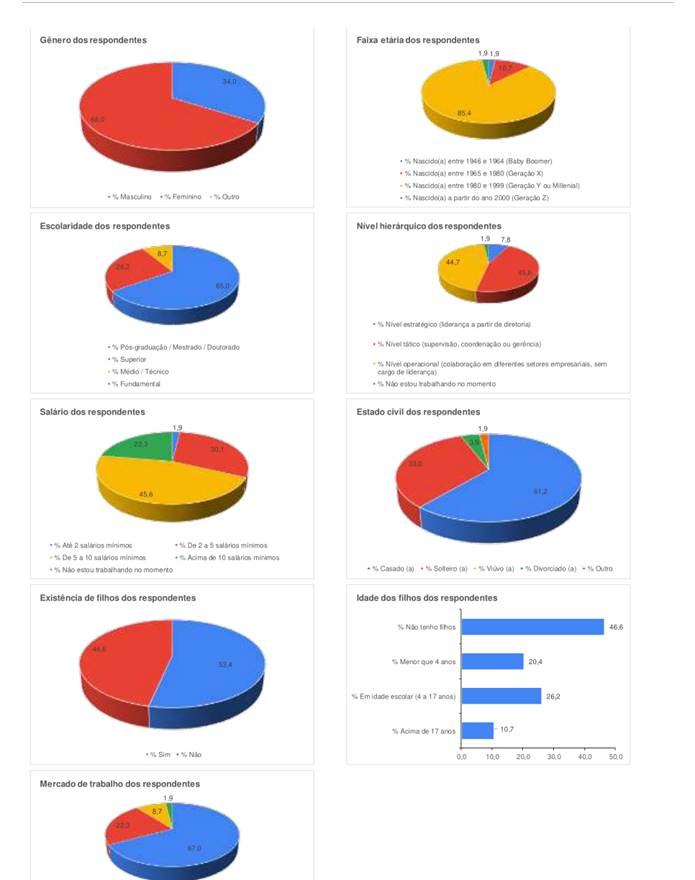
The analysis of the socioeconomic profile of the respondents revealed a predominance of Millennials, representing more than 85% of the sample, followed by Generation X, with more than 10%. This distribution is consistent with the current composition of the formal labor market, where the Millennial generation (25 to 45 years old) is predominant, and Generation X (45 to 60 years old) still maintains an active presence. The Baby Boomers and Generation Z showed low representation, with less than 5% of respondents, and were disregarded for specific analyses due to their limited sample.
Regarding remuneration, only 1.9% of participants receive less than 2 minimum wages, while the rest are distributed between 2 and more than 10 minimum wages. The majority of respondents (over 60%) are married women with postgraduate/master’s/doctoral degrees, active in the secondary market sector (industry). As for the hierarchical level, over 90% of professionals are in the operational and tactical levels. The distribution between having children or not was almost egalitarian. Figure 1 details these percentage distributions.
Figure 1. Socioeconomic profile of the respondent population
Source: Original research results
Exclusive importance of salary and monetary benefits
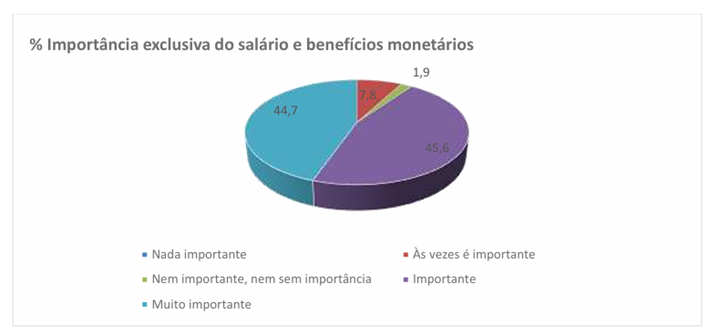
The results indicated that salary and monetary benefits are decisive for more than 90% of respondents, considering the answers “Important” or “Very important”. This finding is aligned with Maslow’s Needs Theory (1970), which postulates that physiological and security needs (including economic ones) must be met as a priority. Figure 2 illustrates this general perception of the importance of monetary factors.
Figure 2. Exclusive importance of salary and monetary benefits for the general population of respondents
Source: Original research results
It was observed that the importance of salary and monetary benefits decreases as positions and remunerations increase. Professionals at higher hierarchical levels and with higher salaries tend to consider an external offer based solely on financial increase less attractive, as their basic needs would, in theory, already be met. Figure 3 demonstrates this decrease in pecuniary importance in relation to hierarchical level and current salary.
Figura 3. Decréscimo da importância financeira conforme aumento de nível hierárquico e salário atual
Source: Original research results
In contrast, respondents without children and single attributed greater importance to monetary salaries and benefits (94% and 97%, respectively) than groups with children and married (87% and 89%). This difference can be explained by the fact that more than 80% of respondents with children and married already receive remuneration of 5 to 10 minimum wages or above 10 minimum wages, while only 52% of respondents without children and single reach these salary conditions. Financial relevance also increases with the degree of education, suggesting that postgraduates seek higher salaries, while those with lower education may be satisfied with lower remuneration. Figure 4 presents this evaluation.
Figure 4. Increase/Decrease in financial importance according to the presence of children, marital status, and schooling

Source: Original research results
For the secondary (industry) and technology markets, the monetary importance proved to be greater (94% and 100% of exclusive financial relevance, respectively) than for the tertiary market (83%). This difference may be related to the lower representativeness of the tertiary and technology markets in the sample, as more than 50% of respondents belong to the secondary market.
Non-monetary factors relevant to employees
Despite the high relevance of monetary factors, non-monetary factors were identified that significantly influence employee retention, even if salary and financial benefits are not ideal. Table 1 lists the non-pecuniary benefits and parameters considered most relevant by the respondent population, categorized by impact (large, medium, or low) based on the percentage of “Important” or “Very important” responses.
Table 1. Non-monetary factors influencing employee retention
| Parameter | Very important/Important (%) | Impact |
| Satisfaction with activities | 93 | Large |
| Relationship with leadership | 91 | Large |
| Flexibility of schedules and shifts | 90 | Large |
| Job Satisfaction | 90 | Large |
| organizational culture | 88 | Large |
| Corporate values | 85 | Large |
| Relationship with colleagues | 85 | Large |
| Possibility of hybrid work | 84 | Large |
| Possibility of extending leaves and vacations | 79 | Large |
| Extended maternity/paternity leave | 76 | Large |
| Possibility of low workload studies during working hours | 63 | Average |
| Possibility of international travel | 63 | Average |
| Possibility of workation | 62 | Average |
| 4-day work week | 59 | Average |
| Possibility of 100% non-face-to-face work | 52 | Average |
| Day off on birthday | 45 | Low |
| Possibility of unpaid leave | 41 | Low |
Source: Original research results
Emotional factors of great impact on employee retention
The six emotional factors evaluated in the questionnaire, according to Herzberg’s theory (1993), demonstrated a great impact on the decision to stay. Satisfaction with activities (93%) and relationship with leadership (91%) were the most important factors. These were followed by job satisfaction (90%), organizational culture (88%), corporate values (85%), and relationship with colleagues (85%). Overall, at least 85% of respondents considered these emotional factors crucial to their decision to remain in the organization.
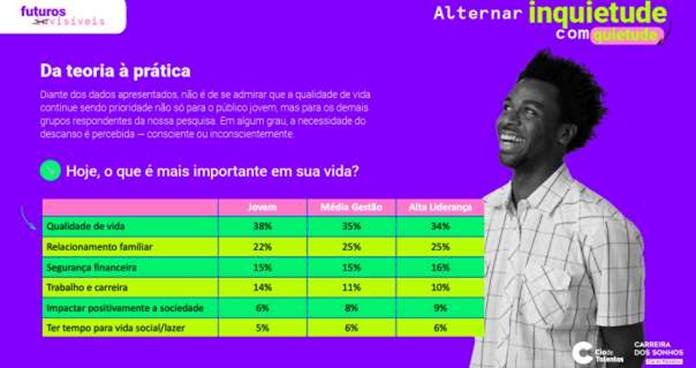
Organizational values and culture that are misaligned with the professional’s personal beliefs can lead to frustration and reduced performance. Quality of Work Life (QWL), which encompasses satisfaction with daily activities and interpersonal relationships, is fundamental for engagement and a sense of belonging. Professionals’ concern for mental health and sense of belonging, which leads them to feel fulfilled, are essential for talent retention, aligning with the social and belonging needs of Maslow’s hierarchy (1970). Data from Cia de Talentos (2024) reinforce that quality of life is the most important factor for professionals of all age groups, as illustrated in Figure 5.
Figure 5. Importance of quality of life for different age groups
Source: Cia de Talentos, 2024
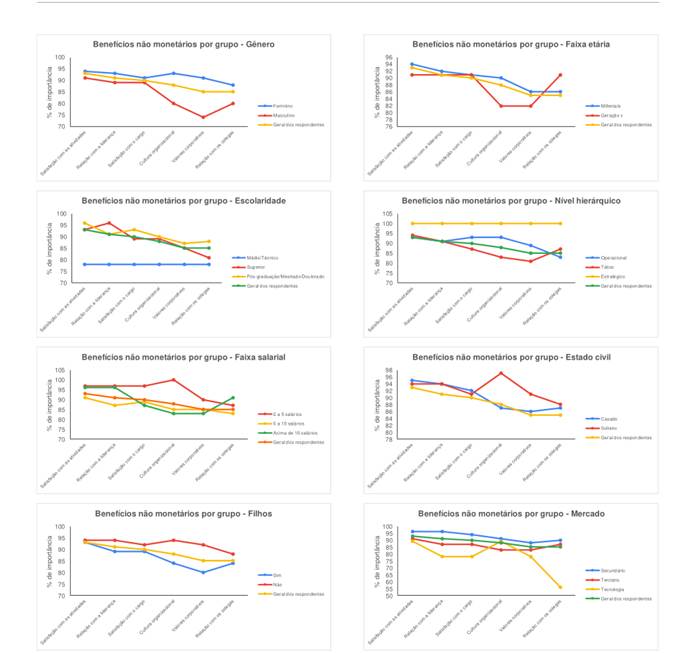
The analysis by specific groups, presented in Figure 6, revealed that women, professionals with higher education, in strategic levels, with salaries between 2 and 5 minimum wages, and single tend to value emotional factors more. Technology market professionals showed less importance to the relationship with colleagues, possibly due to remote work. Generation X, in turn, attributed greater importance to this factor compared to the population average.
Figure 6. Importance of high-impact emotional factors for different groups
Source: Original research results
Non-monetary hygiene factors with a significant impact on employee retention
Four non-monetary hygiene factors were identified as having a significant impact: flexibility of schedules and shifts, possibility of hybrid work, extension of days off and vacations, and extended maternity/paternity leave. Flexibility of schedules and shifts reflects the pursuit of reconciling personal needs with professional life, being preferred by in-person collaborators (Pendell, 2023). The extension of days off and vacations is a direct consequence of this flexibility, allowing for greater autonomy.
The possibility of hybrid work is a post-pandemic trend (Góes et al., 2021), indicating that professionals value the combination of in-person and non-in-person work to strengthen bonds and cooperation, while also enjoying the quality of life provided by remote work. Extended maternity/paternity leave, in turn, addresses the need for family support during crucial moments, ensuring parents’ presence in childcare (Oliveira et al., 2022).
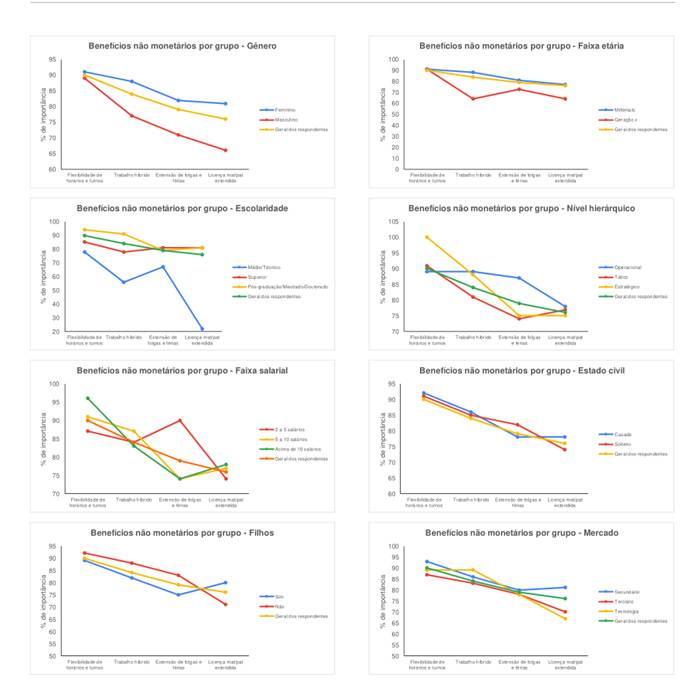
Figure 7 shows the divergences between specific groups in the valuation of these hygiene factors. Women and Millennials showed a greater tendency of importance for these factors. Specifically, 81% of women confirmed the importance of maternity leave, compared to 66% of men, which correlates with the attribution of parenthood to the female gender (Oliveira et al., 2022). Millennials also value these factors more, which are relatively new benefits in the job market.
Figure 7. Importance of non-monetary hygienic factors with great impact for different groups
Source: Original research results
Mid-level professionals showed lower adherence to these benefits compared to those with higher education. Those earning between 2 and 5 minimum wages tend to adhere more to the extension of days off and vacations. Overall, no major discrepancies were observed between the groups for most of these factors.
Other medium and low impact factors
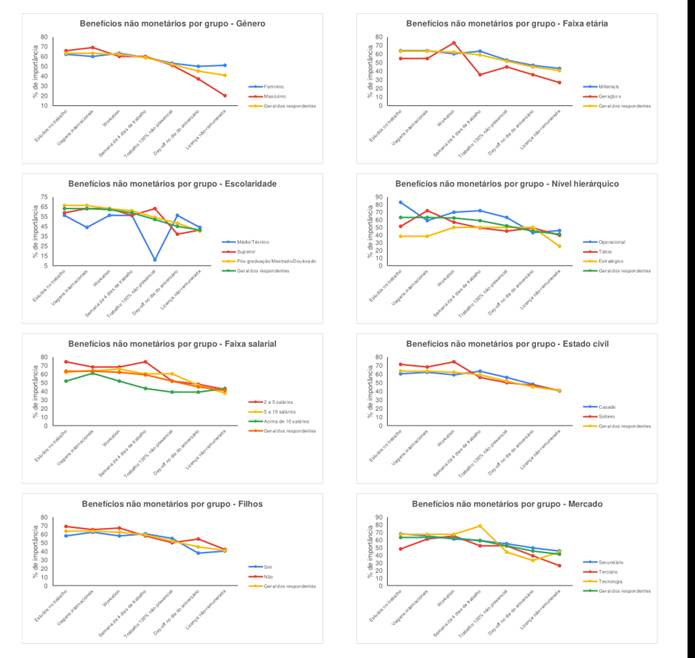
The factors that obtained less than 75% of “Important” or “Very important” responses were classified as medium and low impact, not being considered crucial for employee retention. Figure 8 presents the possible discrepancies between groups for these factors.
Figure 8. Importance of medium and low impact factors for different groups
Source: Original research results
A single medium-impact parameter that stood out was the 4-day work week, which showed a great impact (78%) for professionals in the technology market, suggesting its relevance for this specific group.
The research results indicate that, although remuneration and monetary benefits are of extreme importance to most respondents, non-monetary factors play a crucial role in talent retention. Organizational culture and values, job satisfaction and activities, and the quality of interpersonal relationships with leaders and colleagues are essential elements that contribute to the quality of work life and the sense of professional accomplishment. Furthermore, hygiene benefits such as flexible hours, hybrid work options, and extended parental leave also proved important for employee retention, by promoting autonomy and work-life balance. Investing in these initiatives can be an effective strategy to retain professionals, especially in contexts where financial ideality has already been achieved or when monetary improvements are not feasible, as the quality of life for the professional and their family is a relevant factor in the decision to stay.
4. Conclusion
This study sought to identify the relevance of salary and monetary benefits for the retention of professionals in organizations, as well as non-monetary initiatives that could assist in attracting and retaining employees, considering diverse socioeconomic profiles. It was found that salary and monetary benefits were decisive for over 90% of respondents, confirming their fundamental importance for retention. However, it was observed that the relevance of these pecuniary factors decreased in higher positions and remuneration, highlighting the growing importance of non-monetary incentives when basic financial needs are met.
In this context, it was identified that organizational culture and values, job and activity satisfaction, and the quality of relationships with managers and colleagues proved crucial for employee retention, with over 85% of participants attributing great impact to them. Non-monetary hygiene factors, such as flexible hours and shifts, the possibility of hybrid work, extended days off and vacations, and extended maternity/paternity leave, were also considered of great relevance, significantly influencing the decision to stay. The main contribution of this study lies in demonstrating that, although compensation is a pillar, strategic investment in non-monetary factors is essential for talent retention, promoting a better quality of work life and a sense of professional accomplishment.
The analysis by specific groups revealed that women and Millennials showed a greater tendency to value non-monetary hygiene factors, while technology market professionals demonstrated high importance for the four-day work week. Such findings reinforce the need for personalized retention policies. Despite the results, the study presented limitations related to the sample, with low representativeness of some generations and professionals earning less than two minimum wages, which restricts generalization to these groups. Future studies with broader and more in-depth samples are suggested, encompassing greater diversity of profiles and sectors, in order to validate and expand the conclusions obtained and improve talent retention strategies.
Bibliographic References
Bertram, D. 2007. Likert scales. Retrieved November (p. 1-10). Volume 2. Researchgate.
Boas, A. A. V.; Morin, E. M. 2021. Qualidade de vida no trabalho: Um modelo sistêmico. Editora UFLA. Minas Gerais.
E-book Carreira dos Sonhos 2024. Disponível em: https://lp.ciadetalentos.com.br/cs2024
Esteves, K. C.; Vieira, I. S.; Bittencourt, M. F.; Nunes, C. P.; Cardoso, B. L. C; Souza, L. H. R. 2024. As técnicas de amostragem nas pesquisas em educação. Análise de dados quantitativos na educação (p. 10-19). Volume 1. Editora Omnis Scientia. Recife.
Góes, G. S.; Martins, F. S.; Nascimento, J. A. S. 2021. O trabalho remoto e a pandemia: o que a PNAD Covid-19 nos mostrou. Carta Conjunt. (Inst. Pesqui. Econ. Apl.) (p. 1-16).
Oliveira, A. C. A.; Henriques, C. C.; Komatsu, V. N.; Gama, A. S. 2022. GÊNERO, TRABALHO E FAMÍLIA o papel das licenças maternidade, paternidade e parental em perspectiva comparada. XVII Encontro Nacional de Pesquisadores em Serviço Social.
Pendell, R. Frontline Workers Want Flexibility Too. Gallup, December 4, 2023. Disponível em: https://www.gallup.com/workplace/544775/front-line-workers-flexibility.aspx
Pinto, A. T. F. 2011. Incentivos não monetários – Uma alternativa de compensação em tempos de crise? – Faculdade de Economia e Gestão, Faculdade do Porto.
Tielman, D.; Salazar, R. P. 2020. Estudo Econômico da América Latina e do Caribe Principais condicionantes das políticas fiscal e monetária na era pós pandemia de Covid-19. Resumo executivo.
Wolffenbüttel, C. R. 2023. Pesquisa qualitativa e quantitativa: compreendendo as abordagens e construindo possíveis combinações. Conhecimento e divulgação científica: Investigação e transformação para popularização da ciência (p. 39-53). Volume 1. Editora e-Publicar.
Article originating from the Final Course Work of the Specialization in People Management of the MBA USP/Esalq
To learn more about the course, click here and access the MBX Academy platform