
School Management
September 15, 2026
Relationship between Teaching Qualification and Academic Performance in Dentistry Courses
Jackeline Gallo do Amaral; João Paulo Staconi
DOI: 10.22167/2675-6528-202602230
Article derived from a Final Course Work (TCC), with content based on the student’s original work and adapted to the editorial format of the Revista E&S with the support of the ResumeAI tool, an artificial intelligence solution developed by the Pecege Institute for textual synthesis and organization.
Abstract
The National Student Performance Examination (ENADE) is one of the main instruments for evaluating the quality of undergraduate courses in Brazil. The study aimed to analyze the relationship between faculty qualification and the performance of Dentistry courses in ENADE in the state of São Paulo. A descriptive, documentary, and quantitative research was conducted, using secondary data from the Anísio Teixeira National Institute for Educational Studies and Research. The population consisted of 68 public and private higher education institutions for Dentistry in the state of São Paulo that participated in ENADE in 2023. The proportions of faculty with master’s and doctoral degrees and the scores obtained in ENADE were analyzed. Descriptive analysis measures and Spearman’s correlation coefficient (α = 0.05) were used. The correlation analysis between the ENADE score and the proportion of faculty with stricto sensu postgraduate degrees indicated a moderate positive association (p = 0.423; p < 0,001). A proporção de docentes com titulação de mestre não apresentou correlação estatisticamente significativa com o conceito ENADE (p > 0.05). A weak positive correlation (p = 0.242; p = 0.046), but significant, was observed between the proportion of doctoral faculty and course performance in ENADE. It was concluded that a higher proportion of faculty with stricto sensu degrees may be associated with better ENADE results, although course performance is influenced by multiple institutional factors.
Keywords: Educational assessment; Dental Education; Higher education; Teacher training; Quality of education.
1. Introduction
The expansion of Dentistry courses in Brazil has sought to keep pace with the transformations in the job market, as well as the training of capable professionals aligned with current societal demands (Macau-Lopes and Knupp, 2021). In this context, the quality of higher education, especially in health fields, constitutes a determining factor for the training of competent and socially responsible professionals. In Dentistry courses, the training process goes beyond the transmission of technical content, requiring innovative pedagogical methodologies, integration between theory and practice, and, above all, qualified faculty to promote meaningful learning (Franco et al., 2011; Porto et al., 2021).
In the context of higher education, faculty qualification is understood as the set of academic, professional, and pedagogical attributes that a professional possesses to work in this environment. Faculty qualification encompasses academic qualification, which includes master’s and/or doctoral degrees and scientific production; professional qualification, related to market experience and connection with professional practice; and pedagogical qualification, which refers to training in teaching, didactics, and teaching methodologies (Miranda, 2011). Academic performance, in turn, refers to the goals that students achieve in their undergraduate activities, encompassing grades, attendance, course progression, and other performance indicators (Fagundes et al., 2014).
The National Student Performance Examination (ENADE) is one of the main instruments for evaluating the quality of undergraduate courses in Brazil, integrating the National Higher Education Evaluation System (SINAES). This examination seeks to assess students’ performance in relation to the competencies, skills, and programmatic content provided for in the National Curriculum Guidelines (DCNs), allowing the construction of comparable indicators between courses and institutions. Despite its limitations, such as dependence on student participation and the influence of contextual factors, ENADE is one of the main public and standardized benchmarks for analyzing academic performance in higher education.
Within the scope of educational management, the use of indicators, such as ENADE results, plays a strategic role in guiding institutional decision-making processes. The analysis of these indicators allows higher education institutions to identify weaknesses, monitor academic performance, and support the planning of actions aimed at improving teaching quality. In this context, the qualification of the teaching staff constitutes a relevant variable for management, as it can guide institutional policies for hiring, continuing education, and professional development, contributing to the enhancement of undergraduate courses.
Between 2015 and 2025, the number of Dentistry courses offered in Brazil grew from 412 to 698, according to institutions registered in the National Registry of Higher Education Courses and Institutions system (Macau-Lopes and Knupp, 2021; e-MEC, 2025). Although this expansion represents an advance in access to higher education, it also intensifies questions about the quality of the training offered. In the 2023 ENADE, 123 evaluated courses were classified as insufficient, with scores of one or two (ENADE, 2023). This scenario highlights concerns about the quality of training and challenges related to faculty training and the commitment of institutions to excellence standards.
Teacher qualification represents one of the pillars for teaching. The National Education Plan, through Law No. 13.005/2014, established as a goal to raise the quality of higher education and increase the proportion of masters and doctors among the faculty in active service in the entire higher education system to 75%, with, of the total, at least 35% doctors (Brasil, 2015). The pedagogical training of Dentistry professors is still a challenge, and many professors enter the academic career based on their clinical experience, which can compromise the quality of the teaching-learning process (Porto et al., 2021; de Lima et al., 2022; Pavane and Machado, 2024). Furthermore, in higher education courses, there is a need to overcome challenges in the curricular integration of content and curricular components, as well as the adoption of teaching methodologies that develop other student skills according to current societal demands (Broch et al., 2020; Ministério da Educação, 2021; de Lima et al., 2022).
Professional training at the stricto sensu level contributes to the development of human capital, which can generate benefits for institutions, faculty, and academics (Zonatto et al., 2013; De Souza et al., 2025). Research shows that academic qualification, teaching experience, involvement in continuing education, and mastery of active methodologies can positively influence student performance, favoring meaningful learning and the development of clinical and social competencies (Vogt et al., 2016; De Souza et al., 2025). Thus, investigating the relationship between faculty qualification and the performance of undergraduate Dentistry courses, as measured by ENADE, is crucial for improving the quality of higher education. The present study aimed to evaluate the association between faculty qualification (master’s and/or doctoral degree) and the performance of undergraduate Dentistry courses, as measured by the concept obtained in ENADE, in public and private higher education institutions in the state of São Paulo.
2. Material and Methods
This study is characterized as a descriptive research, whose purpose is to describe the characteristics of a population or identify relationships between variables (Marconi, 2022). Regarding the problem approach, it presents a quantitative character, employing descriptive analyses and statistical tests (Gil, 2002). It is documentary research, based on public secondary data made available by the National Institute for Educational Studies and Research Anísio Teixeira (INEP).
The study population was composed of 68 public and private higher education institutions in the state of São Paulo that offer the Dentistry course and participated in the 2023 ENADE evaluation cycle. Undergraduate Dentistry courses, public and private, that participated in the 2023 ENADE in the state of São Paulo were included. No cases meeting the exclusion criteria (lack of complete information or data inconsistencies) were identified, maintaining the entirety of eligible institutions in the analysis. The unit of analysis was each Dentistry course participating in ENADE 2023 in the state of São Paulo.
The data were collected from the INEP public website, where a Microsoft Excel file was obtained containing information about the faculty and the scores obtained in ENADE. The variables analyzed included: institution name, city, acronym, administrative category (public or private), percentage of faculty with stricto sensu postgraduate degrees, percentage of faculty with master’s degrees, percentage of faculty with doctoral degrees, and the continuous score and range obtained by the course in ENADE.
The extracted information was checked, standardized, eliminating duplicates and verifying the consistency of the records. Then, the total percentage of faculty with stricto sensu degrees (masters and doctors) for each course was calculated, consolidating the data by institution. The final database was exported to the statistical software Jamovi, version 2.6.44, for statistical analyses.
Initially, descriptive statistics measures were applied, including means, minimum and maximum values, and standard deviation. Subsequently, the association between variables (percentage of faculty titling and continuous ENADE score) was analyzed using Spearman’s p correlation coefficient, as the data did not exhibit normal distribution. The significance level adopted was 5% (α = 0.05).
3. Results and Discussion
In the state of São Paulo, 68 Higher Education Institutions (IES) offering the Dentistry course and participating in ENADE in 2023 were evaluated. The distribution of the grades obtained in ENADE was as follows: 47.1% (n = 32) obtained grade 3, 29.4% (n = 20) grade 2, 11.8% (n = 8) grade 4, 8.8% (n = 6) grade 5, and 2.9% (n = 2) grade 1. It was observed that institutions with grades 4 and 5 generally presented higher proportions of faculty with postgraduate stricto sensu degrees, corroborating previous studies that indicate a positive association between faculty qualification and academic performance in external evaluations (Zonatto et al., 2013). However, the presence of high proportions of qualified faculty also in courses with intermediate and low grades suggests that qualification, although relevant, does not act in isolation in determining performance in ENADE.
Table 1 presents the distribution of the proportion of faculty with stricto sensu postgraduate degrees in Higher Education Institutions (HEIs) in the state of São Paulo, according to the score obtained in ENADE. Most institutions showed high proportions of qualified faculty, especially in courses with scores 4 and 5, where the averages were above 90%. Overall, 75% of the evaluated institutions presented proportions of faculty with stricto sensu postgraduate degrees higher than 75%, and 64.7% had at least 35% of doctoral faculty, meeting the goal established by the National Education Plan (Law No. 13.005/2014). This data highlights a scenario of faculty qualification in terms of academic degrees.
Table 1. Proportion of faculty with stricto sensu postgraduate degrees in higher education institutions in the state of São Paulo according to the ENADE score (Dentistry) in 2023
| ENADE Concept | Universities | Minimum (%) | Maximum (%) | % (Average) Faculty with Stricto Sensu (± SD) |
|---|---|---|---|---|
| 1 | 2 | 71,6 | 74,5 | 73,1 (± 2,03) |
| 2 | 20 | 64,8 | 94,0 | 81,0 (± 9,80) |
| 3 | 32 | 65,0 | 100 | 83,3 (± 9,02) |
| 4 | 8 | 69,1 | 99,9 | 91,6 (± 10,79) |
| 5 | 6 | 85,4 | 99,9 | 92,2 (± 7,5) |
Source: Original research results
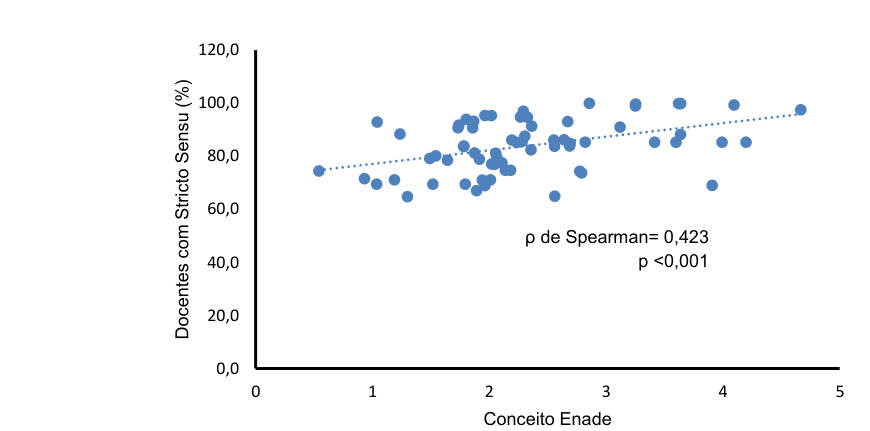
The correlation analysis between the continuous concept of ENADE and the proportion of faculty with stricto sensu postgraduate degrees indicated a moderate positive association (p = 0.423; p < 0.001), as illustrated in Figure 1. The strength of the correlation was classified according to the magnitude of the correlation coefficient found, considering: very strong (≥ 0.90), strong (0.70 to 0.89), moderate (0.40 to 0.69), weak (0.20 to 0.39), and very weak (0.0 to 0.19) (Baba et al., 2014). This correlation suggests that the academic qualification of the faculty is a relevant, though not exclusive, factor for the performance of Dentistry courses in ENADE. This finding is in line with the literature that points to stricto sensu level training as an element associated with the improvement of higher education quality, as faculty with higher qualifications tend to show greater involvement in research activities, scientific production, and the development of more structured pedagogical practices (Zonatto et al., 2013; Vogt et al., 2016; De Souza et al., 2025). In the context of Dentistry education, this qualification can contribute to the integration between teaching, research, and extension, favoring the training of professionals with technical and critical competencies aligned with the DCNs (Franco et al., 2011; Porto et al., 2021).
Figure 1. Correlation between ENADE concept and faculty with stricto sensu postgraduate degrees (%)
Source: Original research results
From the perspective of educational management, the results reinforce the importance of using academic indicators as decision-making support tools. The observed association suggests that institutional policies aimed at increasing teacher qualification, such as incentives for master’s and doctoral degrees, continuing education programs, and strategies for attracting and retaining qualified teachers, can contribute to the improvement of the academic performance of courses. In this sense, the analysis of data from external evaluations, such as ENADE, can support institutional strategic planning, allowing for the monitoring of quality indicators and the definition of goals aligned with current educational policies, such as those established by the National Education Plan. However, the moderate magnitude of the correlation indicates that teacher qualification alone does not explain course performance, reinforcing the multifactorial nature of higher education quality. Aspects such as curricular organization, adoption of active methodologies, institutional infrastructure, student profile, and working conditions for teachers can also play a relevant role in this process (Broch et al., 2020; de Lima et al., 2022). Thus, from a management standpoint, it becomes fundamental to adopt an integral approach, in which teacher qualification is articulated with other institutional dimensions in the pursuit of improving educational quality.
When analyzing the proportion of faculty with master’s and doctoral degrees, it was observed that courses with intermediate scores (2 and 3) in ENADE showed higher averages and lower standard deviation in the proportion of master’s degrees, while courses with higher scores (4 and 5) showed greater variability, without a consistent increase in the average proportion of faculty with master’s degrees, as detailed in Table 2.
Table 2. Proportion of master’s degrees in higher education institutions in the state of São Paulo according to the concept obtained in ENADE (Dentistry) in 2023
| ENADE Concept | Universities | Minimum (%) | Maximum (%) | Mean (± SD) |
|---|---|---|---|---|
| 1 | 2 | 22,6 | 29,7 | 26,2 (± 5,04) |
| 2 | 20 | 34,6 | 54,4 | 43,5 (± 6,86) |
| 3 | 32 | 15,2 | 60,5 | 42,9 (± 9,79) |
| 4 | 8 | 0,5 | 57,2 | 31,9 (± 20,82) |
| 5 | 6 | 0,5 | 49,2 | 32,5 (± 24,6) |
Source: Original research results
For the doctoral degree, Table 3 indicates that, in general, there were higher average proportions of doctoral faculty in courses with higher ENADE scores, especially in scores 4 and 5. However, this trend was accompanied by marked internal variability, indicating heterogeneity among the best-performing institutions.
Table 3. Proportion of doctors in higher education institutions in the state of São Paulo according to the concept obtained in ENADE (Dentistry) in 2023
| Concept | Universities (n) | Minimum (%) | Maximum (%) | Mean (± SD) |
|---|---|---|---|---|
| 1 | 2 | 41,9 | 51,9 | 46,9 (± 7,07) |
| 2 | 20 | 25,0 | 47,9 | 37,5 (± 7,23) |
| 3 | 32 | 21,0 | 81,8 | 40,4 (± 13,74) |
| 4 | 8 | 32,1 | 99,4 | 59,7 (± 29,12) |
| 5 | 6 | 37,3 | 99,4 | 59,6 (± 30,63) |
Source: Original research results
Table 4 presents the correlation between the continuous ENADE score and the proportion of faculty with master’s and doctoral degrees. No statistically significant correlation was observed between the ENADE score and the proportion of faculty with master’s degrees (p = -0.020; p = 0.874), suggesting an absence of association between these variables. In contrast, a weak positive correlation (Baba et al., 2014), though statistically significant, was observed between the ENADE score and the proportion of doctoral faculty (p = 0.242; p = 0.046), suggesting that courses with a higher proportion of doctoral faculty tend to achieve higher ENADE scores.
Table 4. Correlation between ENADE concept and the proportion of qualified faculty (Dentistry, 2023)
| Variable | Spearman’s rho | p |
|---|---|---|
| Faculty with master’s degree (%) | -0,020 | 0,874 |
| Doctorate-holding faculty (%) | 0,242 | 0,046* |
Source: Original research results
Doctoral-level training can contribute to the development of skills related to research, pedagogical innovation, and scientific production, in addition to often being associated with work regimes with greater institutional dedication, factors that can positively impact teaching quality. Mello and Sousa (2015) observed that the highest-rated production engineering courses were those offered by public institutions with a predominance of doctoral faculty. De Souza et al. (2025) demonstrated that the presence of master’s degree holders had no significant impact on course performance, while the proportion of doctoral degree holders was positively correlated with ENADE scores, highlighting the relevance of educational policies aimed at increasing the number of doctoral degree holders for improving teaching quality and academic performance.
The positive, albeit weak, association between the proportion of doctoral professors and ENADE performance points to the doctorate as a possible factor in academic planning. This result indicates that policies to encourage doctoral degrees, attract and retain doctoral professors may contribute to the improvement of institutional performance, provided they are articulated with adequate working conditions, such as more stable dedication regimes, research incentives, and integration between teaching, research, and outreach. It is important to consider that ENADE, although an evaluation instrument, has limitations and does not encompass all the specificities of institutional contexts and training processes.
In summary, the Dentistry courses evaluated in the state of São Paulo presented a high proportion of faculty with stricto sensu postgraduate degrees. A moderate positive association was found between general faculty qualification and the ENADE concept, and a weak but significant positive correlation between the proportion of faculty with doctorates and ENADE performance. These findings suggest that faculty qualification is one of the factors associated with the ENADE concept, although the courses’ performance is influenced by multiple institutional and pedagogical aspects. The results reinforce the importance of educational management oriented by indicators to support strategies for improving the quality of higher education, recognizing ENADE as a component of the national evaluation system that should be interpreted in conjunction with other institutional indicators.
4. Conclusion
This study sought to analyze the association between faculty qualifications and the performance of Dentistry courses in the National Student Performance Examination (ENADE) in higher education institutions in the state of São Paulo. It was found that the evaluated courses generally presented a high proportion of faculty with stricto sensu postgraduate degrees. Correlation analysis indicated a moderate positive association between general faculty qualifications and the ENADE score. Specifically, a weak but statistically significant positive correlation was observed between the proportion of faculty with doctoral degrees and course performance in ENADE. In contrast, the proportion of faculty with master’s degrees did not show a statistically significant correlation with the ENADE score. These findings suggest that the academic qualification of the faculty, especially at the doctoral level, is one of the factors associated with course performance in external evaluation.
The main contribution of this study lies in reinforcing the importance of indicator-driven educational management, demonstrating how the analysis of ENADE data can support institutional strategic planning. The results suggest that institutional policies aimed at encouraging doctoral-level training, as well as attracting and retaining doctoral faculty, can contribute to the improvement of academic performance in Dentistry courses. However, it is fundamental to recognize that faculty qualification does not act in isolation in determining performance, which is influenced by multiple institutional and pedagogical factors, such as curriculum organization, the adoption of active methodologies, infrastructure, and student profile. Furthermore, ENADE, although a relevant instrument, has inherent limitations and does not encompass all the specificities of the educational contexts. For future studies, it is recommended to deepen the investigation into the interaction between faculty qualification and these other factors, seeking a more comprehensive understanding of the quality of higher education in Dentistry.
Bibliographic References
Baba, R. K.; Vaz, M. S. M. G.; Costa, J. D. 2014. Correção de dados agrometeorológicos utilizando métodos estatísticos. Revista Brasileira de Meteorologia 29(4): 515-526.
Brasil. Plano Nacional de Educação [PNE]. 2015. Plano Nacional de Educação 2014-2024 [recurso eletrônico]: Lei nº 13.005, de 25 de junho de 2014, que aprova o Plano Nacional de Educação (PNE) e dá outras providências. – 2. ed. – Brasília: Câmara dos Deputados, Edições Câmara. Disponível em: https://bd.camara.leg.br/bd/items/1ea19605-ddec-4930-a61d-baa1399ddef2. Acesso em: 19 set. 2025.
Broch, C.; Breschiliare, F. C. T.; Barbosa Rinaldi, I. P. 2020. A expansão da educação superior no Brasil: notas sobre os desafios do trabalho docente. Avaliação: Revista da Avaliação da Educação Superior – Campinas 25(2): 257-274.
Cadastro Nacional de Cursos e Instituições de Educação Superior [e-MEC]. 2025. Disponível em: https://emec.mec.gov.br/emec/nova. Acesso em: 19 set. 2025.
de Lima, T. M. N. R.; Barboza, A. R. G.; Galvão, M. H. R.; Pessoa, T. R. R. F. 2022. Abordagem Pedagógica na formação em Odontologia sob a percepção discente. Research, Society and Development 11(10): e381111032817-e381111032817.
de Souza, É. M. A.; da Silva Machado, P. A.; de Souza Santos, L. C. G.; de Lima, T. H.; Rodrigues, J. M.; Diniz, H. A. G. 2025. A influência da qualificação docente no desempenho acadêmico em cursos de engenharia de produção: análise comparativa regional no Brasil. Revista de Gestão e Secretariado 16(1): e4466-e4466.
Exame Nacional de Desempenho dos Estudantes [ENADE]. 2023. Relatório de Instituições de Ensino Superior (IES) e Cursos. Disponível em: https://enade.inep.gov.br/enade/#!/index . Acesso em: 19 set. 2025.
Fagundes, C. V.; Luce, M. B.; Rodriguez Espinar, S. 2014. O desempenho acadêmico como indicador de qualidade da transição Ensino Médio-Educação Superior. Ensaio: avaliação e políticas públicas em educação 22(84): 635-669.
Franco, L. L. M. M.; Soares, É. F.; Martorell, L. B.; Marcelo, V. C. 2011. O professor do curso de odontologia: sua formação e os desafios frente às exigências atuais. Revista Profissão Docente 9(20): 57-74.
Gil, A. C. 2002. Como elaborar projetos de pesquisa. 4ed. Atlas, São Paulo, SP, Brasil.
Macau-Lopes, M.G.; Knupp, R.R.S. 2021. Formação em odontologia no brasil: história, avanços e desafios na mudança do olhar e das práticas em saúde. Revista Ciências e Odontologia 5(2): 9-19.
Marconi, M.A. 2022. Metodologia científica. 8ed. Atlas, São Paulo, SP, Brasil.
Mello, J. A. V. B.; De Sousa, F. R. 2015
Ministério da Educação. Diretrizes Curriculares Nacionais do Curso de Graduação em Odontologia [DCN]. 2021. Disponível em: https://portal.mec.gov.br/docman/junho-2021-pdf/191741-rces003-21/file. Acesso em: 19 set. 2025.
Miranda, G. J. 2011. Relações entre a qualificação do professor e o desempenho discente nos cursos de graduação em Contabilidade no Brasil. Tese de Doutorado em Ciências: Concentração em Controladoria e Contabilidade. Faculdade de Economia, Administração e Contabilidade, Universidade de São Paulo, São Paulo, SP, Brasil.
Pavane, R. M.; Machado, M. B. 2024. A docência universitária como base do ensino de qualidade dos profissionais da área odontológica. Revista Ibero-Americana de Humanidades, Ciências e Educação 10(8): 1486-1501.
Porto, E.C.L.; Boas, A.M.V.; Da Silva, L.L.P. 2021. A formação pedagógica dos docentes de Odontologia. Revista Docência do Ensino Superior 11: e024846.
Vogt, M.; Degenhart, L.; Biavatti, V. T. 2016. Relação entre formação docente, metodologias de ensino e resultados do Exame Nacional de Desempenho dos Estudantes de Ciências Contábeis. Revista Catarinense da Ciência Contábil 15(45): 63-77.
Zonatto, V. C. D. S.; Dallabona, L. F.; Moura, G. D. D.; Domingues, M. J. C. D. S.; Rausch, R. B. 2013. Evidências da Relação entre Qualificação Docente e Desempenho Acadêmico: uma análise à luz da Teoria do Capital Humano. Sociedade, Contabilidade e Gestão 8(1): 6-25.
Article originating from the Final Course Work of the Specialization in School Management of the MBA USP/Esalq
To learn more about the course, click here and access the MBX Academy platform