
Quality Management
Process Management
Sop
Training
May 26, 2021
Procedure and training – a duo to standardize routine and eliminate waste
DOI: 10.22167/2675-6528-20210004
E&S 2021.2: e.20210004
Marcos Milan, Leandro Maria Gimenez, Thiago Libório Romanelli
An organization of any branch and size can be divided into three administrative levels: strategic, tactical, and operational. The strategic (leadership) being responsible for the direction, the tactical (management) integrating the strategic and the operational, which executes the routine activities related to the product or service.
To define the directions, the strategic analysis examines the organization in relation to its current situation, establishes where it wants to go and how to get there, being its responsibility to build the foundations of management, the basic guidelines: mission, vision, and values. The mission represents what the organization does, the vision the state it wishes to achieve in the future, and the values determine the way of acting towards other organizations, society, and the environment. The basic guidelines define for the company “who we are”.
Having defined “who we are”, it is necessary to know the current state, “how we are”. This implies performing an analysis of the environments in which the organization is inserted: macro, market, and internal. The macro refers to the political, legal, economic, social, environmental, and technological environments. The market is associated with the field of activity, encompassing competitors, suppliers, customers, and the target market. The internal refers to the organization.
The macro and the market exert influences on the organization, but it has no control over them. The way to act will be to take advantage of or mitigate the effects of these influences. The increase in the dollar, an economic factor, is reflected in the prices of commodities, as is the case with soybeans, but it also affects the price of inputs necessary for production. The measures to be taken should capitalize on the increase and at the same time reduce the impacts on the prices of inputs. In the market environment, the expectation of soybean crop production from a competing country, such as the USA, affects the price of this commodity in the international market. Regarding the internal environment, directly related to soybean production, the organization has control, but it is necessary to know its strengths and weaknesses. A strength can be the level of employee training, while a weakness can be process instability. The internal environment is associated with the company’s mission, “what it does”, where things happen. It is in the routine, day-to-day, that results are obtained regarding quality, productivity, costs, safety, and the environment.
It is based on the analysis of the environments that leadership defines the strategies or strategic objectives, “where we want to go”. In general terms, strategies can be divided into two main branches, one focused on growth, serving the vision, and another for survival, focused on the mission, thus ensuring sustainability.
One of the critical points in management is to draw up plans for the future (growth) without paying attention to routine, survival. Many companies “lose their way” regarding their products due to instability in their processes. When this happens, difficulties arise and sustainability is compromised. Drops in productivity and quality, reduction in sales, increase in costs and complaints, deterioration in the organizational climate are some of the symptoms of “losing one’s way”.
The challenge for the manager is to stabilize the routine so that the company does not lose competitiveness. Attention should be focused on the internal environment, on day-to-day operations. Most companies still use traditional management, with a focus on productivity, which is characterized by centralization of power, rigid division by departments or areas, vertical communication, excessive formalization, and employees who merely receive and follow orders.
The paradigm shift is to achieve the change from productivity to competitiveness, and one way to do this is through process management. It encourages teamwork and autonomy, horizontal and diagonal communication, and stimulates collaboration between people and areas. The focus is on the satisfaction of internal and external customers. This stimulates creativity in the company, generating innovation and increasing competitiveness and, consequently, sustainability. Process management is based on the standardization of routines. Standardizing involves understanding how processes occur within the company, establishing procedures for execution, monitoring them, and adopting a culture of constantly implementing incremental improvements. A process can be defined as a sequence of activities that generate results for customers (Figure 1). This sequence is initiated by the input of resources from suppliers, resources that undergo a series of activities (actions) to generate a product or service (add value) to meet the needs of the customer, internal or final (output). The inputs must be verified for their specifications, as well as for the production means employed (verification items). The team linked to the process has the autonomy to use these means and the responsibility to meet quality requirements (control items). A process is both a supplier and a customer. It is a customer when receiving a product or service and a supplier for the next step: “the next process is your customer”. To know the quality requirements, ask the customer.
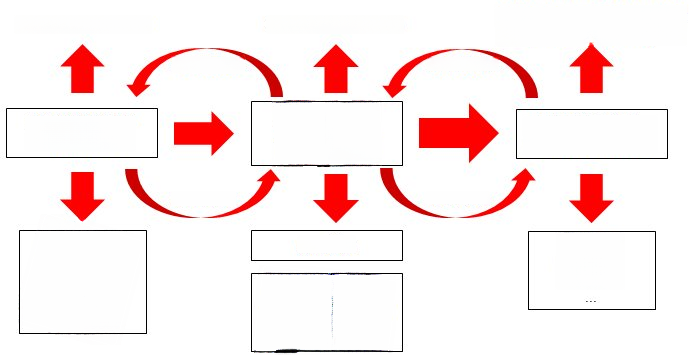
Figure 1. Process, checklist items, and quality requirements
Processes can be divided into core and support processes. Core processes are those directly linked to the product or service, and support processes are not, although they are essential for the core processes to occur. In agriculture, the processes are directly linked to implementation, management, and harvesting. Depending on the crop and the production system adopted, they involve soil preparation, sowing (planting), cultural treatments, and harvesting. Products must meet the quality requirements of final customers, as is the case with soybeans delivered for storage, sugarcane to be transported to the mill, and eucalyptus supplied to the pulp and paper industry.
Support processes can be represented by the administration that acquires inputs, takes care of human resources, and performs financial control, by maintenance (workshop) that ensures machine availability for the teams, by the nursery that produces seedlings, by the warehouse that supplies inputs for operations, among others. Soil preparation must provide the necessary conditions for seed germination and allow plant roots to develop. It can be carried out conventionally through scarification and harrowing processes, cited here as an example and not as a technical recommendation. Scarification primarily meets the root’s needs, eliminating soil impediments. Harrowing acts to provide adequate conditions for the seed to germinate – root bed and seed bed. The preparation consisting of scarification and harrowing delivers a product, prepared soil, to the customer, sowing. In turn, the sowing process must deposit seeds in the desired quantity, spacing, and depth (quality requirements), so as to ensure plant density per area and uniformity in crop development, thus serving the cultural treatments customer. This, in turn, basically includes processes related to nutrition and health, such as fertilization and pest, disease, and weed control. Thus, the crop will be in ideal conditions to be harvested. Harvesting must deliver the product according to the quality requirements that meet the final customer. The main processes in agriculture provide the plant, a living being, with the necessary conditions for it to express its full production potential. The crop is a customer and it determines the quality requirements of the involved processes. Ask the customer, crop (plant), what these requirements are. If met, there are great possibilities that the final customer will receive the adequate product, be it grain, sugarcane, or eucalyptus log (Figure 2).
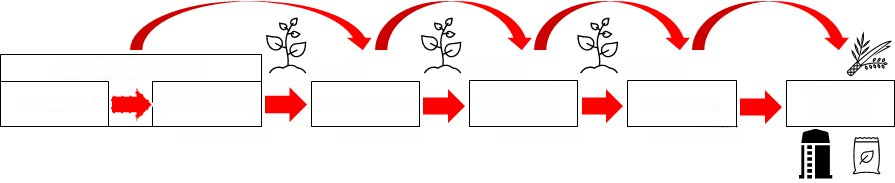
Figure 2. Main processes in agriculture: the plant as a customer
With the sequence of processes, the supplier-client relationship, and the established quality requirements, the next step is to develop the standard operating procedure, known as SOP (Figure 3), emphasizing that the document’s presentation format may vary. SOPs are developed for each product, or products, of a process. Generally, they contain the name of the task, the reason why the task will be performed (Why?), the objective to be achieved (What?), the actions to be performed (How?), the responsible team (Who?), the time of performance (When?), the location (Where?). It is the already established 5W1H, in English: (Why?), (What?), (How?), (Who?), (When?), (Where?).
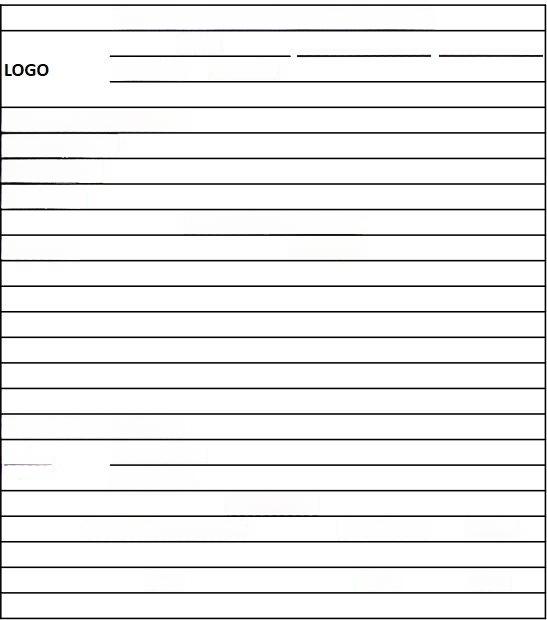
Figure 3. A model of a Standard Operating Procedure-SOP form
It is important that the SOP be developed together with the team that will use it, because, besides stimulating creativity, it creates a sense of belonging, “the methodology was created here”. This distances the “NIH – Not Invented Here” syndrome that causes so many problems in companies. SOPs must be periodically reviewed. Reviews happen to incorporate adjustments and improvements observed by the team during the execution of processes, on a day-to-day basis, being a basic foundation for continuous improvement. They ensure that production technology is recorded and allow for a standard for the realization of products and services. Unreviewed SOPs are unused SOPs that turn into “filed papers”. It is based on the quality requirements defined in the SOPs that the last phase of routine standardization occurs: evaluating process behavior. For this, the seven quality tools assist in this phase: check sheet; histogram; flowchart; cause-and-effect diagram or fishbone or Ishikawa diagram; Pareto diagram; scatter diagram; process behavior or control chart. They should be disseminated throughout the company and most problems are solved with their application. Three of them are widely used when the subject is processes (Figure 4): Ishikawa diagram (Figure 4A); Pareto diagram (Figure 4B); control chart (Figure 4C).
.
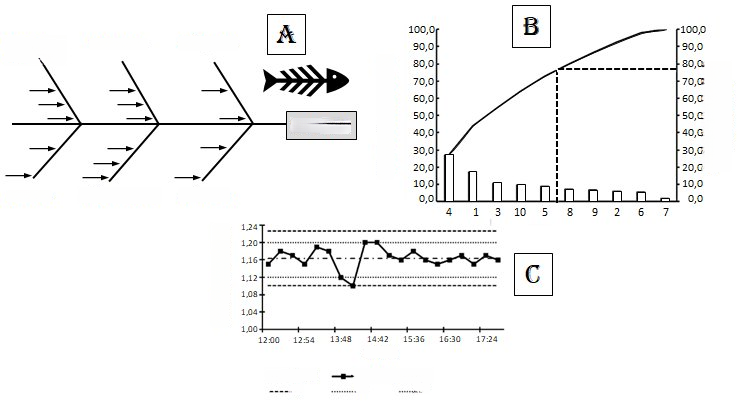
Figure 4. A: Ishikawa Diagram; B: Pareto Diagram; C: Control Chart (LIC Lower Control Limit; LSC: Upper Control Limit; LIE: Lower Specification Limit; LSE: Upper Specification Limit
If something is not going well in the process, the Ishikawa diagram is used to identify the causes related to the problem (effect). Once the causes are identified, the Pareto chart is applied to prioritize them, and thus the team acts on what is important at the moment. The control chart expresses the voice of the process, which is different from the voice of the customer. The manager can specify a value to be achieved (voice of the customer), but it is necessary to ask the process if it is capable of meeting it (voice of the process). It is useless to specify that the height of the sugarcane stubble to be left after harvest should be 5 centimeters or that the size of the eucalyptus log should be 3 meters, if the harvesting processes cannot meet these specifications. This is a reason for many misunderstandings in the day-to-day of companies, when the inadequate result is attributed to the team, but, in reality, it is the process that lacks the capacity to meet it. Either the process or the specification must change.
SOPs are fundamental for training company employees, both old and new. They prevent the famous “shadowing” training: “shadow someone, and they will teach you everything.” “Shadowing” is a way of training without a defined standard, influenced by the person teaching, and also a way to spread ingrained bad habits. The way training is delivered also makes all the difference to the company’s results. It is another challenge for managers to overcome.
This challenge becomes even greater due to the increase in agricultural production, which has placed the country in a position of global prominence in food production. This increase has also brought the need to hire labor to meet demand. However, qualification remains a barrier to be overcome, despite all efforts focused on training carried out by various governmental, non-governmental institutions, and companies operating in the sector. Qualifying people is a problem for all segments of the country and has been a cause for concern over time.
In the last century, at the beginning of the second world war, the United States faced this problem. There was a need to rapidly increase production to supply allies with the necessary inputs, for both civilian and military purposes. When the US entered the war, at the end of 1941, the problem became more critical. In addition to allies, it was necessary to supply the American military area and continue to produce goods for the country’s daily life. The lack of qualified labor was a barrier to be overcome.
The American government created several emergency groups to deal with the conflict and adapt the industry for the war effort, and among them, one of the first was the Training Within Industry Service (TWI). The TWI aimed to assist in workforce training through training conducted within industries.
Initially, the program was structured to provide consulting to factories, at their request, to solve production problems. The demand was so great that it was no longer possible to meet it, and the program had to be reevaluated, radically changing the way of working. The consulting was terminated, and the new method focused on training supervisors (operational level) in competencies considered fundamental by TWI for improving and increasing production: knowing the job and responsibilities; skills in instructing, in improving processes, and in leading. The first two were the responsibility of the companies, while TWI focused on the skills. These five competencies are, even today, fundamental for training people in any field of activity.
One of TWI’s pillars was the methodology developed by a vocational instructor, Charles Allen, in the 1900s. At the request of the American government, he had employed the methodology during World War I in training welders for the naval industry, a role for which there was no qualified labor to meet the demand of the time. The four-step method, as it became known, was incorporated into TWI. The first step consisted of situating the student in the objective of the subject to be presented, the second was to instruct them in the activity, the third involved accompanying the student in carrying out the activity and correcting errors, and the fourth allowed the student to develop the activity on their own, with remote supervision. If the student could not complete the task, the training had been inadequate and should be repeated. Another important point of TWI was the understanding that, amidst a myriad of steps (actions) in manufacturing processes, only some are critical. These critical steps were termed key points, pontos chaves, and the training should focus on them.
The TWI was structured in four parts, three of them starting with the letter J, from job (work): Job Instructions; Job Methods for Process Improvement, Job Relations e Program Development. Job Instruction is based on Charles Allen’s method for teaching supervisors how to train people. Job Methods for Process Improvement aims to train supervisors to simplify and develop improvements in work. Job Relations is used to train supervisors in the art of dealing with people and developing teamwork. Program Development deals with how to manage training within the company itself, using its own facilities and personnel.
The TWI lasted until the end of the conflict in 1945, approximately five years, and during this period, more than 1.7 million people were trained and 16,000 companies were served. In a sample of 600 companies from various segments that participated in the program, the results showed an increase of at least 25 percent in production, as well as a reduction in waste, working hours, complaints, and training time.
After the war ended, the project was deactivated by the government, being restricted to a few companies and eventually falling into oblivion. However, the American troops who occupied Japan in the post-war period, from 1945 to 1952, implemented the program, understanding that TWI was vital for the recovery of Japanese industries. In addition to TWI, which was handled by a consulting firm with roots in the American program, consultants and engineers were sent, including Willian Edwards Deming and Joseph Moses Juran. The two, along with Kaoru Ishikawa, laid the foundations for the system that became known as Company Wide Quality Control (CWQC). One of the denominations used for CWQC in our country is Total Quality Management (TQM).
Throughout the development of CWQC, the fundamentals of TWI were incorporated into it: basic principles of instructions, continuous improvement, and human relations. This allowed the training carried out by supervision within the company to be consolidated and provided the foundations for the development of kaizen (continuous improvement): how to find opportunities, generate ideas, and introduce improvements in daily life, including the suggestion system. It also influenced changes in the way supervisors related to their teams, making management more human-oriented. CWQC revolutionized Japanese companies and, over time, they began to compete in the global market, surpassing American and European companies in various segments, including the automotive industry.
Throughout the 1950s, Toyota created and perfected the Toyota Production System – TPS – (Sistema Toyota de Produção – STP), which incorporates concepts from CWQC and TWI. According to company executives, TWI played an important role in the development of TPS. The Job Instruction, initiated in 1951, was implemented based on a union demand for supervisor training. This J remains practically the same to this day. Job Methods, 1952, contributed to the implementation of the 5W1H concept and, gradually, was modified to adhere to new methods being applied on the assembly line: takt time, continuous flow, pull production. Over time, it was replaced by the P-course, with P referring to productivity. Job Relations was introduced in 1953 and remains basically the same. Currently, the main training for supervisors at Toyota are: Job Instruction; Job Relations; Job Safety (developed by the company); routine standardization; kaizen; problem-solving. Lean Production has its origins in TPS and carries TWI in its DNA.
The standardization of routines and the training of people are fundamental factors for the company to “not lose its grip”, thus ensuring its survival and creating the foundation for sustainable growth. Many companies, even today, do not have a stabilized routine, which translates into waste. No customer pays more for a product to compensate for the waste of those who produce it. In agriculture, a countless number of situations can be pointed out where waste occurs, from the most direct and impactful, such as, for example, those related to excessive fuel consumption, losses in harvest, planting failures, unplanned machine downtime due to breakdowns, to the indirect ones, such as a light left on unnecessarily in the office or leftover food in the cafeteria. Waste, of any type and size, must be constantly combated in the company, as it does not add value to the product.
Transforming traditional management into competitiveness-oriented management is a challenging task that requires time and effort, and is the responsibility of leadership. It is the way for agriculture to maintain and improve its sustainability. The fundamentals of TWI, tested and approved over the years under critical conditions and present in models such as TPS, Lean Production, ISO standards (International Organization for Standardization) among others, create the appropriate environment for the implementation at the operational level of techniques and concepts that stimulate creativity and value human beings, resulting in increased competitiveness. In this environment, the supervisor’s role changes from someone who gives orders and supervises to someone who trains and guides. The supervisor must have a deep knowledge of the processes related to their area. What is needed is to teach them to train, to define critical steps and establish operational procedures, to stimulate improvements and to relate to the teams, thus creating a culture of organizational learning, focused on learning by doing – learn by doing. In this way, the specter of “loss of skills” is dispelled and the company moves towards sustainability, even in critical times. If the concepts present in TWI have made it possible to meet the war efforts of a nation and its allies, helped in the recovery of a country and its industries, making them globally competitive, and are part of the tools contained in successful management models tested and approved in daily practice, then these concepts can assist, in relatively short periods, in the training and development of the workforce, not only in agriculture but in the most diverse activities.
References
Associação Brasileira das Entidades Fechadas de Previdência Complementar (ABRAPP). 2007. Planejamento Estratégico. ABRAPP, São Paulo, SP, Brasil.
Associação Brasileira de Normas Técnicas (ABNT NBR, ISO 9000). 2015. Sistemas de gestão da qualidade -Fundamentos e vocabulário. ABNT, Rio de Janeiro, RJ, Brasil.
Allen, C.R. 1919. The instructor the man and the job: a handbook for instructors of industrial and vocational subjects. J.B. Lippincott Company, Philadelphia, EUA.
Andriani, C.S. 2003. Gestão sistêmica com base nos valores humanos. Dialivros Editora, Campinas, SP, Brasil.
Campos, V.F. 1994. TQC: gerenciamento da rotina do trabalho no dia a dia. Escola de Engenharia da UFMG/Fundação Christiano Ottoni, Belo Horizonte, MG, Brasil.
Campos, V.F. 1999. TQC-Controle da Qualidade Total (no estilo japonês). Editora de Desenvolvimento Gerencial, Belo Horizonte, MG, Brasil.
Dietz, W; Bevens, B.W. 1970. Learn by doing: the story of training within industry. Summit, New Jersey, EUA.
Fundação Nacional da Qualidade. 2008. Cadernos Rumo à Excelência®: Introdução ao Modelo de Excelência da Gestão ® (MEG). Fundação Nacional da Qualidade, Série Cadernos Rumo à Excelência, São Paulo, SP, Brasil.
Huntzinger, J. 2002. The roots of lean- Training within industry: The origin of kaizen. Target 18(1): 6-19.
Likker, J.K. 2005. O modelo Toyota: 14 princípios de gestão do maior fabricante do mundo. Bookman, Porto Alegre, RS, Brasil.
Maximiano, A.C.A. 2000. Introdução a administração. Atlas, São Paulo, SP, Brasil.
Robinson, A.G.; Schroeder, D.M. 1993. Training, continuous improvement, and human relations: The U.S. TWI programs and the Japanese management style. California Management Review 35(2): 35-57.
Como citar
Milan, M.; Gimenez, L.M.; Romanelli, T.L. 2021. Procedimento e treinamento – uma dupla para padronizar a rotina e eliminar desperdícios. Estratégias e Soluções, 2: e.20210004.
Sobre os autores
Marcos Milan, professor do Departamento de Engenharia de Biossistemas na Escola Superior de Agricultura “Luiz de Queiroz” (ESALQ) – Universidade de São Paulo (USP), Piracicaba, SP
Leandro Maria Gimenez, professor no Departamento de Engenharia de Biossistemas da Escola Superior de Agricultura “Luiz de Queiroz” – Universidade de São Paulo (USP), Piracicaba, SP
Thiago Libório Romanelli, professor no Departamento de Engenharia de Biossistemas da Escola Superior de Agricultura “Luiz de Queiroz” – Universidade de São Paulo (USP), Piracicaba, SP
Editorado por: EdsonPereira da Mota
Link para Download: https://cms.revistaes.com.br/wp-content/uploads/2021/05/16.pdf