
Neuroscience And Learning In Education
September 15, 2026
Teacher Perceptions of Executive Functions and Spatial Cognition in Mathematical Learning: Pedagogical Implications for Equity
Marcia Nogueira Castaldi Abel; Maria Fernanda Celli De Oliveira
DOI: 10.22167/2675-6528-202602269
Article derived from a Final Course Work (TCC), with content based on the student’s original work and adapted to the editorial format of the Revista E&S with the support of the ResumeAI tool, an artificial intelligence solution developed by the Pecege Institute for textual synthesis and organization.
Abstract
This study investigated the perceptions of early-grade teachers regarding the role of executive functions (EFs) and spatial cognition in mathematical learning, as well as their implications for gender equity in the educational context. A total of 48 teachers from Kindergarten and Elementary School I participated, responding to a questionnaire comprising Likert scale items and open-ended questions. The analyses included descriptive statistics, reliability estimates, non-parametric tests, and thematic analysis of discursive responses. The results indicated high agreement on the relevance of EFs (M=4.83) and spatial cognition (M=4.85) for mathematical learning. However, the systematic integration of these skills and the daily observation of self-regulation showed less uniformity in teaching practice. Pedagogical practices were frequent but heterogeneous, especially in interventions for spatial cognition and EFs (M=4.25). Regarding gender, uncertainty was observed about the equivalent initial interest between boys and girls (M=3.35), but strong agreement that school can reduce inequalities (M=4.75). Teachers who attributed greater importance to EFs and spatial cognition reported a higher frequency of associated pedagogical practices. The findings highlighted the need to strengthen the translation of this knowledge into intentional pedagogical practices, offering support for teacher training and the promotion of equity in mathematical learning from the early school years.
Keywords: Mathematical learning; Spatial cognition; Gender equity; Executive functions; Pedagogical practices.
1. Introduction
Mathematical learning in the early years of schooling is recognized as one of the main predictors of lifelong educational and professional trajectories. The development of mathematical reasoning is intrinsically linked to a set of essential cognitive skills that underpin the ability to solve problems and interact with the world in a logical and structured manner.
Among these skills, executive functions (EFs) stand out, encompassing processes of self-regulation, planning, and problem-solving. These functions are crucial for engagement with school tasks and for the active construction of mathematical knowledge, being mobilized through proposals that demand strategy planning, step-by-step execution, and self-performance monitoring (Diamond, 2013; Blair, 2016). The quality of the development of these EFs in childhood has a significant impact on individuals’ academic trajectory.
In parallel, spatial cognition plays a relevant role in mathematical learning. Skills such as mental rotation, spatial perception, and manipulation of visual representations are important predictors of mathematical performance throughout schooling, even when socioeconomic factors and other cognitive skills are controlled (Verdine et al., 2017; Gilligan et al., 2017). The close relationship between mathematical reasoning and the ability to represent and transform spatial relationships translates, pedagogically, into the appreciation of activities with manipulable materials, visual representations, and embodied experiences.
However, the opportunities for developing these skills are not distributed equitably. Contexts of poverty and material deprivation can limit access to environments rich in cognitive stimuli and spatial exploration experiences, affecting processes such as attention, planning, and decision-making by consuming a significant part of the available cognitive reserve (Mullainathan & Shafir, 2013). In this scenario, the school assumes a central role as a compensatory space, capable of expanding the cognitive repertoire of children in situations of greater vulnerability.
Furthermore, literature points to the persistence of gender differences in the domain of mathematics, where sociocultural factors can influence the interest and self-confidence of girls and boys (Stoet & Geary, 2018). Although teaching performance is decisive in creating environments that favor the development of these skills, great variability is observed in teachers’ knowledge about these processes and their integration into pedagogical practices (Gagnier et al., 2021). There is a gap between the recognition of the importance of spatial cognition and its systematic integration into practices, as well as a heterogeneity in the intentionality and systematization of pedagogical practices related to executive functions and spatial cognition.
Given this context, intentional pedagogical practices are strategic for mitigating origin-based inequalities, aligning with the National Common Curricular Base (BNCC) and Sustainable Development Goal 5 (SDG 5) of Agenda 2030, which aims to promote gender equality. The continuing education of teachers is crucial for qualifying pedagogical practice and promoting educational equity. Thus, this study aimed to investigate the perceptions of teachers of early childhood education and the initial years of elementary school regarding the role of executive functions and spatial skills in the development of mathematical reasoning, analyzing their relationship with pedagogical practices and with the promotion of educational and gender equity.
2. Material and Methods
Experimental design
This is a descriptive-analytical study, with a quantitative approach and an exploratory qualitative component, carried out through a survey. The objective was to investigate the perceptions of teachers from Early Childhood Education (EI) and the initial years of Elementary School (EF-I) regarding the role of executive functions and spatial cognition in mathematical learning, and their relationship with pedagogical practices and equity.
Participants
The sample consisted of 48 teachers working in Early Childhood Education and/or the initial years of Elementary School, who fully answered the online questionnaire.
Inclusion criteria
The inclusion criteria were: teachers of Early Childhood Education and/or the initial years of Elementary School in practice, who consented electronically and completed the questionnaire.
Exclusion criteria
Exclusion criteria were: incomplete answers or without TCLE acceptance.
Collection procedure
Data collection was carried out using a self-administered online questionnaire, containing closed items (Likert scale) and open-ended questions. The invitation was distributed through professional networks and institutional channels, ensuring voluntariness and anonymity. The average response time was 10 to 15 minutes.
Collection instrument
The questionnaire was structured into five blocks of Likert scale items (1 = totally disagree to 5 = totally agree), in addition to two open-ended questions and demographic variables. The thematic blocks were: Executive Functions (EFs), addressing knowledge/value, classroom observation, and intentional stimulus (4 items); Spatiality, on the importance of spatial skills and their pedagogical use (4 items); Pedagogical Practices, referring to the frequency of practices that mobilize attention, memory, planning, manipulative materials, body-space-mathematics integration, and metacognition (5 items); Gender and Mathematics, investigating perceptions about interest, confidence, stereotypes, and the school’s role (6 items); and Teacher Training, covering prior contact with neuroscience, EFs, continuing education, and perceived relevance for equity (5 items).
Analysis Procedures
The analysis procedures included the calculation of a composite score (arithmetic mean of valid items) for each thematic block. Internal consistency was evaluated by Cronbach’s alpha, with the following values: FEs (α=0.52), spatiality (α=0.76), practices (α=0.70), gender (α=0.55), and training (α=0.59), considered adequate for exploratory measures. Responses to open-ended questions were subjected to inductive-deductive thematic analysis, assisted by a keyword dictionary. The textual corpus was concatenated by participant and coded to identify previously defined themes and emerging terms, resulting in a binary matrix theme x participant, which allowed for the integration of quantitative and qualitative dimensions.
Software and Presentation
The analyses were performed in Python, and the figures and tables were organized and finalized in Excel.
Ethical aspects of research
Participation in the research was voluntary and anonymous, with participants reading and accepting the Free and Informed Consent Form (TCLE). No personally identifiable data were collected. The study followed Resolution nº 510/2016 and was exempt from ethical review according to Art. 1, item I, with the Ethical Direction Form (FDE) having been duly completed and attached to the TCC.
Methodological limitations
Methodological limitations included a non-probabilistic (convenience) sample, mostly composed of teachers from the private sector, which may introduce selection bias. The measures were self-reported, subject to social desirability biases. Furthermore, internal reliability was moderate in some blocks (α≈0.52–0.59). Such limitations do not compromise the validity of the findings, but they should be considered in the interpretation and generalization of the results.
3. Results and Discussion
The results obtained from the application of the questionnaire to 48 teachers of Early Childhood Education and the initial years of Elementary School were organized into descriptive analyses, inferential statistical tests, and qualitative findings from the open-ended responses.
Sample Characterization
The sample consisted of 48 in-service teachers. The general distribution showed that 45.8% of the participants worked transversally in more than one stage. Regarding the year of practice, teachers from the 2nd year (18.8%), 3rd year (16.7%), 1st year (10.4%), and Early Childhood Education (8.3%) stood out. Teaching time was concentrated in the group with more than 20 years of experience (47.9%), and the predominant qualification was postgraduate lato sensu (60.4%). As for the network of practice, a higher participation of teachers from the private network (54.2%) was observed, followed by the public network (37.5%) and simultaneous work in both (8.3%), as detailed in Table 1.
Table 1 – Sample profile (N = 48)
| Block | Category | n | Percentage (%) |
|---|---|---|---|
| Network of action | Private | 26 | 54.2 |
| Network of action | Public | 18 | 37.5 |
| Network of action | Both | 4 | 8.3 |
| Stage/year of operation | Early Childhood Education | 4 | 8.3 |
| Stage/year of operation | 1st year | 5 | 10.4 |
| Stage/year of operation | 2nd year | 9 | 18.8 |
| Stage/year of operation | 3rd year | 8 | 16.7 |
| Stage/year of operation | More than one step | 22 | 45.8 |
| Teaching time | > 20 years | 23 | 47.9 |
| Teaching time | Other tracks | 25 | 52.1 |
| Academic background | Postgraduate lato sensu | 29 | 60.4 |
| Academic background | Other qualifications (undergraduate/bachelor’s degree, master’s degree, doctorate) | 19 | 39.6 |
Source: Original research findings (2026).
Descriptive results of the instrument answered by the faculty
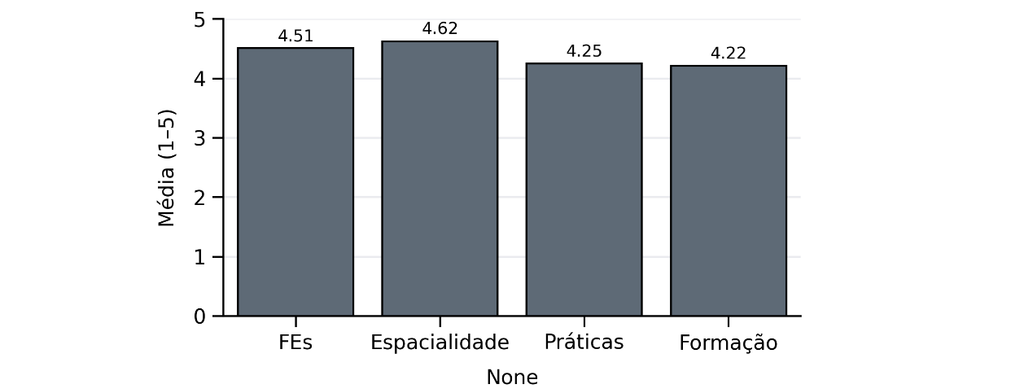
The descriptive results were presented according to the thematic blocks of the questionnaire: Executive Functions, Spatiality, Pedagogical Practices, Gender and Mathematics, and Teacher Training. Figure 1 summarizes the general pattern of perceptions, highlighting the high recognition of the importance of spatial skills and executive functions in mathematical learning.
Figure 1 – Means of the thematic blocks (Likert scale 1-5).
Source: Original research findings (2026).
Executive functions
Table 2 presents the means and standard deviations of the items related to executive functions (EFs). The results indicated a high level of agreement regarding the relevance of EFs for learning, with the item on the relationship between EFs and school performance obtaining the highest mean (M = 4.83; SD = 0.43). In contrast, the daily observation of self-regulatory behaviors showed greater dispersion (SD = 0.92), suggesting variability in the practical perception of these skills in the classroom. The intentional stimulation of EFs also showed a high mean (M = 4.56; SD = 0.62).
Table 2 – Faculty perception of Executive Functions (N = 48)
| Evaluated item | Mean (M) | Standard Deviation (SD) |
|---|---|---|
| Knowledge about executive functions | 4,43 | 0,71 |
| Recognition of the FE-learning relationship | 4,83 | 0,43 |
| Observation of self-regulation in the classroom | 4,21 | 0,92 |
| Intentional stimulation of executive functions | 4,56 | 0,62 |
Source: Original research findings (2026).
Spatiality
In Table 3, faculty perceptions of spatial skills and their relationship with mathematical learning are presented. There was high agreement regarding the importance of spatial cognition in the early years of schooling, with emphasis on the relevance of spatial skills for learning mathematics (M = 4.85; SD = 0.36). The contribution of spatial experiences to future reasoning also obtained a high average (M = 4.77; SD = 0.52). However, the intentional proposition of spatial activities (M = 4.50; SD = 0.68) and the systematic integration between spatiality and mathematics (M = 4.38; SD = 0.73) showed greater dispersion, indicating variability in the operationalization of these practices and a gap between theoretical knowledge and implementation.
Table 3 – Teacher perceptions of spatiality and mathematics (N = 48)
| Evaluated item | Mean (M) | Standard Deviation (SD) |
|---|---|---|
| Importance of spatial skills for mathematics | 4,85 | 0,36 |
| Contribution of spatial experiences to mathematical reasoning | 4,77 | 0,52 |
| Intentional proposition of spatial activities | 4,50 | 0,68 |
| Integration between spatiality and mathematics | 4,38 | 0,73 |
Source: Original research findings (2026).
Pedagogical Practices
Table 4 details the pedagogical practices adopted by the faculty. The results revealed a high frequency of strategies promoting cognitive development. The item with the highest average was the request for explanation of reasoning (M = 4.52; SD = 0.71). Games requiring attention and memory (M = 4.33; SD = 0.78), problem-solving situations and planning (M = 4.23; SD = 0.72), and the use of concrete materials (M = 4.29; SD = 0.90) were also frequent. The lowest average in the block, still high, was for the integration of body-space-mathematics (M = 4.02; SD = 0.96), suggesting heterogeneity in the use of embodied practices, possibly due to infrastructure conditions or teacher training.
Table 4 – Pedagogical practices related to executive functions (N = 48)
| Evaluated item | Mean (M) | Standard Deviation (SD) |
|---|---|---|
| Games that require attention and memory | 4.33 | 0.78 |
| Problem situations and planning and decision-making | 4.23 | 0.72 |
| Request for explanation of reasoning | 4.52 | 0.71 |
| Use of concrete materials | 4.29 | 0.90 |
| Body-space integration–mathematics | 4.02 | 0.96 |
Source: Original research findings (2026).
Gender and Mathematics
Table 5 presents faculty perceptions of gender and mathematics learning. Strong recognition was observed of the school’s role in reducing gender inequalities (M = 4.75; SD = 0.48) and of faculty actions to achieve this (M = 4.57; SD = 0.75). However, items on the influence of family cultural capital (M = 3.71; SD = 1.25) and the potential for teachers to reinforce stereotypes (M = 3.77; SD = 1.17) showed intermediate means and greater variability. The item with the lowest mean and highest dispersion was “boys and girls have the same initial interest in mathematics” (M = 3.35; SD = 1.19), indicating uncertainty about the initial involvement of both genders in the field.
Table 5 – Faculty perception of gender and mathematics (N = 48)
| Evaluated item | Mean (M) | Standard Deviation (SD) |
|---|---|---|
| Boys and girls have the same initial interest in mathematics | 3,35 | 1,19 |
| Perceived trust differences | 3,65 | 1,12 |
| Influence of family cultural capital | 3,71 | 1,25 |
| Professors can reinforce stereotypes | 3,77 | 1,17 |
| School can reduce gender inequalities | 4,75 | 0,48 |
| Teaching actions can reduce inequalities | 4,57 | 0,75 |
Source: Original research findings (2026).
Faculty Training
Table 6 details perceptions of professional training. There was great variability in the items investigating initial training, such as contact with neuroscience (M = 3.56; SD = 1.51) and subjects on EF (M = 3.50; SD = 1.50), indicating little formal contact with these topics for part of the sample. In contrast, the items related to continuing education showed higher averages and less dispersion, with almost unanimous consensus on the importance of continuing education in cognitive and emotional development (M = 4.90; SD = 0.37) and high participation in training (M = 4.52; SD = 0.74). Neuroscience training was also recognized as a contributor to reducing gender inequalities (M = 4.62; SD = 0.57).
Table 6 – Faculty perception of professional training (N = 48)
| Evaluated item | Mean (M) | Standard Deviation (SD) |
|---|---|---|
| Contact with neuroscience in initial training | 3,56 | 1,51 |
| Disciplines on executive functions in initial training | 3,50 | 1,50 |
| Importance of continuing education | 4,90 | 0,37 |
| Regular participation in training | 4,52 | 0,74 |
| Neuroscience training contributes to reducing gender inequalities | 4,62 | 0,57 |
Source: Original research findings (2026).
Inferential statistical analyses
Non-parametric analyses were conducted to assess differences by network of operation and correlations between thematic blocks.
Differences by network (Kruskal-Wallis)
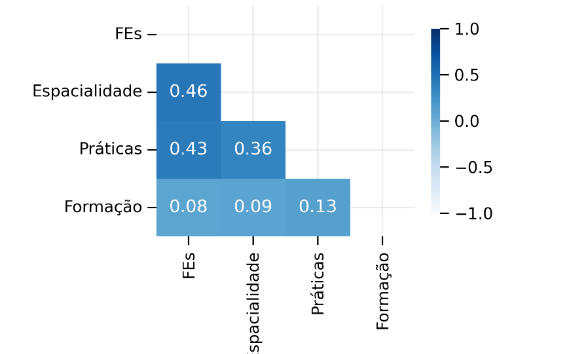
The results indicated a statistically significant difference between the networks of action only for the Executive Functions (EFs) compound (H = 12.27; p = 0.002; ε² ≈ 0.23), with a moderate effect size. For the other blocks (Spatiality, Pedagogical Practices, and Training), no statistically significant differences were observed (p > 0.45), according to Table 7. Figure 2 illustrates this difference, showing a higher concentration of high values for EFs among teachers in the private network.
Table 7 – Kruskal-Wallis tests by network (N = 48)
| Block | H | p | ε² |
|---|---|---|---|
| Executive functions | 12,27 | 0,0022 | 0.23 |
| Spatiality | 1,58 | 0,4546 | ≈ 0 |
| Pedagogical practices | 1,08 | 0,5828 | ≈ 0 |
| Training | 0,89 | 0,6399 | ≈ 0 |
Source: Original research findings (2026).
Figure 2 – Distribution of the composite executive function score by network of operation (public, private, and both).
Source: Original research findings (2026).
Post-hoc comparisons for EFs revealed a statistically significant difference between the private and public networks (U = 374; p = 0.0007; δ ≈ 0.60), indicating a higher EF score in the private network. Comparisons involving the “Both” category were not statistically significant (p > 0.19), as shown in Table 8.
Table 8 – Post-hoc comparisons (Mann-Whitney test) for executive functions by network (N = 48).
| Paragraph | U | p | Cliff’s δ | n1 | n2 |
|---|---|---|---|---|---|
| Both vs. Private | 34 | 0,2806 | -0.34 | 4 | 26 |
| Both vs. Public | 51 | 0,1942 | 0.43 | 4 | 18 |
| Private vs Public | 374 | 0,0007 | 0.60 | 26 | 18 |
Source: Original research findings (2026).
Correlations between compounds (Spearman)
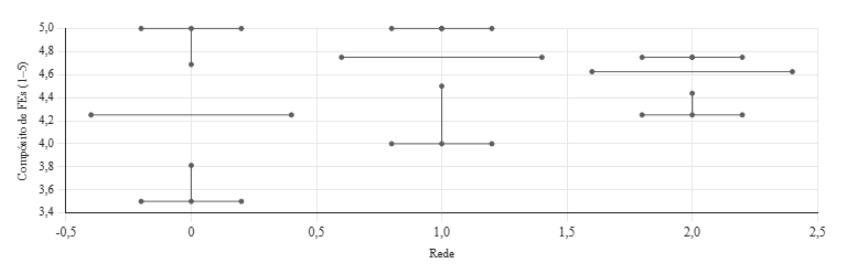
Moderate and statistically significant associations were observed between executive functions and pedagogical practices (rho = 0.43; p = 0.0026), as well as between spatiality and practices (rho = 0.36; p = 0.0123). The correlations between training and practices (rho = 0.13; p = 0.38), as well as between training and the other constructs, were not statistically significant (p > 0.50), according to Table 9. Figure 3 presents these coefficients, visualizing the relational patterns between beliefs, knowledge, and teaching practices. The highest correlations were concentrated between EFs and practices, and between spatiality and practices, suggesting that teachers who value these constructs tend to engage more frequently in corresponding pedagogical practices.
Table 9 – Spearman correlations between blocks (N = 48)
| Pair of compounds | p (rho) | p |
|---|---|---|
| FE × Specialization | 0.46 | 0.0011 |
| FE × Prat | 0.43 | 0.0026 |
| FE × Form | 0.08 | 0.5670 |
| Spec. × Pract. | 0.36 | 0.0123 |
| Specialization × Training | 0.09 | 0.5212 |
| Practice vs. Formation | 0.13 | 0.3796 |
Source: Original research findings (2026).
Figure 3 – Spearman correlations between thematic blocks (FEs, Spatiality, Practices, and Training).
Source: Original research findings (2026).
Thematic analysis of open-ended responses
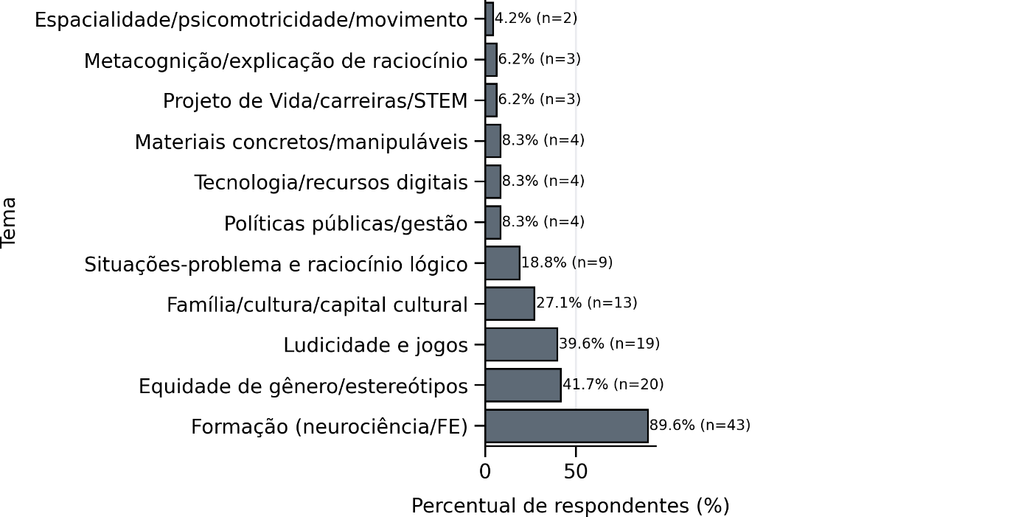
The open-ended questions sought to deepen teachers’ perceptions about training priorities, actions to expand opportunities in mathematics, and strategies to reduce gender inequalities. Table 10 presents the identified themes and their frequencies. The most recurrent theme was teacher training in neuroscience and executive function, mentioned by 89.6% of the participants. Other highlighted themes were gender equity and stereotypes (41.7%) and playfulness and games (39.6%). Complementary themes included family, culture, and cultural capital (27.1%) and problem situations and logical reasoning (18.8%). More specific mentions of concrete materials, technology, public policies, metacognition, life project, and spatiality/movement represented less than 10% of the sample. Figure 4 visually synthesizes the relative predominance of these themes.
Table 10 – Frequency of themes in open-ended responses (N = 48)
| Topic | n | % |
|---|---|---|
| Teacher training in neuroscience and Executive Function | 43 | 89,6 |
| Gender equity and stereotypes | 20 | 41,7 |
| Ludicity and games | 19 | 39,6 |
| Family, culture and cultural capital | 13 | 27,1 |
| Problem situations and logical reasoning | 9 | 18,8 |
| Concrete and manipulable materials | 4 | 8,3 |
| Public policies and management | 4 | 8,3 |
| Technology/digital resources | 4 | 8,3 |
| Metacognition and explanation of reasoning | 3 | 6,2 |
| Life Project, careers and STEM | 3 | 6,2 |
| Spatiality, psychomotricity and movement | 2 | 4,2 |
| Formative assessment and feedback | 0 | 0,0 |
Source: Original research findings (2026).
Figure 4 – Frequency of themes identified in open-ended responses (N = 48)
Source: Original research findings (2026).
Representative examples of the responses included the demand for “Neuroscience applied to education […] content based on learning science”, the need to “Encourage girls and boys as potentials in mathematics and bring examples of women who work…” and the importance of “Playful tools are fundamental in Early Childhood Education for the development of children.”
Synthesis of results
The results allowed for an integrated visualization of the perceptions, practices, and training demands of teachers in Early Childhood Education and the initial years. High agreement was observed regarding the relevance of executive functions and spatiality for mathematical learning, accompanied by frequent pedagogical practices, albeit with distinct levels of variability. Descriptive analyses showed high means for EFs and spatiality, and for pedagogical practices such as explicitation of reasoning, use of games, and concrete materials. In the gender and mathematics block, the belief in the school’s role in addressing inequalities stood out, alongside more diverse perceptions about the initial interest and confidence of girls and boys. Teacher training revealed significant variation in initial training, contrasting with the consensus on the importance of continuing education.
Inferential analyses indicated differences between networks of action only in the executive functions block, with a significantly higher score among teachers from the private network. Moderate correlations were observed between beliefs about EFs and pedagogical practices, and between spatiality and practices, suggesting alignment between teacher knowledge and action. Declared training did not correlate significantly with practices. Thematic analysis of open-ended responses reinforced the demand for continuing education in neuroscience and EFs, and highlighted gender equity, playfulness, and problem-solving situations.
Discussion
The development of mathematical learning in childhood is strengthened when executive functions, spatial skills, and intentional pedagogical practices operate in an integrated manner, especially in contexts committed to gender equity. The results of this study, in line with the literature (Bethlehem et al., 2022; Diamond, 2013), indicate that these cognitive competencies constitute pillars of children’s mathematical reasoning, particularly in contexts marked by social and cultural inequalities.
Executive Functions, Engagement, and Metacognition
The participating teachers demonstrated high recognition of the importance of executive functions (EFs) in mathematical learning, converging with evidence from developmental neuroscience (Diamond, 2013). The observed correlation between beliefs in EFs and pedagogical practices (rho = 0.43; p = 0.0026) indicates that their valuation translates, at least partially, into concrete didactic actions. Evidence on brain development (Bethlehem et al., 2022) points to sensitive windows in childhood for strengthening self-regulation and planning, reinforcing the importance of practices that promote metacognition and active engagement. Early childhood education, a period of high neural plasticity, offers expanded potential for the impact of intentional pedagogical interventions on the development of EFs and mathematical reasoning.
Spatiality and Mathematics
Spatiality showed high valuation in the study, with consensus on its role in mathematical learning. This result aligns with the Triple Code Model (Dehaene; Cohen, 1995), which proposes that numerical representations have a spatial basis. Longitudinal studies indicate that early spatial skills predict future mathematical performance (Verdine et al., 2017). The observed correlation between spatiality and pedagogical practices (rho = 0.36; p = 0.0123) suggests alignment between teacher beliefs and actions. However, the variability in the systematic integration of spatiality into the pedagogical routine highlights a gap between theoretical recognition and practical implementation, indicating the need for specific training and adequate structural conditions.
Pedagogical Practices and Applied Neuroscience
The pedagogical practices reported, such as the use of games, the proposition of problem-solving situations, the use of manipulable materials, and the explicit articulation of reasoning, are aligned with the literature recommendations for the integrated development of executive functions, spatial cognition, and logical reasoning (Vandenbroucke et al., 2018). Such practices align with the National Common Curricular Base (BNCC). Nevertheless, embodied and spatial exploration practices showed greater variability, possibly due to limitations in space, resources, or teacher training.
Faculty Training
Regarding teacher training, great variability was observed in initial training on topics related to neuroscience and executive functions, contrasting with an almost unanimous consensus on the importance of continuing education. The literature indicates that undergraduate courses often offer limited preparation in neurodevelopment (Engel de Abreu et al., 2015), leading teachers to seek further training. Open-ended responses reinforce this demand for theoretical and practical deepening. It is important to consider the sample bias, composed of teachers with possible prior exposure to neuroscience content, which may have positively influenced the appreciation of EFs, spatiality, and gender equity. Thus, the results should be interpreted with caution regarding their generalization.
Gender Equity
Regarding gender equity, the results indicate a high recognition of the school’s role in promoting more equitable opportunities in mathematical learning. Although heterogeneous perceptions were observed regarding the interest and confidence of girls and boys, teachers recognize that intentional pedagogical practices can expand opportunities and reduce inequalities. Studies suggest that performance differences between genders are more strongly explained by sociocultural factors than by intrinsic cognitive differences (Stoet; Geary, 2018). International evidence, such as from PISA, indicates that girls often exhibit lower self-confidence and higher anxiety in mathematics, even when they achieve similar or superior performance to boys, which reinforces the role of educational experiences and social expectations in the construction of these differences.
SDG 5 and the Articulation between Poverty, Spatiality and Gender
The articulation between poverty, spatial cognition, and gender inequalities emerges as a relevant axis for understanding differences in mathematical performance. Research indicates that children in vulnerable situations have less access to diversified spatial experiences, which are fundamental for building robust mental representations (Lipina, 2020). In the case of girls, sociocultural factors can further restrict this repertoire. These elements suggest that socioeconomic and gender conditions can interact, influencing both spatial repertoire and mathematical self-confidence. By highlighting these processes, this study contributes to Sustainable Development Goal 5 (SDG 5), by emphasizing the role of schools, teacher training, and educational environments that confront limiting beliefs about who belongs in mathematics and STEM fields. The school, especially in early childhood education, is configured as one of the main devices for equity, by enabling access to cognitive and spatial experiences that many children do not find in their home environments.
In summary, the results indicate that mathematical learning is favored when pedagogical practices integrate executive functions, spatial skills, bodily exploration, metacognition, and problem-solving. These elements contribute to the construction of learning contexts that promote autonomy, logical reasoning, and equitable participation between girls and boys. By recognizing that gender inequalities are socially constructed and can be amplified by inequalities in access to cognitive experiences, this study reinforces the role of the school and teacher training in promoting SDG 5 and in building fairer and more inclusive mathematical trajectories.
4. Conclusion
This study investigated the perceptions of preschool and early elementary school teachers regarding the role of executive functions and spatial skills in the development of mathematical reasoning, as well as their relationship with pedagogical practices and the promotion of gender equity. High recognition of the importance of executive functions and spatial cognition for mathematical learning was found, although the systematic integration of these skills and the daily observation of self-regulation showed greater variability in teaching practice. Pedagogical practices were identified as frequent but heterogeneous, especially in interventions for spatial cognition and executive functions. It was observed that teachers who attributed greater importance to these constructs reported a higher frequency of associated pedagogical practices. Regarding gender, uncertainty was found about the equivalent initial interest between boys and girls, but strong agreement that schools can act to reduce inequalities. The findings offer support for teacher training and the promotion of equity in mathematical learning from the early school years, reinforcing the school’s role as a device for equity, in alignment with Sustainable Development Goal 5.
However, the study presented limitations arising from its non-probabilistic sample, composed mainly of teachers from the private sector, which requires caution in generalizing the results. Self-reported measures may also be subject to social desirability biases, and the moderate reliability in some blocks demands careful interpretation. It is suggested that future studies explore effective strategies for translating this knowledge into intentional and systematic pedagogical practices, investigating the impact of specific continuing education programs on the qualification of teaching practice and on student learning outcomes, especially in contexts of greater socioeconomic vulnerability.
Bibliographic References
Bethlehem, R. A. I. et al. Brain charts for the human lifespan. Nature, v. 604, p. 525–533, 2022.
Blair, C.; Raver, C. C. School readiness and self-regulation: a developmental psychobiological approach. Annual Review of Psychology, v. 66, p. 711–731, 2015.
Dehaene, S.; Cohen, L. Towards an anatomical and functional model of number processing. Mathematical Cognition, 1995.
Diamond, A. Executive functions. Annual Review of Psychology, v. 64, p. 135–168, 2013.
Engel de Abreu, P. M. J. et al. A pobreza e a mente: perspectiva da ciência cognitiva. Luxembourg: University of Luxembourg, 2015.
Gagnier, K. M.; Wager, T. D.; Booth, J. L. Brain-based approaches to learning: Evidence and implications for education. Nature Reviews Neuroscience, v. 22, p. 181–197, 2021.
Gilligan, K. A.; Flouri, E.; Farran, E. K. The contribution of spatial ability to mathematics achievement in middle childhood. Developmental Science, v. 20, n. 4, 2017.
Lipina, S. J. Pobre cérebro: o que a neurociência propõe sobre os efeitos da pobreza no desenvolvimento cognitivo e emocional. Buenos Aires: Siglo XXI, 2020.
Stoet, G.; Geary, D. C. The gender-equality paradox in STEM education. Psychological Science, v. 29, n. 4, p. 581–593, 2018.
Vandenbroucke, L. et al. Teacher-child interactions and executive functions. Early Childhood Research Quarterly, 2018.
Verdine, B. N. et al. Contributions of executive function and spatial skills to preschool mathematics achievement. Journal of Experimental Child Psychology, v. 126, p. 37–51, 2014.
Article originating from a Final Course Work on Neuroscience and Learning in Education
To learn more about the course, click here and access the MBX Academy platform