
Digital Business
September 09, 2026
Influence of Digital Experience on Legal Entity Customer Retention in a Financial Institution
Dayana Priscilla Soares Jesus; Renê De Oliveira Joaquim Dos Santos
DOI: 10.22167/2675-6528-202602199
Article derived from a Final Course Work (TCC), with content based on the student’s original work and adapted to the editorial format of the E&S Magazine with the support of the ResumeAI tool, an artificial intelligence solution developed by the Pecege Institute for textual synthesis and organization.
Abstract
Digital transformation in the financial sector has redefined the expectations of corporate clients, making the user experience on digital platforms a strategic factor for retention, especially in the Small and Medium-sized Enterprises (SME) segment. The study analyzed the influence of the user experience on the digital platforms of a financial institution and its relationship with banking retention in this segment. To this end, a mixed methodology was applied, combining qualitative and quantitative approaches, through structured questionnaires administered to 63 SME clients from a High Retail segment portfolio. The results revealed a high frequency of daily platform usage, with a concentration on basic transactional operations and low adoption of higher value-added services. Digital support was identified as the most critical point, with only 30.2% of users consistently receiving useful assistance in error situations. The digital experience directly or moderately influenced the retention decision of more than 90% of respondents, with an average score of 4.28 and an NPS of 33.32 points. It was concluded that the customer journey is highly sensitive to the quality of the digital experience, and that operational autonomy and support quality are determinants of loyalty in the B2B banking context. The redesign of friction points, strengthening of contextual support, and a digital education strategy were proposed.
Keywords: User experience; Loyalty; Customer journey; Retention; Digital transformation.
1. Introduction
The financial services sector is undergoing a profound transformation, driven by technological evolution and significant changes in consumer behavior. The rise of fintechs and digital banks has introduced new standards of convenience, agility, and personalization, redefining expectations regarding the banking experience. This scenario imposes on traditional financial institutions the simultaneous challenge of modernizing their technological platforms and revising their relationship models, in order to serve increasingly digitally sophisticated clients.
In this context, user experience on digital platforms has become a strategic factor for customer retention, especially in the Corporate segment. Organizations that do not align with a customer-oriented economy tend to lose relevance in increasingly competitive markets (Kotler and Keller, 2016). For traditional financial institutions, understanding and meeting customer needs has become not only a competitive advantage, but an essential condition for survival.
The banking relationship with corporate clients presents particularities that amplify the importance of the digital experience. Companies demand operational efficiency, predictability, autonomy, and consistency in their financial interactions. The customer journey, defined as the set of interactions and touchpoints established throughout the relationship with the organization (Kalbach, 2017), assumes a central role, allowing us to identify not only moments of satisfaction but also friction points that compromise the fluidity of the experience and can lead to abandonment.
User experience (UX), understood beyond technical usability, constitutes the foundation of the customer journey in digital environments. Garrett (2011) describes it as the set of perceptions and responses resulting from interaction with products and services, encompassing functional, emotional, and aesthetic aspects. In the digital banking sector, attributes such as navigation clarity, response time, reliability, and support quality are strategic components of the value proposition. Krug (2011) reinforces that simplicity and clarity are determinants for the continued use of digital solutions, especially in contexts where trust is a critical factor. For Legal Entity clients, a deficient digital experience represents not only inconvenience but also operational risk.
The relevance of the digital experience is intensified when considering the factors that influence the behavior of corporate clients. Solomon (2016) points out that decision-making is influenced not only by rational criteria but also by emotional and perceptual elements, such as trust, sense of control, and security. In the B2B environment, where decisions involve multiple stakeholders and long-term strategic implications, the perception of the quality of the digital experience can be decisive for remaining with or migrating to another institution. Bateson and Hoffman (2016) highlight that, in services, retention is challenging but more valuable, as long-lasting relationships tend to be built on trust and recurring satisfaction. Thus, relationship marketing assumes a strategic role in managing corporate clients, requiring financial institutions to have capabilities for active listening, personalization, and anticipation of needs (Gordon, 2001).
Despite the relevance of the topic, there are still gaps in understanding how attributes such as usability, autonomy, and support on digital platforms influence the retention decision of Legal Entity clients in traditional banking institutions, especially in the Brazilian context and in the High Retail segment. Neglecting the consumer experience entails high risks of market loss (Kotler, 2021), and investing in the quality of the digital experience is a strategic decision with a direct impact on financial results, given the high acquisition cost and the significant value of the customer lifecycle in B2B (Reichheld, 2011).
Given this scenario, the present study is justified by the need to deepen the understanding of the dynamics of corporate client retention in a digitized environment, and aims to analyze how the user experience on digital platforms influences the retention of legal entity clients in this segment, evaluating clients’ perception of usability and efficiency, identifying friction points in the digital journey, and pointing out opportunities for improvement in the digital experience that contribute to the enhancement and strengthening of the relationship with corporate clients.
2. Material and Methods
This research is classified as descriptive, seeking to describe the characteristics and perceptions of a specific group of Legal Entity customers from the High Retail segment of a Financial Institution regarding their experience using digital platforms and the influence of this experience on the decision to remain with the bank (Gil, 2017). A mixed (qualitative-quantitative) approach was adopted, where the quantitative dimension measured usage patterns, usability perceptions, and satisfaction indicators, with data statistically treated and represented in graphs. The qualitative dimension explored open-ended questionnaire responses to identify perceptions and demands not capturable by closed metrics.
The study design was a single case study (Yin, 2015; Gil, 2017), focused on a portfolio of Legal Entity clients from the High Retail segment of a Specialized Agency of a Financial Institution, located in Campinas/SP. The researched universe comprised 182 Legal Entity clients from the studied portfolio, segmented according to the revenue profiles presented in Table 1.
Table 1. Profiles of companies in the High Retail segment at the Financial Institution
| Segment | Annual Gross Revenue Range | Description |
|---|---|---|
| Small Business | Above BRL 1 million up to BRL 5 million | Businesses already structured with local or regional operations. |
| Company | Above BRL 5 million up to BRL 15 million | Companies with greater operational and investment capacity. |
| High Company | Above BRL 15 million up to BRL 50 million | Companies with a more robust performance and expansion potential. |
Source: Normative Instructions of the Researched Financial Institution
For the acquisition of information and data, two techniques were used: (a) bibliographic research, carried out in the initial stage to survey the theoretical framework on customer journey, user experience, and customer retention in the financial sector; and (b) a structured questionnaire, applied digitally via WhatsApp to the portfolio’s clients. The questionnaire, composed of fourteen questions, included closed questions (multiple choice and scales) and open questions, seeking to identify the respondents’ perceptions, challenges, and expectations in their digital journey (Malhotra, 2012). The complete form is in the Appendices.
63 valid responses were obtained, representing a participation rate of approximately 34.6% of the surveyed universe.
3. Results and Discussion
The results were obtained from the application of a structured questionnaire to 63 corporate clients from the High Retail portfolio of a Financial Institution, representing a response rate of 34.6% of the surveyed universe (N=182). The data were analyzed in light of the theoretical framework, connecting the empirical findings to the concepts of user experience, usability, and customer retention.
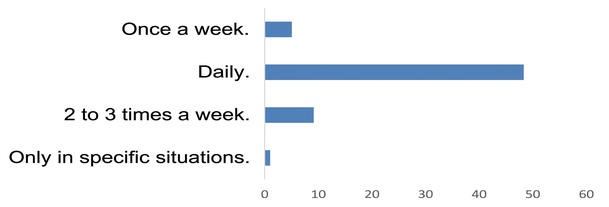
The research revealed the centrality of digital platforms in the business routine, with 76.2% of companies accessing them daily and 7.9% weekly, according to Figure 1. This intensive use, aligned with Kotler’s (2021) observation on the dependence on digital channels, indicates that platforms have become the main point of contact between bank and client. From the perspective of the customer journey (Kalbach, 2017), this high frequency of interaction represents multiple “moments of truth” that impact the perception of value. Consistently positive experiences build trust and loyalty (Norman, 2013), reinforcing the essentiality of investments in usability and performance for the sustainability of the corporate banking relationship.
Figure 1. Frequency of access to digital channels.
Source: Original Survey Data
Usage patterns: focus on basic transactional operations
The analysis of the most used functionalities revealed a concentration in basic transactional activities: payment of bills and taxes (88.9%), transfers (81%), and balance and statement inquiries (87.3%). More complex services, such as issuing payment slips (41.3%), financial investments (27%), payroll (34.9%), insurance contracting (1.6%), and foreign exchange closing (11.1%), showed low adoption. This pattern aligns with Krug’s (2011) concept of “basic tasks,” where users prioritize immediate needs, and may indicate usability or communication barriers that inhibit the exploration of sophisticated services (Nielsen, 1993).
The low utilization of insurance and digital foreign exchange (1.6% and 11.1%, respectively) suggests that complex services require greater support and informational clarity (Bateson and Hoffman, 2016), possibly directing these operations to in-person channels. Although basic operations validate the core functionality of the platforms, the underutilization of higher value-added services represents a missed opportunity for the bank and for customers, potentially related to support deficiencies.
Usability: positive perception with reservations
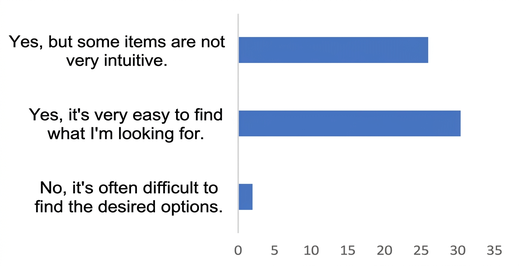
The evaluation of the digital platforms’ structure indicated a predominantly positive perception, with 44.4% of respondents reporting total ease and 52.4% minor intuitiveness difficulties, according to Figure 2. These results partially align with Nielsen’s (1993) usability principles, such as “consistency and standards.”
Figure 2. Ease of locating functionalities used by companies on digital platforms.
Source: Original Survey Data
Despite the positive perception, the average ease of use rating was 4.26 (scale of 1 to 5), with 52.4% assigning a score of 4 and 38.1% a score of 5. This score, although good, does not reach the excellence of experiences that “disappear” from the user’s consciousness (Preece, Rogers, and Sharp, 2013). Usability, although functional, still demands moderate cognitive effort for 38.7% of users in simple tasks, characterizing what Garrett (2011) calls “interaction friction,” which reduces the fluidity of the experience.
Communication and language: barrier to universal access
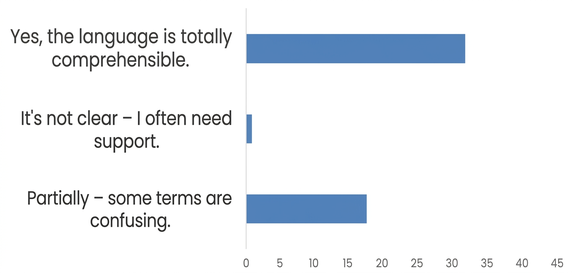
The clarity of the language was considered understandable by 63.5% of respondents, but 34.9% identified confusing terms, according to Figure 3. This significant percentage contradicts Nielsen and Mack’s (1994) “user language” principle, which advocates for familiar vocabulary and the absence of technical-financial jargon.
Figure 3. Clarity and comprehensibility of the language used on digital platforms.
Source: Original Survey Data
The perception of complexity in financial services is a critical factor for usage and retention (Solomon, 2016). The difficulty in understanding terms increases the perception of risk and reduces trust. The presence of confusing terms for more than a third of users suggests that the content design of the platforms is not fully adapted to the business context.
Support and assistance: main critical point identified
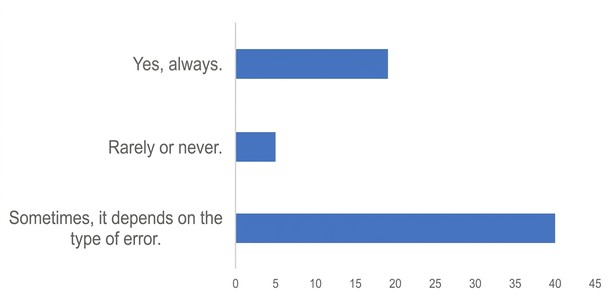
Support in situations of error or difficulty was the most problematic aspect of the digital experience. Only 30.2% of users report always receiving useful instructions, while 61.9% report partial help and 7.9% indicate a lack of effective support, according to Figure 4. These results contrast with the need for robust error recovery mechanisms and contextual support in quality systems (Preece, Rogers, and Sharp, 2013), and with the premise that usability testing occurs at moments of failure (Norman, 2013).
Figure 4. Support of digital platforms in case of error or difficulty.
Source: Original Survey Data
The predominance of “partial” support (61.9%) indicates generic error messages or insufficient instructions, forcing users to resort to external channels and disrupting the fluidity of the digital experience. Effective problem resolution is a determinant of satisfaction (Bateson and Hoffman, 2016), and this deficiency poses a risk to retention, as frustrations at critical moments disproportionately impact the relationship.
Consistency and responsiveness: stability with room for improvement
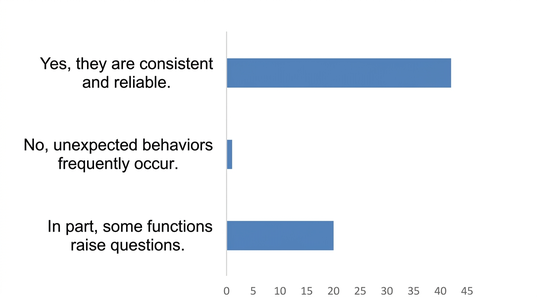
The system’s consistency was considered reliable by 66.7% of users, while 31.7% reported partial confidence due to doubts in some functions, as shown in Figure 5. This indicates that the platforms reasonably meet the principle of “error prevention” (Nielsen, 1993), but partial consistency compromises predictability, which is essential for trust in financial services.
Figure 5. Consistency and predictability of systems.
Source: Original Survey Data
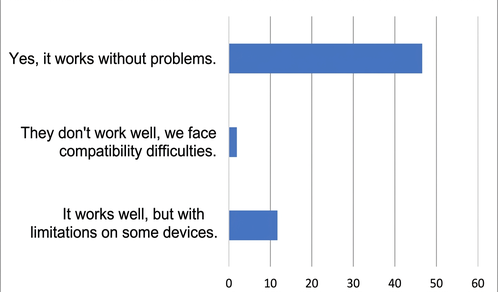
Regarding cross-device responsiveness, 77.8% considered the performance fully satisfactory, but 19% identified limitations on some devices, as shown in Figure 6. Consistent cross-platform experience is a fundamental requirement (Garrett, 2011), and the identified limitations may indicate exclusion of segments with less prevalent operating systems or older devices.
Figure 6. Functioning of digital platforms on different devices.
Source: Original Survey Data
Demands for simplification: the paradox of limited autonomy
The open-ended responses indicated that excessive steps in login and authentication, bureaucracy in PIX and transfer processes, manager dependency for user management, and lack of clarity in financial applications and reports are barriers to autonomy and agility. These demands reflect the concept of “customer effort” (Reichheld, 2011) and the principle of “don’t make me think” (Krug, 2011), which advocate for interfaces that minimize user effort.
A strategic paradox was observed: digital platforms, although promoted as instruments of autonomy, maintain dependencies on the in-person model, such as managerial approval for access management. This contradicts the expectations of the PJ segment and the promises of digital transformation. The results suggest that the Financial Institution has not yet balanced human proximity with operational efficiency (Gordon, 2001), offering digitalization without full autonomy.
Global evaluation and behavioral intention
The overall digital experience obtained an average score of 4.28 (scale of 1 to 5), with 47.61% of respondents assigning a score of 4 and 41.26% a score of 5. The influence of digital experience on customer retention was considered direct by 52.4% and moderate by 39.7%, with less than 10% indicating no impact, according to Figure 7.
Figure 7. Ease of use of digital platforms.

Source: Original Survey Data
These results validate the relevance of the digital experience in retaining corporate clients, aligning with Kotler and Keller (2016). However, the average score of 4.26, although positive, suggests a level of “satisfaction” without “delight” (Solomon, 2016), indicating that operational needs are met, but without differentials that generate spontaneous advocacy.
The average Net Promoter Score (NPS) was 8.13 (scale of 0 to 10), with concentrations in scores of 8 (19%), 9 (20.6%), and 10 (28.61%), positioning the Financial Institution as a satisfactory, but not exceptional, digital provider (Figure 8).
Figure 8. Financial Institution Recommendation based on user digital experience.

Source: Original Survey Data
According to Reichheld’s (2011) methodology, the Financial Institution has 49.2% promoters (scores 9 and 10), 34.92% neutral users (scores 7 and 8), and 15.88% detractors (scores 0 to 6). The resulting NPS of 33.32 points (49.2% – 15.88%) demonstrates competitive and solid performance, but with room to convert the base of neutral users into active promoters. The concentration of score 8 indicates that customers are satisfied enough not to switch, but not enthusiastic enough to recommend, requiring the addressing of identified frictions.
Interpretive synthesis: operational satisfaction versus experiential excellence
The integrated analysis of the results reveals that the Financial Institution’s digital platforms meet basic operational needs, but show deficiencies in aspects that distinguish satisfactory from exceptional experiences. Using Garrett’s (2011) “Elements of User Experience” framework, Table 2 summarizes the layer-by-layer evaluations.
Table 2. User Experience Elements Framework
| Layer | Evaluation | Evidence |
|---|---|---|
| Strategy | Partially aligned | Focus on basic operations addressed; complex services underutilized |
| Scope | Adequate | Essential functionalities present |
| Structure | Satisfactory | Functional but not intuitive navigation |
| Skeleton | With gaps | Partially confusing language; poor support |
| Surface | Functional | Good responsiveness; reasonable consistency |
Source: Original research results.
The shortcomings are concentrated in the Skeleton layers (interface and information design) and Structure (interaction design), especially in support, communication clarity, and flow simplification.
Research limitations and methodological considerations
This study has important limitations. The response rate of 34.6% may indicate self-selection bias, with greater participation of engaged individuals or those with intense perceptions. The investigation was restricted to a portfolio of clients from the High Retail segment of a Specialized Agency, which limits the generalization of the results to other segments or institutional realities.
Additionally, respondents’ familiarity bias can lead to an underestimation of difficulties, as frequent users tend to adapt to failures. The absence of benchmarking with competitors prevents a more precise evaluation of whether the deficiencies are specific to the Financial Institution or industry standards. Although the method is predominantly quantitative, more in-depth qualitative techniques could capture unvoiced frictions and perceptions.
According to Yin (2015), case studies offer contextual depth but require caution in generalization. Thus, findings should be understood as indicative of trends for similar organizational contexts, rather than as universal conclusions.
Theoretical and practical contributions
This study deepens the understanding of the relationship between digital experience and retention in the B2B banking context, highlighting specific nuances compared to B2C. Autonomy emerges as a differentiator, with companies valuing operational independence and considering dependence on managerial approvals a friction point. Underutilization of complex services indicates the need for differentiated approaches in experience design. In the B2B environment, the quality of contextual support in case of errors carries more weight than observed in B2C.
Based on these findings, three priority directions are proposed. The first is the redesign of the most friction-prone flows: authentication, transfers, PIX, and user management. The excess of steps in login and the dependence on managerial approval for basic operations were recurring friction points, evidencing a contradiction between the proposal of digital autonomy and the real experience.
The second direction focuses on contextual digital support, the most critical aspect. Only 30.2% of customers reported consistent useful support in error situations, and 61.9% indicated partial help. Norman (2013) emphasizes that the quality test of a system occurs in failures, where the Financial Institution shows vulnerability. Strengthening support implies replacing generic error messages with actionable ones, developing a proactive contextual support layer, building a dynamic knowledge base, and creating an agile escalation channel within the platform. Effective problem resolution is decisive for satisfaction (Bateson and Hoffman, 2016), and in the PJ segment, the quality of support in critical moments disproportionately impacts retention.
The third direction addresses the low adoption of complex and value-added services, such as insurance (1.6%), foreign exchange (11.1%), and financial investments (27%). This pattern indicates usability barriers or communication gaps. The digital education strategy should include progressive functional onboarding, simplification of the language for complex products, and training for the financial managers of client companies. Gordon (2001) emphasizes that lasting B2B relationships are based on creating mutual value, not just transactional efficiency.
Deficiencies in support, workflow simplification, and operational autonomy represent competitive vulnerabilities and differentiation opportunities. In a scenario of increasing pressure from fintechs and digital banks, addressing these frictions is imperative to sustain the corporate client base. The study demonstrates that, in Brazilian B2B, operational autonomy and the quality of contextual support are critical determinants of loyalty. The current NPS (~8.0) is insufficient to protect the base against the rise of digital competitors. Differentiation will come from the ability to transform banking complexity into a low-friction journey, making the addressing of these gaps a survival strategy.
4. Conclusion
This study analyzed the influence of user experience on the digital platforms of a financial institution on the retention of Legal Entity clients from the High Retail segment. The centrality of these platforms in the business routine was verified, with most clients accessing them daily for basic transactional operations, such as payments and inquiries. However, low adherence to services with higher added value, such as insurance and financial investments, was observed, indicating possible usability or communication barriers. Digital support in error situations was identified as the most critical point, with a reduced portion of users consistently receiving useful assistance. Despite this, the digital experience directly or moderately influenced the decision of more than 90% of respondents to remain, with a generally positive evaluation, but without reaching a level of excellence that generated delight. The main contribution of this work lies in demonstrating that, in the banking B2B context, operational autonomy and the quality of contextual support are critical determinants of loyalty, going beyond mere usability attributes.
Research limitations include the response rate, which may have introduced self-selection bias, and the restriction to a specific client portfolio, which prevents unrestricted generalization of results to other segments or institutions. Additionally, the absence of benchmarking with competitors and user familiarity bias may have influenced perceptions. Based on the findings, it was proposed to redesign friction flows, such as login and user management, strengthen contextual digital support by replacing generic messages with actionable instructions and creating agile escalation channels, and implement a digital education strategy for complex services. It is suggested that future studies expand the sample, incorporate observational usability tests, and conduct comparative analyses with fintechs, in order to deepen the understanding of the limited autonomy paradox and the determinants of corporate loyalty in an ever-evolving banking market.
Bibliographic References
BATESON, J. E. G.; HOFFMAN, K. D. (2016). Princípios de Marketing de Serviços: Conceitos, estratégias e casos. 3.ed. Porto Alegre: +A Educação – Cengage Learning Brasil. E-book. pág.6. ISBN 9788522124039. Disponível em: https://unibb.minhabiblioteca.com.br/reader/books/9788522124039/. Acesso em: 22 mar. 2025.
GARRETT, J. J. (2011). Os elementos da experiência do usuário: design centrado no usuário para a web e além dela. Rio de Janeiro: Alta Books.
GORDON, Ian. Marketing de relacionamento: estratégias, técnicas e tecnologias para conquistar clientes. São Paulo: Makron Books, 2001.
KALBACH, J. (2017). Mapeando experiências: um guia completo para o design de experiências centradas no cliente. Rio de Janeiro: Alta Books.
KOTLER, P.; KELLER, K. L. (2016). Administração de marketing. 15. ed. São Paulo: Pearson.
KRUG, S. (2011). Não me faça pensar: uma abordagem de bom senso à usabilidade na web. Rio de Janeiro: Alta Books.
SOLOMON, M. R. (2016). O comportamento do consumidor: comprando, possuindo e sendo. 11. ed. Porto Alegre: Bookman.
Article originating from a Final Course Work in Digital Business
To learn more about the course, click here and access the MBX Academy platform