
Projects
January 12, 2026
Implementation of a project office in maintenance to enhance continuous improvement processes
Authors: Jaqueline de Oliveira, Luana Lopes de Oliveira and Diogo Leite da Cruz
DOI: 10.22167/2675-6528-2024080
E&S 2026, 7: e2024080
In industrial maintenance, activities are developed to ensure the continuous operation of machines and equipment, such as periodic inspections, parts replacement, cleaning, and lubrication[1]. Preventive, corrective, and predictive actions are also carried out to anticipate failures that compromise production, in order to ensure worker safety and product quality.
The implementation of a Project Management Office (PMO) in maintenance adds strategic value, as it assists in conducting continuous improvement projects identified in the field. The PMO acts as a conciliating and centralizing function, standardizes management practices, obtains better results, and ensures adequate planning, execution, and monitoring[2]. It also establishes policies and methodologies for greater assertiveness, supports managers in delivering projects within deadline, budget, and quality, as well as strengthens organizational governance[3].
Historically, maintenance has evolved significantly. Between 1930 and 1940, repairs only occurred after failures, with low equipment availability. Between 1940 and 1970, planned maintenance and manual controls emerged. From 1970 onwards, monitoring began to consider condition, reliability, and the use of robust software involving multidisciplinary teams[4]. This evolution demonstrates continuous improvement and superior results, as failures cause delays, losses, and compromise operational planning.
The work is based on the Lean methodology, derived from the Toyota Production System, which seeks to maximize customer value and eliminate waste[5]. Lean strengthens communication among those involved, encourages collaborative management, reduces rework and waste, and leverages the creative potential of teams[6]. In this way, it promotes innovation and generates opportunities for improvement.
Therefore, the objective of this study is to implement a departmental PMO in maintenance, manage demands identified by technicians, and promote continuous improvement projects. The research was conducted in a national fuel distribution company, headquartered in Rio de Janeiro, with 43 storage bases, three airports with fueling facilities, and two Supply Chain depots, covering industrial equipment in all states. The company handles approximately 5,000 daily loadings and operates with 615 tanks at bases, 23 at airports, 2,700 safety valves, 1,191 pumps, 1,169 metering units, and 719 loading arms. Failures and maintenance downtimes occur daily, and this complex scenario highlights the need for a robust management model to optimize the sector’s processes and projects. To meet this demand and structure the solution, the present study was designed using a specific methodological approach.A qualitative exploratory research was adopted to guide the implementation of the structure through the PMO Value Ring method, which allowed for an understanding of this management model in an industrial context and an analysis of the perceptions of those involved[7,8]. The target audience consisted of five maintenance management employees: two from distribution units and three from the administrative headquarters, working in a hybrid arrangement with frequent technical visits. They were selected based on their proactive profile and experience in improvements.
Data collection occurred in April 2023, with 100% adherence, through a structured questionnaire applied via PMO Value Ring software. The questionnaire presented 30 potential benefits of a PMO; each participant selected five and indicated priority and relevance. The data processed by the software generated a sequence of eight structured steps for the implementation of the framework, replicable in other contexts with similar criteria.
The company underwent a major restructuring three years ago. Previously, maintenance was managed regionally, which facilitated control. With the change, a maintenance management department was created, responsible for all units in Brazil, which faced challenges of cultural adaptation, reduced staff, and recurring failures.
The analysis of the PMO Value Ring results indicates that the departmental PMO constitutes a robust strategic initiative as a channel for controlling and monitoring demands[9]. Projects will be monitored punctually, which avoids delays and budget deviations, with clear communication between technicians, coordinators, and managers, aligned with organizational objectives.
The PMO will provide centralized and updated information, based on a structured portfolio. With adjustments and analysis of indicators, it will evolve in maturity, which will result in governance and good practices. Lean Manufacturing will support the optimization of processes, people and equipment[5,10] and strengthens the elimination of waste, in addition to increasing value.
From the beginning, the active participation of technicians is foreseen (Figure 1): they identify operational problems, register requests, and the PMO evaluates and prioritizes actions to initiate continuous improvement projects.

Source: Elaborated by the authors.
Potential benefits for PMO
In the first step, the Mix Manager PMO (Figure 1) assists in defining the priority functions that should be offered by the Project Management Office. Each of these functions is critical to the success of the structure in delivering value to the organization. The Value Ring PMO provides a flexible model that allows organizations to adapt the office’s functions to their specific needs and gradually evolve to higher levels of maturity in project and program management[9].
Table 1. The 26 most frequent functions in Project Management Offices (PMOs)
| 1 | Support project planning |
| 2 | Perform specialized tasks for project managers |
| 3 | Manage resource allocation across projects |
| 4 | Manage the interface with project clients |
| 5 | Manage organizational changes and transformations |
| 6 | Managing people in projects |
| 7 | Manage the projects or programs |
| 8 | Manage project stakeholders |
| 9 | Conduct project audits |
| 10 | Manage project documentation |
| 11 | Manage lessons learned databases |
| 12 | Perform comparisons (benchmarking) |
| 13 | Manage lessons learned meetings |
| 14 | Promote project management in the organization |
| 15 | Provide mentoring to project managers |
| 16 | Provide training and skills development for projects |
| 17 | Provide information systems and tools for project management |
| 18 | Provide the project management methodology |
| 19 | Monitor and control project performance |
| 20 | Provide the project or program performance report to senior management |
| 21 | Provide the strategic framework for projects |
| 22 | Support the definition of the project portfolio |
| 23 | Manage project or program benefits |
| 24 | Monitor portfolio performance |
| 25 | Participate in strategic planning |
| 26 | Provide advice to senior management in executive decision-making |
Source: Elaborated by the authors from the PMO Value Ring (PMOVR).
Through a study conducted by Pinto[11], based on the opinions of PMO clients from 11 organizations, the software indicated 30 potential expected benefits (Table 2) for these structures. From this point on, the respondents selected and prioritized only five benefits, which will serve as the basis for the following steps.
Table 2. The 30 expected potential benefits for Project Management Offices (PMOs)
| 01 | Greater availability of resources with project management skills |
| 02 | Greater availability of information on lessons learned from previous experiences |
| 03 | Effective knowledge transfer |
| 04 | Better communication between areas of the organization |
| 05 | Better communication between the project team |
| 06 | Better communication with the executive level |
| 07 | Greater reliability in the information presented |
| 08 | More reliable time and cost estimates |
| 09 | Greater availability of quality information for decision-making |
| 10 | Better control over project teams |
| 11 | Better control over project deadlines and costs |
| 12 | Better control over third parties and subcontractors |
| 13 | Greater commitment from the executive level to the projects |
| 14 | Greater motivation and individual commitment |
| 15 | Greater clarity in the definition of responsibilities and roles |
| 16 | Greater agility in decision-making |
| 17 | Better allocation of resources among the organization’s projects |
| 18 | Reduction of project deadlines/lifecycles |
| 19 | Lower exposure to risks |
| 20 | Greater integration between the organization’s areas |
| 21 | Productivity increase |
| 22 | Best quality in project results |
| 23 | Higher customer satisfaction from projects |
| 24 | Best definition of priorities |
| 25 | Greater visibility of the relationship between projects and strategy |
| 26 | Greater visibility of the relationship between projects |
| 27 | Greater commitment to results |
| 28 | Greater visibility of the project’s progress |
| 29 | Greater visibility of demand for resources |
| 30 | Greater predictability for decision-making |
Below, the tabulation of the results obtained through the research conducted in the PMOVR software (Table 3) is presented, classified by degree of priority and relevance. The respondents identified the five most important benefits that a departmental maintenance PMO can offer when starting its activities.
Table 3. PMOVR benefits chosen by respondents
| Priority | Expected benefit | Relevance (In percent %) |
| 1 | Best definition of priorities | 21,5 |
| 2 | Better control over project deadlines and costs | 15,9 |
| 3 | Greater availability of quality information for decision-making | 14,1 |
| 4 | Better allocation of resources among the organization’s projects | 13,3 |
| 5 | Greater visibility of demand for resources | 10,3 |
The analysis of the results is consistent with the reality of the maintenance sector, where there are difficulties in prioritizing demands and projects. Many activities are treated reactively, performed only in emergency situations — a frequent scenario in organizations without a formal project portfolio[3,13].
The implementation of a PMO allows for the definition of a prioritized portfolio, generation of periodic reports, monitoring of deadlines, and tracking of costs aligned with the engineering department’s CAPEX and OPEX. This structure also prevents losses caused by recurring failures or obsolescence, which ensures close monitoring of initiatives.
The implementation of a PMO allows for the definition of a prioritized portfolio, generation of periodic reports, monitoring of deadlines, and tracking of costs aligned with the engineering board’s budget. This includes the control of CAPEX, referring to capital asset investments, and OPEX, related to day-to-day operational expenses. This structure also prevents losses caused by recurring failures or obsolescence, which ensures close monitoring of initiatives.
In alignment meetings, the PMO presents data and evidence from the operational area, provided by the technicians who face the problems daily. With a structured portfolio, the company can allocate budgets efficiently, reduce corrective orders, and minimize losses, which allows the team to dedicate itself to strategic demands[9,13].
Based on the five defined benefits, the software generated recommended functions for the departmental PMO. Careful evaluation of priority and relevance is essential to optimize resources and initiatives[9,11]. Table 4 presents the functions selected by the respondents, organized by priority and relevance.
To translate the expected benefits into practical actions, the PMO Value Ring software recommended a set of services and responsibilities for the new structure. These functions represent the activities that the PMO must execute to deliver the value perceived by stakeholders, such as the improvement in defining priorities and in project control. Table 4 details the 26 generated functions, organized by priority and with their respective percentage of relevance, serving as a guide for the initial configuration of the project office.
Table 4. PMOVR Benefits Chosen by Respondents
| Priority | Recommended functions for Project Management Offices (PMOs) | Relevance (In percent %) |
| 1 | Monitor portfolio performance | 9,8 |
| 2 | Provide project management methodology | 9,6 |
| 3 | Provide tools and information systems for project management | 8,9 |
| 4 | Manage projects or programs | 7,5 |
| 5 | Strategic project framework provider | 7,1 |
| 6 | Monitor and control project performance | 6,2 |
| 7 | Manage resource allocation between projects | 5,7 |
| 8 | Support the definition of the project portfolio | 4,5 |
| 9 | Provide advice to senior management in executive decision-making | 4,5 |
| 10 | Conduct project audits | 4,4 |
| 11 | Strategic planning participation | 4,3 |
| 12 | Provide project or program performance report to senior management | 4,2 |
| 13 | Perform specialized tasks for project managers | 3,3 |
| 14 | Manage project or program benefits | 2,7 |
| 15 | Provide mentorships for project managers | 2,7 |
| 16 | Support project planning | 2,6 |
| 17 | Manage lessons learned database | 2,4 |
| 18 | Provide training and skills development for projects | 2,4 |
| 19 | Manage lessons learned meetings | 1,9 |
| 20 | Manage project documentation | 1,6 |
| 21 | Perform benchmarking | 1,0 |
| 22 | Manage organizational changes and transformations | 0,9 |
| 23 | Promote project management in the organization | 0,8 |
| 24 | Manage interface with project clients | 0,4 |
| 25 | Manage project stakeholders | 0,4 |
| 26 | Managing people in projects | 0,1 |
The analysis of Table 4 reveals that the functions most valued by respondents, such as “Monitor portfolio performance”, “Provide methodology”, and “Provide tools and systems”, are directly linked to the need to establish control, standardization, and visibility over maintenance projects. This prioritization reflects the current scenario in the sector, which seeks greater organization and efficiency in managing its demands. The maturity of the PMO and the maximization of value delivery, however, depend on the harmonization between these operational and control functions and others of a more strategic and support nature, which justifies the evaluation of the next step in the methodology: the balancing of these functions.
Balancing of functions
The balancing of functions in the PMO Value Ring consists of distributing responsibilities among strategy, delivery, support, and governance to meet organizational needs and maximize value. The emphasis varies according to context and maturity, which requires adaptation to the specific demands of maintenance, as indicated in the results.
For the departmental PMO in maintenance, the balancing of functions (Table 5) distributed activities to meet the sector’s needs. Adherence to the function mix was 45.6%, and to stakeholder expectations: 53.78% in the short term, 19.22% in the medium term, and 27% in the long term, which demonstrates confidence in the results.
Table 5. Balancing of PMOVR functions
| Function | Relevance | Short-term perception | Medium-term perception | Long-term perception |
| In percentage (%) | ||||
| Monitor portfolio performance | 9,8 | 18,0 | 29,0 | 53,0 |
| Manage projects or programs | 7,5 | 88,0 | 8,0 | 4,0 |
| Provide strategic project framework | 7,1 | 90,0 | 7,0 | 3,0 |
| Monitor and control project performance | 6,2 | 89,0 | 8,0 | 3,0 |
| Support the definition of the project portfolio | 4,5 | 5,0 | 14,0 | 81,0 |
| Strategic planning participation | 4,3 | 19,0 | 48,0 | 33,0 |
| Provide project performance report to senior management | 4,2 | 91,0 | 5,0 | 4,0 |
| Manage project documentation | 1,6 | 18,0 | 22,0 | 60,0 |
| Manage interface with project clients | 0,4 | 66,0 | 32,0 | 2,0 |
Definition of PMO Functions
Defining functions helps to establish specific responsibilities and assignments for each team member[14]. This avoids task overlap and ensures that each person knows exactly what is expected of them, which increases the overall effectiveness of the organization. Table 6 shows these detailed functions.
Table 6. Definition of functions and steps for the PMO
| Step | Description | Detailing / Resulting functions |
| Define stakeholder group | Scale of relevance: the higher the scale, the higher the priority for meeting expectations | Groups created: |
| Maintenance management – 23.1% | ||
| Aviation bases – 38.5% | ||
| Common bases – 38.5% | ||
| Define PMO stakeholders | Map the people who integrate each group and who will participate in the survey of expected benefits | Five respondents selected as focal points for maintenance management, aviation and bases |
| Collect stakeholder expectations | Sending of link with the list of 30 benefits for the choice of the five most relevant, which indicates degree of priority | Functions defined for the PMO: |
| 1. Monitor portfolio performance, which allows tracking strategic status and benefits | ||
| 2. Manage continuous improvement projects and support selection and prioritization | ||
| 3. Provide a consolidated strategic framework for management and board (status reports and planning) | ||
| 4. Centralize the documentation of continuous improvement projects | ||
| 5. To be an effective communication channel with stakeholders, which allows monitoring expectations, results, and satisfaction |
PMO Processes and monitor portfolio performance
The definition of PMO processes establishes the “how-to” and provides clear guidelines for achieving organizational goals[15]. The software offers recommended flowcharts, detailing of activities, and best practices, which allows adaptation to the maintenance scenario. This ensures consistency, quality, and understanding, with macro-flows that guide all functions of the structure. The first PMO function is to monitor the portfolio (Figure 2), which allows tracking progress, risks, deviations, action plans, lessons learned, and stakeholder evaluation, with an emphasis on effective communication among those involved and support for defining the project portfolio.

Source: Elaborated by the authors.
Monitor and control project performance
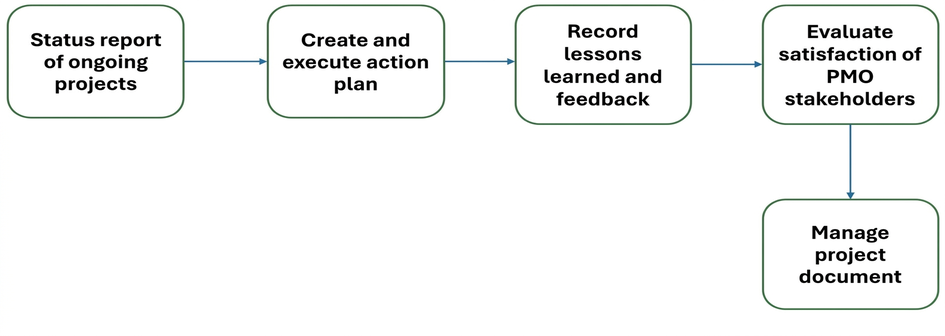
This function allows for providing project status (planned x actual), analyzing performance, implementing action plans, recording lessons learned and feedback, evaluating stakeholders, managing projects and documentation, in addition to providing performance reports to senior management to ensure established deadlines and costs (Figure 3).
Source: Prepared by the authors.
Managing the projects, providing performance reports, and coordinating documentation are important steps for the success of ongoing projects[16]. The weekly report keeps everyone involved updated, and action plans are monitored as they are important for the progress of the projects. Performance reports can be presented to senior management if necessary; however, they are of utmost importance to the maintenance manager to track progress and support necessary actions.
Implementing a PMO in maintenance with the PMO Value Ring methodology is an essential strategy to enhance project management. Aligned with organizational objectives, it promotes benefits such as cost reduction and quality improvement. The methodology, in partnership with maintenance technicians, encourages a culture of continuous improvement, stimulates the proactive identification and resolution of problems. It is expected to significantly reduce corrective notes and orders by addressing demands in a structured manner. With a focus on transparency, collaboration, and engagement, the organizational environment becomes more productive and efficient.
As the study was conducted in a single company in the fuel distribution sector, with only five participants, the results cannot be generalized to all organizations. The qualitative research did not include quantitative measurements, such as post-implementation indicators, which could confirm the described benefits, constituting a limitation of the present study.
Therefore, as suggestions for future research, longitudinal studies are recommended to evaluate the PMO’s performance after its implementation, with analysis of indicators such as reduction of corrective orders, greater equipment availability, and cost efficiency. It is suggested to expand the sample to different sectors and compare the PMO Value Ring with other methodologies, including mixed approaches that provide more robust evidence.
References
[1] Oliveira, J. C. 2013. Manutenção industrial moderna. Rio de Janeiro, RJ: Elsevier.
[2] Project Management Institute (PMI). 2023. A guide to the project management body of knowledge (PMBOK® Guide). 7ed. Newtown Square, PA: Project Management Institute.
[3] Vargas, R.V. 2016. Manual prático do plano de projeto. 4ed. Rio de Janeiro, RJ: Brasport.
[4] Moraes, E.J. 2004. Manutenção: função estratégica. São Paulo, SP: Pearson Prentice Hall.
[5] Womack, J.P.; Jones, D. T.; Roos, D. 2007. The machine that changed the world: the story of lean production Toyota’s secret weapon in the global car wars that is now revolutionizing world industry. Simon and Schuster. New York, NY: Free Press
[6] Koskela, L. 1992. Application of the new production philosophy to construction. Technical Report n. 72. Stanford: Stanford University, Center for Integrated Facility Engineering.
[7] Gil, A.C. 2019. Métodos e técnicas de pesquisa social. 7ed. São Paulo, SP: Atlas.
[8] Yin, R.K. Estudo de caso: planejamento e métodos. 5.ed. Porto Alegre: Bookman, 2015.
[9] Project Management Institute. s/d. Pmo Global Alliance (PMOGA). PMO Value Ring. Disponível em: https://pmoga.pmi.org/pmo-value-ring . Acesso em: 02 set. 2025.
[10] Liker, J.K. 2004. The Toyota way: 14 management principles from the world’s greatest manufacturer. New York: McGraw-Hill.
[11] Pinto, A. 2013. O seu PMO é o que deveria ser? Um modelo para definir quais funções um PMO deve desempenhar levando em consideração os benefícios esperados de seus clientes. Disponível em: https://www.pmi.org/learning/library/organizational-model-functions-client-benefits-5893. Acesso em: 20 ago. 2023.
[12] PMO Global Alliance (PMO GA). 2017. Artigo 1: como fazer o seu PMO sobreviver em tempos difíceis, PMO.
[13] Kerzner, H. 2018. Project management: a systems approach to planning, scheduling, and controlling. 12ed. Hoboken: John Wiley & Sons.
[14] Armstrong, M.; Taylor, S. 2016. Manual de gestão de recursos humanos estratégicos da Armstrong. 6ed. New York,NY: Kogan Page.
[15] Champy, J.; Hammer, M. 1993. Reengineering the corporation: a manifesto for business revolution. New York:,NY: HarperCollins.
[16] Heldman, K. 2014. Gerência de projetos: guia para o exame oficial do PMI. 7ed. São Paulo, SP: GEN Atlas.
COMO CITAR
Oliveira, J.; Oliveira, L.L.; Cruz, D.L. Implementação de um escritório de projetos na manutenção para aprimorar os processos de melhoria contínua. Revista E&S. 2026; 7: e2024080.
ABOUT THE AUTHORS
Jaqueline de Oliveira – Junior Project Analyst. Rua Ator Paulo Gustavo, 380, 03965-005 Cinco de Julho, São Paulo, SP, Brazil.
 Luana Lopes de Oliveira – PhD in Administration. Superior School of Advertising and Marketing. Rua Joaquim Távora, 1240, 04015-013, Vila Mariana, São Paulo, SP, Brazil.
Diogo Leite da Cruz – PhD Candidate in Administration. Sales Manager. School of Advertising and Marketing. Rua Joaquim Távora, 1240, 04015-013, Vila Mariana, São Paulo, SP, Brazil.