
School Management
September 10, 2026
Faculty Listening and Participation: Paths to Democratic Management in a Private School.
Fabíola Cristiane Costa Messias; Milena Pedroso Ruella Martins
DOI: 10.22167/2675-6528-202602213
Article derived from a Final Course Work (TCC), with content based on the student’s original work and adapted to the editorial format of the Revista E&S with the support of the ResumeAI tool, an artificial intelligence solution developed by the Pecege Institute for textual synthesis and organization.
Abstract
Teacher listening and participation are crucial elements for democratic management in educational institutions. The study analyzed teacher listening and participation as components of democratic management in a private school, considering the challenges, limits, and possibilities of this model in a context influenced by business logic. The research adopted a qualitative and quantitative approach. A questionnaire was applied to 21 teachers from a private school in São José dos Campos-SP, with closed and open questions. Documentary analysis of the Political Pedagogical Project and minutes of pedagogical meetings was also carried out to identify perceptions about participation, listening, professional valorization, and decision-making processes. The results indicated that teachers demonstrated conceptual clarity about participatory democratic management and recognized its importance for pedagogical quality and the strengthening of the profession. However, the data revealed concrete limits to its effectiveness, such as the centralization of decisions, the influence of market logic, the fragility of institutional listening channels, and the fear of exposure. It was concluded that teacher listening and participation were configured as political, cultural, and organizational challenges in the private school, requiring intentionality from management, training for democratic practices, and collective commitment between managers and teachers, reaffirming the school as a space for dialogue, collective construction, and the defense of education as a common good.
Keywords: Organizational culture; Participatory management; Market logic; Decision-making processes; Teacher appreciation.
1. Introduction
Democratic management is established as a fundamental principle of contemporary education, finding support in Brazilian educational legislation, notably in the Law of Directives and Bases of National Education (Law nº 9.394/1996). This management model transcends the mere formality of participation mechanisms, seeking to promote a comprehensive transformation in the school environment. Decision-making, in this regard, must consider the opinions of all those involved in the community, including managers, teachers, students, staff, and families. Paro (2007) emphasizes that democratic management is not restricted to an administrative aspect, but is configured as an essential political and pedagogical practice for emancipation and the collective construction of ideas and proposals.
This view is corroborated by authors such as Libâneo (2013) and Lück (2006), who conceive democratic management as a process that values active participation, shared responsibility, and mutual cooperation among members of the school community. The democratization of the school space, therefore, goes beyond the mere organization of resources and structures. It involves the creation of an environment where individuals recognize themselves as true collaborators and participants in institutional decisions and transformations. This implies that decision-making should not be exercised in an authoritarian, hierarchical, and vertical manner, but rather through dialogue, negotiation, and active listening.
Despite its importance, the implementation of democratic management represents a considerable challenge, both for public schools and private institutions. In some contexts, the concept of participation can be reduced to a simple consultation of opinions, sometimes serving to validate decisions that have already been previously established, as pointed out by Sá (2002).
In this scenario, teacher appreciation emerges as a central element for the effective implementation of democratic management. It is not possible to achieve truly democratic management without recognizing the importance of the teacher, both in the pursuit of better salaries and working conditions, and in the social and institutional recognition of their role. Nóvoa (1995; 2009; 2022) argues that educational quality is intrinsically linked to the understanding of the teacher as the main mediator of learning experiences, and that the school environment gains meaning through social participation mediated by the teachers themselves. Lima (2011; 2018) complements this by problematizing that the democratization of the school will only be real with the effective participation and appreciation of the teaching staff, under the risk of becoming an empty discourse.
Teacher appreciation, therefore, goes beyond formal professional recognition, requiring the creation of institutional and administrative conditions that promote the autonomous and reflective exercise of teaching, including listening to their experiences and demands. Weber (2015) observes that public policies often limit appreciation to salary or training indicators, neglecting dimensions such as motivation, belonging, and active participation in decisions. For democratic school management to be effective, it is fundamental that teachers are seen as subjects capable of proposing, questioning, building, analyzing, evaluating, and reconstructing the school reality.
Considering this debate, it becomes relevant to analyze the reality of private schools. Historically, discussions on democratic management have focused on public schools, driven by the legal mandate for participation in school councils, student guilds, and the collective construction of the Political Pedagogical Project. However, in the private sector, market logic and the pursuit of performance results, aiming for profit and institutional visibility, can restrict or hinder effective participation practices (Lima & Sá, 2018). In this context, management is often oriented by performance and control, to the detriment of democratic principles.
This does not mean that private schools are unable to develop democratic experiences; on the contrary, this is a fertile and still little-explored field by academic literature. The significant growth of private educational institutions in Brazil reinforces the need to investigate how democratization can be implemented in this sector. The school, even in a private context, is a public space for citizen formation, and pedagogical content, guided by documents such as the National Common Curricular Base (Brazil, 2017), constitutes a social heritage. Thus, democratization is not a luxury, but a necessity for the institution to fulfill its formative role in a plural and unequal society.
Given this scenario, the present research is justified by the need to deepen the understanding of the challenges and possibilities of democratic management in private schools, focusing on teacher listening and participation, crucial elements for the quality of pedagogical work and the strengthening of the profession. This study aimed to analyze the practices of teacher listening and participation in a private school in the municipality of São José dos Campos, seeking to understand how these processes contribute to the construction of more democratic management, to the strengthening of the educational environment, and to the improvement of student learning.
2. Material and Methods
The research adopted a descriptive and qualitative-quantitative design, structured as a case study in a private basic education school located in São José dos Campos, state of São Paulo. The choice of the case study allowed for the understanding of a contemporary phenomenon in a specific context, preserving its particularities and enabling an analytical generalization for the formulation of hypotheses and recommendations for similar contexts (Yin, 2005).
The quantitative approach was used to measure faculty perceptions of participatory democratic management through a structured questionnaire (Marconi & Lakatos, 2003). The descriptive studies, carried out by documentary analysis, aimed to characterize the phenomenon or the relationship between variables without researcher manipulation (Gil, 2010).
The research subjects were teachers from all segments of the school, actively working in the school year when the questionnaire was applied. Teachers on leave during the data collection period or substitutes with less than one month of service were excluded. Of the 73 teachers invited, 21 effectively participated. All participants signed the Free and Informed Consent Term (TCLE) before completing the instrument.
The data collection instrument was a structured questionnaire via Google Forms, composed of three parts: characterization of the teachers’ profile (gender, age, academic background, teaching subject and level, length of career at the institution, and participation in democratic councils); perceptions of participatory democratic management, using a 5-point Likert scale (1=Strongly Disagree to 5=Strongly Agree) to assess dimensions such as teacher participation in decisions, communication channels, transparency, the manager’s role, coherence of the Political Pedagogical Project, compatibility with the private context, and professional recognition; and open-ended questions about challenges and practices of democratic management. Before the official application, a small subgroup of 10 volunteers from the institution participated in a pilot study to verify the questionnaire’s comprehension and response time, the data from which were not included in the official survey.
The documentary analysis examined the Political Pedagogical Project (PPP) and minutes of the institution’s pedagogical meetings, focusing on the democratic participation of teachers and the teaching goals established for the 2025 academic year. The PPP was the standout document, considered current and revealing of reflections for the continuous improvement of work (Gil, 2010; Marconi and Lakatos, 2003; Yin, 2005).
3. Results and Discussion
The documentary analysis examined the Political Pedagogical Project (PPP) and the minutes of pedagogical meetings of the private school institution, focusing on the democratic participation of teachers and the teaching goals for the 2025 academic year. The PPP was considered a current document that reflects the intentions of continuous improvement. This study, of a documentary nature, used the PPP as the main source, according to the methodological assumptions of Gil (2010), Marconi and Lakatos (2003), and Yin (2005), which allow for the understanding of institutional conceptions and values.
The principle of democratic management, explicitly provided for in the Law of Directives and Bases of National Education (LDB nº 9.394/1996) for public education, is adopted by this private school. Its presence in the PPP reveals an institutional commitment that transcends legal requirements, aligning with a conception of education guided by participation, dialogue, and collective responsibility. Authors such as Paro (2007), Libâneo (2013), and Lück (2006) advocate for democratic management as a universal educational principle, and its incorporation into a private institution reinforces the democratic character of school organization.
The PPP goals for teachers in 2025 highlight the essence of the private school under investigation. The goals include:
1. Participate in the proposed Pedagogical Meetings.
2. Properly assist in the construction of the Individualized Educational Plan (IEP) and share with other teachers.
3. Produce differentiated activities for students according to the IEP.
4. Maintain dialogue with the pedagogical coordination regarding students with IEPs, to ensure adaptations and progress.
5. Participate in meetings with parents/guardians with the coordination, presenting an integrating and objective posture.
6. Properly comply with working hours, not being late for the start of classes.
7. Deliver all documents requested by the coordination/management, within the deadline.
8. Produce the evidence, send it to the coordination for verification and copies within the established deadline.
9. Use the provided handout material appropriately.
Goal 1, which deals with participation in pedagogical meetings, even if presented as a “compliance measure”, signals the appreciation of collective spaces for critical reflection and the construction of pedagogical work. In private schools, these spaces are even more relevant, as they indicate institutional openness to listening and teacher participation, distancing themselves from centralized management models. However, these spaces can be used solely to formalize actions already defined by management, as observed in a pedagogical meeting minutes analyzed, where the coordination merely demanded actions, with little room for discussion of new proposals. Libâneo (2013) and Lück (2006) emphasize that democratic management requires spaces for pedagogical debate and shared decisions, with conscious involvement and teacher co-responsibility.
The participation of teachers in the construction and sharing of the Individualized Educational Plan (IEP) (goal 2) and the continuous dialogue with the pedagogical coordination about students with IEPs (goal 4) demonstrate a conception of collaborative and inclusive work, aligned with the National Common Curricular Base (BRASIL, 2017). Nóvoa (1995; 2009) highlights that recognizing the teacher as a reflective intellectual strengthens their autonomy and participation. Goal 5, concerning participation in meetings with parents, expands the spaces of school democracy, recognizing the family as co-responsible for the educational process (BRASIL, 1996). Lima and Sá (2018) emphasize that democratic management in hierarchical contexts requires political intentionality and systematic dialogue.
Goals 6, 7, 8, and 9, related to administrative responsibilities such as adherence to schedules and document submission, should be interpreted in light of democratic management. Weber (2015) associates teacher appreciation with the clarity of professional responsibilities. However, Lima (2018) warns about the risk of “managerial post-democracy,” where control mechanisms intensify. In the analyzed PPP, these goals should be viewed as collective commitments, not as instruments of verticalized control.
The documentary analysis of the PPP shows that the teaching goals for 2025 are anchored in principles of democratic management, intentionally adopted by the private institution. This reaffirms democratic management as a political-pedagogical choice, aligned with legislation and the theory of authors such as Paro (2007), Libâneo (2013), Lück (2006), Lima (2011; 2018), and Nóvoa (1995; 2009). The analysis of the PPP and the minutes of pedagogical meetings does not seek conclusive answers, but reflections on the possibilities, limits, and contradictions of democratic management in private schools. The data indicate a democratic intentionality, with appreciation for collective spaces, collaborative work, and teacher participation, but raise questions about the effectiveness of these spaces as deliberative instances and the real influence of teachers in decision-making processes. The next section discusses teacher perceptions of these issues.
What do professors tell us about participation and listening
The questionnaire included the participation of 21 teachers from the private school. The characterization of the participants’ profile is fundamental to interpreting perceptions of teaching listening and participation.
Part 1: Faculty Profile
Regarding gender, the feminine is predominant, with 13 participants (61.9%), while 8 (38.1%) identified as masculine. There were no records of non-binary individuals or those who preferred not to declare their gender. This data reflects the female predominance in basic education.
Table 1. Gender of participants
| Gender | Quantity | Percentage |
|---|---|---|
| Female | 13 | 61,9% |
| Male | 8 | 38,1% |
| Non-binary person | 0 | 0% |
| I prefer not to say | 0 | 0% |
| Sum | 21 | 100% |
Source: Original research findings (2026)
The age range of the faculty indicates a more experienced professional body, with no participants under 25 years old. The majority (8 faculty members) are in the 36 to 45 age group, followed by 7 faculty members between 46 and 55 years old. According to Huberman (2000), these groups may be in phases of internal career questioning or have more tolerant attitudes. Four professors are between 26 and 35 years old, and two are over 55 years old.
Table 2. Age of participants
| Age range | Quantity | Percentage |
|---|---|---|
| up to 25 years | 0 | 0% |
| from 26 to 35 years old | 4 | 19% |
| from 36 to 45 years old | 8 | 38,1% |
| from 46 to 55 years old | 7 | 33,3% |
| over 55 years of age | 2 | 9,5% |
| Sum | 21 | 100% |
Source: Original research findings (2026)
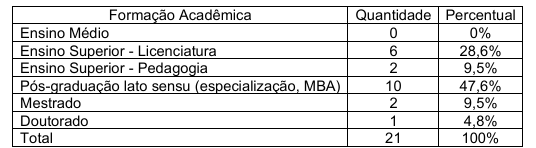
Regarding academic training, a high level of qualification is observed. The majority (10 faculty members) have postgraduate lato sensu degrees (specialization or MBA), 6 have a bachelor’s degree, 2 are graduates in Pedagogy, 2 hold a master’s degree, and 1 holds a doctorate. There were no participants with only a high school education. This qualified profile favors reflective practices and greater interest in participating in decision-making processes and institutional listening spaces.
Chart 3: Academic background
Source: Original research findings (2026)
Nineteen professors participated in the research regarding the curricular component, representing diverse areas of knowledge, including Languages, Mathematics, Natural Sciences, Human Sciences, Art, Robotics, and Polivalence. There are also specialist teachers who teach in more than one component or in integrated areas, such as Physics and Mathematics, and History associated with Project of Life, Philosophy and Sociology, and Robotics integrated with Mathematics. This diversity contributes to a broad view of school management and teacher participation.
Table 3. Curricular component taught
| Curricular Component | Quantity | Percentage |
|---|---|---|
| Art | 2 | 10,5% |
| Physics and Mathematics | 1 | 5,3% |
| Geography/History | 1 | 5,3% |
| Languages and Codes | 1 | 5,3% |
| Portuguese Language | 1 | 5,3% |
| Mathematics | 1 | 5,3% |
| Versatile | 1 | 5,3% |
| Versatile Professor | 1 | 5,3% |
| Chemistry | 1 | 5,3% |
Source: Original research findings (2026)
Regarding the level of education, 9 teachers teach in Middle School (grades 6-8), 6 in Elementary School (grades 1-5), and 6 in High School. There were no preschool teachers. This balanced distribution allows for an understanding of school management from multiple perspectives, considering the specificities of each stage.
Table 4. Teaching level of the professors
| Education Level | Quantity | Percentage |
|---|---|---|
| Early Childhood Education | 0 | 0% |
| Elementary I | 6 | 28,6% |
| Upper Secondary Education | 9 | 42,9% |
| High School | 6 | 28,6% |
| Sum | 21 | 100% |
Source: Original research findings (2026)
The analysis of teaching career time at the institution shows an almost balanced distribution: 5 professors have been working for up to 2 years, 5 between 3 and 5 years, 5 between 6 and 10 years, and 6 for more than 10 years. This data reveals the presence of professionals with different institutional tenure times, enriching the research with diverse perceptions.
The profile of the participants indicates an experienced, academically qualified faculty active in various areas. These characteristics strengthen the relevance of the data for critical analysis on democratic participation and management. However, Huberman (2000) suggests that many of these professionals may be less interested in investing in their careers, adopting more conformist stances.
Regarding participation in democratic collegiate bodies, such as the School Council, the data reveal diverse experiences. Six teachers stated they currently participate, 4 have participated in the past, and 11 have never participated in democratized actions in school institutions.
Table 5. Participation in democratic collegiate bodies
| Participation in collegiate bodies | Quantity | Percentage |
|---|---|---|
| Yes, I currently participate | 6 | 28,6% |
| I have participated before | 4 | 19% |
| I have never participated | 11 | 52,4% |
| Sum | 21 | 100% |
Source: Original research findings (2026)
This data indicates that, although part of the faculty has experienced formal participation practices, a significant number has not had access to or does not recognize the democratic process. This reinforces the need to deepen faculty listening and create strategies to broaden participation, transforming collegiate bodies into effective spaces for dialogue and co-responsibility in democratic school management.
Part 2: Perceptions of democratic participation
Questions 8, 9, and 10, which address the priority of teachers’ active participation in decisions, listening to demands as an essential factor for management quality, and fostering a collaborative environment through democratic management, revealed an almost total agreement among teachers. Nineteen teachers gave the maximum score (5) and the other 2 gave a score of 4, with no disagreement. This reinforces the understanding that active participation, listening, and collaboration are necessary for the quality of school management, aligning with Paro (2007).
The answers to questions 11 and 18, which address the importance of teachers’ participation and opinion in school decisions and their contribution to a collaborative environment, to student learning, and to the coherence of the pedagogical project, also showed high levels of agreement. In question 11, 95% of teachers fully agreed that teacher participation influences student learning.
Table 6. Faculty participation and student learning (question 11)
| Level of agreement | Quantity | Percentage |
|---|---|---|
| 1 (I totally disagree) | 0 | 0% |
| 2 | 0 | 0% |
| 3 | 0 | 0% |
| 4 | 1 | 5% |
| 5 (Strongly agree) | 19 | 95% |
| Sum | 21 | 100% |
Source: Original research findings (2026)
In question 18, 20 out of 21 professors gave the maximum grade (5), reaffirming that collective decisions contribute to a more coherent pedagogical project. These results converge with the National Common Curricular Base (BRASIL, 2017) and with Libâneo (2013), who see school management as an articulator between educational objectives and collective action.
Table 7. Collective decisions and coherent design (question 18)
| Level of agreement | Quantity | Percentage |
|---|---|---|
| 1 (I totally disagree) | 0 | 0% |
| 2 | 0 | 0% |
| 3 | 0 | 0% |
| 4 | 1 | 4,8% |
| 5 (Strongly agree) | 20 | 95,2% |
| Sum | 21 | 100% |
Source: Original research findings (2026)
Questions 12, 13, and 14, which investigate whether the school promotes formal channels of dialogue, whether teaching staff opinions are considered, and whether there is transparency in communication, allowed for a more critical analysis of the institutional reality. There was greater dispersion in the responses, with records of intermediate evaluations (score 3) and disagreement (scores 1 and 2), although the majority assigned scores of 4 and 5. This indicates that, despite recognizing the importance of listening and participation, these actions are not always realized in practice. This tension between discourse and practice is discussed by Lima (2011, 2018), who problematizes the limits of democratic management in centralized contexts.
Table 8. Dialogue channels between managers and teachers (question 12)
| Level of agreement | Quantity | Percentage |
|---|---|---|
| 1 (I totally disagree) | 2 | 9,5% |
| 2 | 2 | 9,5% |
| 3 | 5 | 23,8% |
| 4 | 5 | 23,8% |
| 5 (Strongly agree) | 7 | 33,3% |
Source: Original research findings (2026)
Table 9. Professors’ opinion in decisions (question 13)
| Level of agreement | Quantity | Percentage |
|---|---|---|
| 1 (I totally disagree) | 3 | 14,3% |
| 2 | 2 | 9,5% |
| 3 | 5 | 23,8% |
| 4 | 6 | 28,6% |
| 5 (Strongly agree) | 5 | 23,8% |
Source: Original research findings (2026)
Table 10. Transparency in communication (question 14)
| Level of agreement | Quantity | Percentage |
|---|---|---|
| 1 (I totally disagree) | 1 | 4,8% |
| 2 | 1 | 4,8% |
| 3 | 3 | 14,3% |
| 4 | 8 | 38,1% |
| 5 (Strongly agree) | 8 | 38,1% |
Source: Original research findings (2026)
Regarding question 15, on professional development and faculty participation, 12 professors gave a grade of 5, 8 were distributed between grades 3 and 4, and only 1 registered a grade of 2. This suggests that the majority perceive participation as a factor in professional development, although this perception is not homogeneous. Weber (2015) highlights that faculty development goes beyond salary, including recognition and autonomy. The grade of 2, indicating disbelief in the relationship between development and participation, can be understood through Lima’s (2011) reflections on the reduction of democratic management to formal mechanisms, generating frustration. Paro (2007) reinforces that faculty development is linked to effective participation in decision-making processes.
Table 11. Professional valorization and school management (question 15)
| Level of agreement | Quantity | Percentage |
|---|---|---|
| 1 (I totally disagree) | 0 | 0% |
| 2 | 1 | 4,8% |
| 3 | 3 | 14,3% |
| 4 | 5 | 23,8% |
| 5 (Strongly agree) | 12 | 57,1% |
Source: Original research findings (2026)
Question 16 reinforces the importance of teacher participation, with 18 professors fully agreeing that democratic management strengthens motivation and engagement. This understanding aligns with Nóvoa (1995, 2009), who advocates for the centrality of the teacher as an active subject and professional engagement as a result of contexts that favor participation and dialogue.
Table 12. Democratic management and teacher motivation (question 16)
| Level of agreement | Quantity | Percentage |
|---|---|---|
| 1 (I totally disagree) | 0 | 0% |
| 2 | 0 | 4,8% |
| 3 | 0 | 14,3% |
| 4 | 3 | 14,3% |
| 5 (Strongly agree) | 18 | 85,7% |
Source: Original research findings (2026)
Regarding the school manager’s role as mediator and facilitator (question 17), 19 teachers gave a score of 5, revealing strong adherence to this conception of democratic leadership. This vision is in line with Lück (2006), who sees educational management as a practice of building collective meanings. However, excessive centrality attributed to the manager can become an empty criticism, transferring the responsibility for democratization solely to them, disregarding the active role of other institutional subjects. Lück (2006) points out that democratic management depends on the involvement and co-responsibility of all. Paro (2007) and Nóvoa (2009) reinforce that participation is an active exercise of intervention, and passivity compromises the collective construction of democracy.
Questions 19 and 20 address the compatibility of democratic management with private schools and teachers’ perceptions of the practices adopted in the institution. In question 19, 15 teachers assigned scores of 4 or 5, indicating that the majority consider democratic management possible in private schools, although a minority group expresses doubts.
Table 13. School management in private schools (question 19)
| Level of agreement | Quantity | Percentage |
|---|---|---|
| 1 (I totally disagree) | 1 | 5% |
| 2 | 2 | 10% |
| 3 | 2 | 10% |
| 4 | 7 | 35% |
| 5 (Strongly agree) | 8 | 40% |
Source: Original research findings (2026)
This data is significant, as it breaks with the idea that democratic management is restricted to public education, broadening the understanding of this principle as a possible political-pedagogical choice in the private sector. However, the presence of doubts can be explained by Lima’s (2018) reflections, who points out structural, organizational, and economic conditioning factors that influence the perception of democracy. Paro (2007) and Libâneo (2013) highlight that democratic management requires autonomy and real power-sharing, and the absence of consistent participatory practices reinforces centralizing models.
When analyzing question 20, which assesses whether the school has practices close to a participatory democratic management, a more heterogeneous distribution is observed. Thirteen teachers assigned scores of 4 or 5, indicating a positive perception, but 8 assigned scores between 1 and 3, revealing weaknesses. This reinforces that democratic management requires systematic actions and effective channels for listening and participation, according to Lima and Sá (2018) and Sá (2002).
Table 14. Democratic management where I work (question 20)
| Level of agreement | Quantity | Percentage |
|---|---|---|
| 1 (I totally disagree) | 5 | 23,8% |
| 2 | 1 | 4,8% |
| 3 | 2 | 9,5% |
| 4 | 8 | 38,1% |
| 5 (Strongly agree) | 5 | 23,8% |
Source: Original research findings (2026)
The analysis of teaching perceptions shows a strong conceptual alignment on the importance of listening and participation in democratic management, but also reveals concrete challenges in consolidating these principles in daily school life. This reaffirms the relevance of the study by indicating that teacher listening and participation are political, cultural, and organizational challenges that demand intentionality, training, and collective commitment.
Part 3: Open questions
The analysis of open-ended questions deepened the understanding of quantitative data, revealing lived perceptions, tensions, and contradictions. Gil (2010) and Marconi and Lakatos (2003) highlight the relevance of open-ended questions for capturing complex meanings and experiences.
The answers to question 21, regarding the greatest challenges for democratic management in private schools, indicate that teachers recognize democratic management as an ideal, but identify structural, cultural, and organizational obstacles. One of the most recurring challenges is the centralization of decisions, often associated with the figure of the owner. Teachers point out that, even with formal listening spaces, final decisions remain concentrated in management, configuring a participation that is more consultative than deliberative. This perception dialogues with Lima (2011) on “managerial post-democracy”, where participation is symbolic.
Another axis present in the responses is business logic and the pressure for financial results, characteristic of private schools. Teachers report conflicts between pedagogical demands and administrative interests, such as cost reduction, increasing student numbers, and prioritizing customer (parent) satisfaction. This tension between educational and market logic is widely discussed by Paro (2007) and Libâneo (2013), who warn about the risks of subordinating the pedagogical project to economic criteria. The school, at times, bases its work on “client” demands, organizing events for marketing and attracting new students, which distorts pedagogical work. Lima (2011), Paro (2007), and Libâneo (2013) analyze how managerial and performative logics compromise the quality of formative processes and empty the educational meaning of collective actions.
The responses also highlight a hierarchical and vertical organizational culture, where “those above command and those below execute,” limiting dialogue and collective construction. This structure generates fear of retaliation and professional insecurity, leading professors to avoid critical stances. This scenario reinforces the analyses by Lima (2018) and Lima and Sá (2018) on the infeasibility of authentic participation in emptied formal spaces. Furthermore, challenges such as lack of time, resistance to change, and difficulty in understanding democratic management as a continuous process also emerge. Lück (2006) emphasizes that democratic management requires intentionality, training, and continuity.
The answers to question 22, on how teachers could be more valued, reveal a broad and multifaceted understanding of teacher appreciation, which goes beyond salary. The most recurring element is the need for qualified listening and effective participation in pedagogical and institutional decisions. Teachers wish to be recognized as protagonists of the educational process, aligning themselves with Nóvoa (1995, 2009), who advocates for the teacher as an intellectual of education.
Another highlighted aspect is the importance of constant, transparent, and assertive dialogue between management and faculty. Professors emphasize the need for continuous communication with constructive feedback and clarity about the limits of participation. Libâneo (2013) and Lück (2006) view communication as a structuring axis of democratic management. The understanding that not all suggestions can be incorporated requires professional maturity and an understanding of the complexity of educational management. Lück (2006) and Libâneo (2013) affirm that democratic management is not the sum of individual wills, but the construction of decisions guided by pedagogical and collective principles, with limits and responsibilities. Paro (2007) complements that educational management seeks decisions that favor the common good, even if they generate individual tensions.
The comments also highlight that teacher appreciation is related to concrete working conditions, such as access to pedagogical resources, technology, infrastructure, and respect for labor rights. Simple elements, like adequate spaces, are indicators of institutional recognition. Weber (2015) states that teacher appreciation involves objective and subjective conditions that impact engagement and work quality. Nóvoa (2009) emphasizes that committed professionals understand the limits of the school context, assuming a reflective and responsible stance. Libâneo (2013) and Lück (2006) complement that quality teaching performance presupposes collective engagement and understanding of the pedagogical project, avoiding demands that exceed the school’s structural conditions. Professional autonomy, with the freedom to innovate without fear of punishment, is also a relevant point. There is dissatisfaction when the school adopts a stance of “always siding with the client,” disregarding pedagogical work, which reinforces the need to balance family expectations with the teacher’s pedagogical authority (Paro, 2007; Sá, 2002).
The responses to question 23, regarding experienced democratic management practices, reveal that although some teachers struggle to identify such practices, concrete examples are mentioned, such as class council meetings, school council, collective pedagogical decision-making processes, and listening spaces with real feedback. Reports of proposals debated collectively and defined by the majority stand out, evidencing isolated experiences of deliberative participation. On the other hand, the number of teachers who have never participated or do not know how to identify democratic practices reinforces that these experiences are not fully institutionalized or recognized as part of school culture. Lima (2011) highlights that the absence of consistent democratic practices tends to naturalize centralized models.
In general, the analysis of open-ended questions shows that teachers have conceptual clarity about participatory democratic management and recognize its importance, but the reports reveal concrete limits to its effective implementation in private schools, especially related to business logic, centralization of decisions, and fragility of listening channels. These findings reinforce the relevance of the research by indicating that teacher listening and participation are political, cultural, and organizational challenges that require intentionality, training, and collective commitment for their consolidation. The implementation of democratic management is not restricted to the manager’s actions, but presupposes the co-responsibility of teachers as active subjects, with an ethical, proactive, and responsible stance. Paro (2007) and Lück (2006) emphasize that democratic management is not confused with the satisfaction of individual interests, but with collective decisions oriented towards the common good, accepting that not all demands can be met. Nóvoa (2009) complements that the teaching profession is strengthened when teachers understand the school environment as a territory of democratic coexistence, where mutual respect and commitment to the common educational project override individual demands. Thus, democratic management is consolidated by opening spaces for participation, by the ethical quality of relationships, and by the understanding that deciding democratically implies accepting choices that do not always contemplate all those involved.
This research analyzed teacher listening and participation as elements for democratic management in a private school, using the Political Pedagogical Project (PPP) and teachers’ perceptions. Documentary analysis of the PPP indicated that the school adopts principles of democratic management in its goals for 2025, valuing pedagogical meetings, participation in the construction of the Individualized Educational Plan (IEP), dialogue with coordination and families, and clear definition of professional responsibilities. This demonstrates an institutional intentionality for collaborative practices.
The questionnaire results, however, revealed that although teachers demonstrate conceptual alignment with the importance of participation and listening for pedagogical quality and teacher appreciation, the implementation of these principles in daily school life faces limitations and tensions. A gap was observed between democratic discourse and management practices, with challenges such as decision centralization, the influence of business logic, and the fragility of institutional participation channels. The hierarchical and vertical organizational culture, common in private schools, generates insecurity and limits critical participation, transforming listening spaces into mere consultative environments. Teacher appreciation, according to the teachers, involves qualified listening, effective participation in decisions, transparent dialogue, and adequate working conditions, in addition to professional autonomy. Democratic management, especially in private schools, is a process under construction that requires intentionality from management, investment in professional training, strengthening of collegial spaces, and development of practices that effectively promote listening, dialogue, and participation. Teacher listening and participation are structuring elements of a school culture committed to the integral quality of education, demanding time, institutional maturity, and collective commitment, with the teacher as an active protagonist of the educational process.
4. Conclusion
This study analyzed the teaching listening and participation practices in a private school in São José dos Campos, seeking to understand how these processes contribute to more democratic management, the strengthening of the educational environment, and the improvement of student learning. Through documentary analysis of the Political Pedagogical Project, it was verified that the institution adopts democratic management principles in its goals for 2025, valuing collective reflection spaces, collaboration in the construction of the Individualized Educational Plan, and dialogue with coordination and families. This institutional intentionality for collaborative practices was identified, signaling a commitment that transcends legal requirements. However, teachers’ perceptions, collected via questionnaire, revealed that although there was conceptual clarity about the importance of participation and listening for pedagogical quality and professional valorization, the concretization of these principles in daily school life faced limits and tensions. A gap was observed between the democratic discourse and management practices, with formal channels for dialogue, consideration of opinions, and transparency in communication not always being fully realized.
The findings indicated concrete challenges to the implementation of democratic management, such as the centralization of decisions, often associated with the figure of the maintainer, and the influence of business logic, which sometimes subordinates pedagogical demands to market interests. The hierarchical and vertical organizational culture, perceived by teachers, generated insecurity and limited critical participation, transforming spaces for listening into consultative environments. Teacher appreciation, as expressed by the professors, involved the need for qualified listening, effective participation in pedagogical and institutional decisions, transparent dialogue, and adequate working conditions, in addition to professional autonomy. It was concluded that teacher listening and participation are configured as political, cultural, and organizational challenges in private schools, requiring intentionality from management, training for democratic practices, and collective commitment between managers and teachers. The research contributes to broadening reflections on democratic management in private schools, encouraging new investigations and institutional practices that strengthen teacher participation and promote more collaborative and reflective educational environments, recognizing democratic management as a process under construction that demands time and institutional maturity.
Bibliographic References
BRASIL, 1996. Lei nº 9.394, de 20 de dezembro de 1996. Lei Federal nº° 9.394, de 20/12/1996 – Estabelece as diretrizes e bases da educação nacional. Disponível em: https://www.planalto.gov.br/ccivil_03/leis/l9394.htm . Acesso em 18/07/2023.
BRASIL, 2017. Ministério da Educação. Secretaria de Educação Básica. Base Nacional Comum Curricular. Brasília/DF: MEC, SEB, 2017.
GIL, A. C. (2010). Métodos e técnicas de pesquisa social (6. ed.). São Paulo: Atlas, 2010.
HUBERMAN, M. O ciclo de vida profissional dos professores. In: NÓVOA, A. (org.). Vidas de professores. 2. ed. Porto: Porto, 2000. p. 31-62.
LIBÂNEO, J. C. Organização e gestão da escola: teoria e prática. São Paulo: Heccus, 2013.
LIMA, L. C. A gestão democrática das escolas: do autogoverno à “pós-democracia gestionária”. Educação & Sociedade, Campinas, v. 32, n. 116, 2011.
LIMA, L. C. Por que é tão difícil democratizar a gestão da escola pública? Educar em Revista, Curitiba, n. 70, p. 19-34, 2018.
LIMA, L. C.; SÁ, V. O governo das escolas: democracia, controlo e performatividade. Braga: CIED, 2018.
LÜCK, H. Gestão educacional: uma questão paradigmática. Petrópolis: Vozes, 2006.
MARCONI, M. de A.; LAKATOS, E. M. Fundamentos de metodologia científica (5. ed.). São Paulo: Atlas, 2003.
NÓVOA, A. Os professores e a sua formação. Lisboa: Dom Quixote, 1995.
NÓVOA, A. Profissão professor. Porto: Porto Editora, 2009.
PARO, V. H. Gestão democrática da escola pública. São Paulo: Ática, 2007.
SÁ, V. A escola e os actores: políticas e práticas. Porto: Tipografia Nunes Lda, 2002.
WEBER, S. O Plano Nacional de Educação e a valorização docente. Campinas: CEDES, 2015.
YIN, R. K. Estudo de caso: planejamento e métodos. Porto Alegre: Bookman, 2005.
Article originating from the Final Course Work of the Specialization in School Management of the MBA USP/Esalq
To learn more about the course, click here and access the MBX Academy platform