
Article
October 30, 2025
Internal controls and contract formalization in banking institutions
Authors: Camila Ferreira dos Santos and Leila Chaves Cunha
DOI: 10.22167/2675-6528-2025039
E&S 2025, 6: e2025039
The area of internal controls represents the set of procedures, methods, and routines of companies and constitutes a crucial aspect for ensuring the integrity and effectiveness of processes. The implementation of preventive measures, such as segregation of duties, definition of clear policies, and regular audits, contributes to minimizing the risk of errors and fraud. Furthermore, the use of monitoring systems, advanced technologies, and data analysis allows for the identification of irregularities quickly and accurately. With a proactive approach, organizations can strengthen their internal controls, protect their assets, and promote transparency and compliance[1].
With the changes in corporate structures and transformations in information technology, new demands and risks are expected to emerge. The risks are related to possible threats or exposures that can affect control processes within an organization[2].
The decisions made by the manager present corporate and operational risks that can compromise the organization’s results. Among the risk categories, contractual risk stands out, characterized by the possibility of losses related to inadequate formalization, interpretation of clauses, and non-compliance with legislation[3].
Among the organizations where contracts hold greater relevance are financial institutions. According to CMN Resolution No. 4.968/2021[4], these institutions must implement and maintain internal control systems compatible with their nature, size, complexity, structure, risk profile, and business model. Among financial institutions, banks are companies that, with their own or third-party funds, have credit trading as their main activity, in addition to carrying out accessory activities aimed at attracting clients[5].
According to Aquino[6], the contract is a legal mechanism for interpersonal relationships that contains the parties’ declarations of intent. It is a binding agreement based on two or more opposing, yet harmonized, declarations of will, with the aim of establishing a unique regulation of interests.
According to Antunes[7], contracts represent the main instrument for the creation and regulation of legal relationships linked to business activity. For Tomazette[8], in the banking context, although other theories exist, a banking contract is one that has a financial institution as a party and has credit intermediation as its object.
Myroslavskyi[9] conducted a study with the objective of determining the role of artificial intelligence (AI) in the contract standardization process and analyzing its impact on the optimization of internal business processes. The results indicate the need for team training to ensure data quality. The importance of contract standardization for optimizing legal processes, reducing risks, facilitating document review, and ensuring compliance with legal requirements is highlighted.
In this context, the objective of this study is to identify the perception of financial institution professionals regarding the contract formalization process. The work is justified by the need for research in the area, since analyses of contracts generally focus on the legal sphere, deal with issues related to validity, and rarely discuss aspects related to drafting[10]. In the practical field, the results may assist financial professionals and institutions, with perceptions that contribute to improving the efficiency and effectiveness of processes.
This is a descriptive research, of the survey and data analysis type. According to Gil[11], this type of study seeks to describe the characteristics of a given population. Regarding the nature of the data, the research is quantitative. According to Martins and Theóphilo[12], in this approach, variables are measured to understand the investigated phenomenon.
The data collection instrument is a questionnaire with closed multiple-choice questions. In the block dealing with perceptions of the contract formalization experience, a five-level Likert-type scale is used, which, according to Alvarez-Esteban and Vázquez-Burguete[13], constitutes an interval scale, assumes equal distance between all response categories, and allows obtaining each individual’s score.
The questionnaire was developed with questions directed at the professionals responsible for contract formalization. Contact with the respondents occurred through the LinkedIn tool; banking organizations were also contacted and asked to forward the questionnaire to the formalization department, so that professionals in the area could contribute to the research. Due to this, it was not possible to identify the research population, and the sample consisted of 38 respondents. The data collection period occurred between June and July 2024.
Regarding the profile of the research participants, it is observed that the age group with the highest number of respondents is 26 to 35 years old (50%), and the lowest corresponds to the age group of 46 to 55 years or over 55 (2.6% and 5.3%, respectively). The majority have higher education (65.8%), followed by specialization (31.6%).
Regarding the position held, the results show that 55.3% of participants are analysts, 13.2% are assistants, and 2.6% are auxiliaries. In relation to the time of service at the company, 36.8% of professionals have up to three years of experience, followed by 28.9% with three to five years. It is also observed that 23.7% of respondents have been working for more than five years, and the smallest percentage corresponds to those with up to one year of service (10.5%).
Internal departmental processes and routine
Table 1 presents the answers regarding internal processes: distribution method of demands; receipt of demands; generation of contracts; and, most used drafts.
Table 1. Internal processes – part 1
| Distribution form of demands | A | In percentage (%) |
| Through screening, one member directs the others | 16 | 42,1 |
| Independent performance, each member consults the pipeline and formalizes according to priority | 17 | 44,7 |
| Other | 5 | 13,2 |
| Sum | 38 | 100 |
| Demand reception by system | A | In percentage (%) |
| Totally. All procedures are through the system | 11 | 28,9 |
| Partially. One part is done by system, the other part is not | 23 | 60,5 |
| No system is used | 4 | 10,5 |
| Sum | 38 | 100 |
| Contract generation by system | A | In percentage (%) |
| Totally. All procedures are through the system | 7 | 18,4 |
| Partially. One part is done by system, the other part is not | 19 | 50,0 |
| No system is used | 12 | 31,6 |
| Sum | 38 | 100 |
| Most used draft by the department | A | In percentage (%) |
| Standard | 32 | 84,2 |
| Specific | 3 | 7,9 |
| Specific replicable | 3 | 7,9 |
| Sum | 38 | 100 |
Independent performance, in which each member consults the queue and formalizes according to priority, is more frequent, with 44.7% of responses. Distribution by triage is also a common practice, with 42.1%. Other forms of distribution, classified as “other”, are less common, with 13.2%.
Regarding the receipt of demands, the majority of professionals (60.5%) indicated that part of the demands is received through a system, while 28.9% reported receiving them entirely through systems. It is observed that 10.5% do not yet adopt systems for processing demands.
Regarding contract generation, 50% of participants indicated partial use, with unsystematized systems and methods. Despite the significant adoption of systems, many institutions still rely on manual processes for both contract generation and demand reception. Only 18.4% of contracts are generated exclusively by systems, revealing that institutions have digitized only a limited part of their operations. A considerable proportion (31.6%) uses no system for contract generation.
The results converge with those found by Cunha and Silveira[5], pointing out that the researched organization uses a hybrid model in the use of AI and that the adoption of new technologies can reduce costs. Camargo, Souza and Silva[14] highlight the need for adequate security measures, regulatory compliance, and education to ensure that digital contracts and signatures are used effectively and reliably.
Regarding the most used template, the results indicate that 84.2% adopt the standard template. Replicable specific templates correspond to 7.9% each. This indicates that, although there is room for customized templates to meet particular needs, most operations benefit from standardized documents. In this context, AI can use predefined templates, which include essential clauses, regulatory aspects, information security measures, and risk management. Its continuous learning process limits the scope of the particularities of each contract, but generates gains by producing documents quickly and identifying flaws[15].
Table 2 presents the respondents’ perception of the slowness in the processes.
Table 2. Internal processes – part 2
| Factors that cause delays in the process and delivery | A | In percentage (%) |
| The demand screening/routing stage | 5 | 13,2 |
| Interpretation of demands, due to diverse research sources, attachments, and the like | 9 | 23,7 |
| Contract filling (choice of clauses, product specificities and possible adjustments) | 9 | 23,7 |
| All of the above | 13 | 34,2 |
| Other | 2 | 5,3 |
| Sum | 38 | 100 |
| Delivery time for structured operations | A | In percentage (%) |
| 1h | 11 | 28,9 |
| 1 hour 30 minutes | 8 | 21,1 |
| 2h | 10 | 26,3 |
| 2h 30min | 9 | 23,7 |
| Sum | 38 | 100 |
Regarding the delay in delivery, the stages of demand interpretation and contract filling represent the steps that cause the most delays (23.77% each). The stage of demand screening and routing (13.2%) is relevant, but less critical.
Most participants (34.2%) indicated that all the mentioned stages (screening and referral, interpretation of demands, and contract completion) contribute to the slowness in the process and delivery. This demonstrates that slowness is a diversified problem, not attributable to a single stage. According to Anthony and Govindarajan[16], organizations need a control structure for planning, coordination of activities, information communication, and performance evaluation of people and processes.
Regarding structured operations, defined as those composed of five or more contracts, according to the required guarantees, the results indicate that the most frequent delivery time is one hour, with 28.9% of the responses. The delivery time of two hours was indicated by 26.3% and up to 2h30min by 23.7% of the responses. This variation suggests that the delivery time of structured operations may differ according to the number of contracts.
Perceptions with the formalization of contracts experience
This part of the questionnaire was applied on a five-point Likert scale, where one indicates not contributing at all and five indicates contributing a lot. The results are presented in absolute (A) and relative (%) values.
Table 3. Perceptions of the contract formalization experience
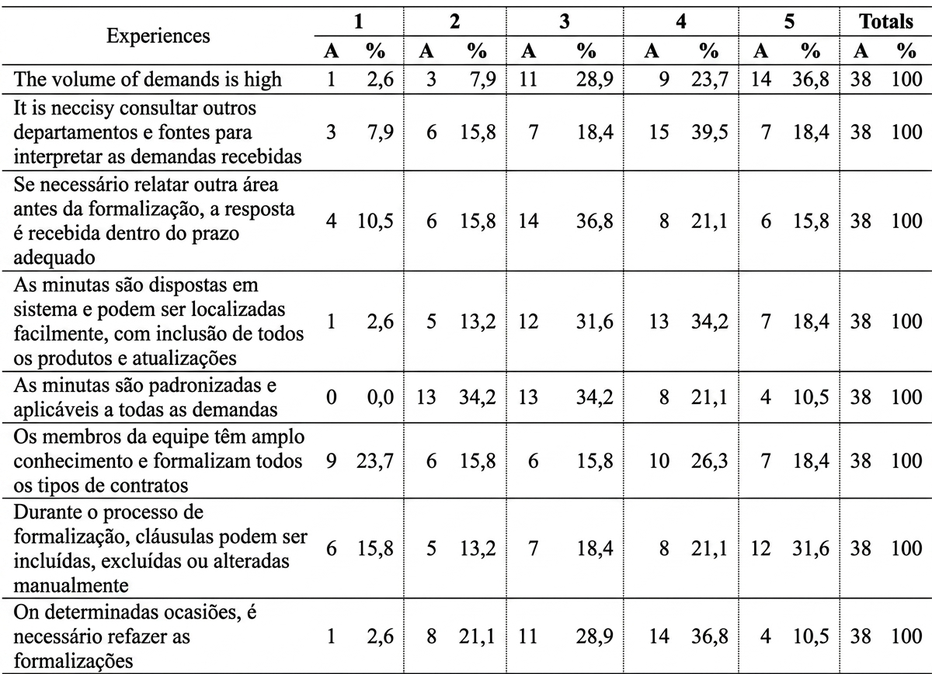
The results reveal that the volume of demands is high, as levels four and five represent 23.7% and 36.8% of the responses, respectively, while only 10.5% of participants indicated levels one and two. Regarding the need to consult other departments or sources to interpret the demands received, 57.9% of respondents agreed with the statement (level four: 39.5%; level five: 18.4%), and 23.7% indicated levels one and two. This data indicates that the majority of participants consider interdepartmental collaboration necessary to understand the requests received.
Regarding the perception of the adequate deadline when it is necessary to report another area before formalization, 21.1% of respondents indicated level four and 15.8% level five. Furthermore, 26.3% pointed to levels one and two (10.5% and 15.8% respectively). These results show that more than 25% of participants perceive that responses from other areas do not arrive within the expected timeframe, which demonstrates the need for improvements to increase efficiency.
Regarding the availability of the minutes in the system and the ease of location, the highest levels evidenced were four and five, with 52.6% and 15.8%, while levels one and two indicate difficulties. These results show the need for adjustments in the system or in the organization of the minutes, in order to ensure that all users have easy access.
For the assertion that the minutes are standardized, the results focus on levels four and five, with 31.6%. However, 34.2% indicated level two, which shows that, although the most used minute is the standard one, according to Table 1, manual changes may still be necessary depending on the product or particularity. According to Aguiar Júnior[17], the adoption of a standard contract for various types of business, which do not differ significantly between establishments, occurs due to compliance with governmental instructions and regulations, as well as the specific conditions of the financial market.
Regarding the team’s knowledge and contract formalization, 44.7% of respondents were in levels four and five, and 39.5% in levels one and two, which demonstrates possible gaps that demand greater attention, despite 89.5% having more than one year of experience. Based on this knowledge, the main challenge related to the adoption of new technologies is the impact on the labor market. The trend is that, over time, job displacement will be accompanied by professional requalification initiatives, which allows for new opportunities[15]. The statement that, during the formalization process, clauses can be included, excluded, or manually altered, was most evident at level five, with 31.6% of respondents, followed by level four, with 21.1%. Therefore, the predominant perception is that contracts need adjustments.
In the aspect that, in certain situations, it is necessary to redo formalizations, 47.4% of respondents were in options four and five, and 23.7% in options one and two, which indicates that the majority recognize the need to redo formalizations in certain situations, revealing quality issues in current processes. In financial institutions, requests for reissuance by the client due to changes in the operation must be considered.
The evaluation of the research results highlights the relevance of process standardization in the organizational environment. According to Kipper et al.[18], the organization of tasks into processes allows for the pre-establishment of expected results, which leads to more agile and reliable execution.
The present work aimed to identify the perception of banking institution professionals regarding the contract formalization process in Brazil. The results indicate that part of the demands is not received by the system, which requires resorting to other departments or sources for interpretation, causing delays in the screening stage.
It was observed that, due to the predominance of manual formalization and the absence of a systemic link for information used in the completion, the estimated time for formalization can exceed two hours. It was found that not all team members have full knowledge of all products, despite 89.5% of respondents having more than one year of experience. This gap contributes to the slowness in deliveries, especially since the majority of participants report a high volume of demands.
It should be noted that this research has limitations, such as the number of respondents, which, due to it being a specific function within institutions, did not allow for an expanded sample. Therefore, it is recommended to conduct new research in other institutions to evaluate the contract formalization process. Furthermore, it is suggested to investigate the use of more modern management systems, the creation of smart contracts, the application of AI, and the automation of repetitive processes.
REFERENCES
[1] Pizo. F. 2023. Mapeamento de Controles Internos Sox. São Paulo, SP: Atlas.
[2] Copello, F. 2020. Controles Internos – Uma Visão Prática: Um guia objetivo para descomplicar a gestão de riscos. Porto Alegre, RS: Pro Innovation.
[3] Assi, M. 2021. Gestão de riscos com controles internos: ferramentas, certificações e métodos para garantir a eficiência dos negócios. São Paulo, SP: Saint Paul.
[4] Brasil. 2021. Resolução CMN nº 4.968, de 25 de novembro de 2021. Dispõe sobre os sistemas de controles internos das instituições financeiras e demais instituições autorizadas a funcionar pelo Banco Central do Brasil. Disponível em: https://www.bcb.gov.br/estabilidadefinanceira/exibenormativo?tipo=Resolu%C3%A7%C3%A3o%20CMN&numero=4968. Acesso em: 24 jul. 2025.
[5] Abrão, N. 2005. Direito Bancário. São Paulo, SP: Saraiva.
[6] Aquino, L.G. 2021. Teoria Geral dos contratos. Belo Horizonte, MG: Expert.
[7] Antunes, J.E. 2023. Direito dos contratos comerciais. Rio de Janeiro, RJ: Leya.
[8] Tomazette, M. 2025. Contratos Empresariais. Guarulhos/SP: Juspadvin.
[9] Myroslavskyi, S. 2025. The role of AI in standardizating contracts and its impact on business process optimization. Legal Horizons, 25(2), 47-62.
[10] Cunha, C., Silveira, H. 2020. Inteligência artificial na formalização de contratos – análise do impacto em uma instituição financeira brasileira de médio porte. Revista Gestão & Tecnologia, 20(2): 231–254.
[11] Gil, A.C. 2022. Como elaborar projetos de pesquisa. São Paulo, SP: Atlas.
[12] Martins, G.A.; Theóphilo, C.R. 2009. Metodologia da investigação científica para ciências sociais aplicadas. São Paulo, SP: Atlas.
[13] Alvarez-Esteban, R.; Vázquez-Burguete, J. L. 2024. Consideraciones sobre la naturaleza de la escala de Likert a través de diferentes estructuraciones de los datos Una aplicación para identificar estilos de aprendizaje en un entorno universitario. Revista Internacional de Sociologia, 82(3): 1-14.
[14] Camargo, A.P.L.; Souza, F.S.; Silva, J. J. 2024. Revista Multidisciplinar do Nordeste Mineiro, 12: 1-15.
[15] Dias, S.P.F. 2022. Inteligência artificial na formalização de contratos de seguro: ótica dos consumidores. Dissertação de mestrado. Instituto Superior de Contabilidade e administração. Coimbra. Portugal.
[16] Anthony, R.N.; Govindarajan, V. 2006. Sistemas de controle gerencial. São Paulo, SP: Atlas.
[17] Aguiar Júnior, R. R. 2003. Os contratos bancários e a jurisprudência do Superior Tribunal de Justiça. Conselho da Justiça Federal, Brasília, DF, Brasil.
[18] Kipper, L. M.; Ellwanger, M. C.; Jacobs, G.; Nara, E. O. B.; Frozza, R. 2011. Gestão por processos: Comparação e análise entre metodologias para implantação da gestão orientada a processos e seus principais conceitos. Tecno-Lógica, 15(2): 89-99.
COMO CITAR
Santos, C.F.; Cunha, L.C. 2025. Controles internos e formalização de contratos em instituições financeiras. Revista E&S. 6: e2025039.
ABOUT THE AUTHORS
 Camila Ferreira dos Santos – Specialist in Finance and Controlling. Formalization Analyst. Rua Intendência, 319, Belenzinho, 03015-010, São Paulo, SP, Brazil.
Leila Chaves Cunha – Doctor in Accounting and Business Administration. Supervising Professor. Rua Dr. Percy João de Borba, Trindade, 88036-200, Florianópolis, Santa Catarina, Brazil.