
Economy, Investments And Banking
August 17, 2026
Analysis of Relevance and Impact of the Use of the Selic Rate by the Central Bank of Brazil in Controlling Inflation and Other Economically Relevant Variables (2013-2019)
Daniel Silveira da Silva Leite; Amarildo de Paula Júnior
DOI: 10.22167/2675-6528-202601580
Article derived from a Final Course Work (TCC), with content based on the student’s original work and adapted to the editorial format of the E&S Magazine with the support of the ResumeAI tool, an artificial intelligence solution developed by Instituto Pecege for textual synthesis and organization.
Abstract
This study analyzed the relevance and impact of the SELIC rate, the main monetary policy instrument in Brazil, on selected macroeconomic variables in the period from 2013 to 2019, within the context of the inflation targeting regime. The objective was to empirically analyze the relationship between the use of this instrument and its effects on the Broad Consumer Price Index (IPCA), Gross Domestic Product (GDP), Credit Balance, and Credit Cost Indicator (ICC). To this end, a quantitative approach based on secondary data from official institutions was employed, using the Toda-Yamamoto Causality Test to investigate the relationships and estimating Vector Autoregression (VAR) models. The results indicated that the SELIC rate showed a statistically significant relationship with GDP and credit cost, evidencing the action of monetary transmission mechanisms on economic activity and financial conditions. However, its explanatory power on inflation proved statistically insignificant, suggesting the influence of additional factors on inflationary dynamics, and no significant relationship was observed with the credit balance. It was concluded that, although relevant, the SELIC rate is insufficient to solely explain Brazilian macroeconomic dynamics, reinforcing the need for an integrated economic policy approach.
Keywords: Interest; Monetary policy; Gross Domestic Product; Toda-Yamamoto Causality Test; Autoregressive Vectors.
1. Introduction
Since the early 2000s, Brazil has been implementing an inflation-targeting regime (ITR), complemented by primary surplus and floating exchange rate. This macroeconomic tripod primarily aims to ensure the stability of the national economy. In this context, the Special System for Settlement and Custody (SELIC) rate emerges as the main instrument of monetary policy, formulated by the National Monetary Council (CMN) and executed by the Central Bank of Brazil (BACEN), playing an essential role in inflation control (Bacha, 2017).
Despite the relevance of the SELIC rate in containing price increases, its application is not restricted to this purpose alone, generating other significant consequences for the Brazilian economy. The linkage of monetary policy to the State’s public debt, where SELIC acts as the remuneration rate for a substantial portion of the securities issued by the National Treasury, illustrates how this inflationary control instrument can directly impact the country’s fiscal policy (Brito et al., 2019).
Beyond the effects on public debt and fiscal policy, the grounding of monetary policy in the nominal interest rate, such as the SELIC, entails additional implications for the Brazilian economic scenario. Studies indicate that the inflation targeting regime and monetary measures, whether expansionary or contractionary, can influence income distribution and other macroeconomic indicators. Monetary policy, although vital for price stability, also affects Gross Domestic Product (GDP) and income inequality (Santos, 2022).
The SELIC rate is, therefore, a central mechanism in monetary policy management, whose effects propagate through various transmission channels. These channels influence not only liquidity and the cost of credit in the economy, but also investment and consumption decisions, directly impacting economic activity and general financial conditions. Understanding the scope of these effects is crucial for a complete analysis of Brazilian macroeconomic dynamics.
Although the literature recognizes the fundamental role of the SELIC rate in the inflation targeting regime, there is a gap in the in-depth discussion about the consequences of this instrument on distributive and growth variables in Brazil. The complexity of the Brazilian economy and the interaction between various macroeconomic factors require a detailed empirical analysis to unveil the real extent of SELIC’s influence.
Thus, this study is justified by the need to deepen the understanding of the multiple impacts of the SELIC rate, contributing to a more integrated view of economic policy. Therefore, this study aims to empirically analyze the relationship between the use of the SELIC rate and its effects on other relevant economic variables in the period from 2013 to 2019, namely: the Broad Consumer Price Index (IPCA), the Brazilian Gross Domestic Product (GDP), the Credit Balance, and the Credit Cost Indicator (ICC).
2. Material and Methods
This study was characterized as exploratory research with a quantitative approach, according to the research typology proposed by Gil (2017). The main objective was to investigate a complex economic phenomenon, seeking to make it more explicit and to support the construction of hypotheses for future investigations. The quantitative methodology was employed to analyze secondary data, allowing for an empirical evaluation of the relationships between macroeconomic variables.
The unit of analysis consisted of historical series of Brazilian economic variables, focusing on the period from 2013 to 2019. This time frame was defined to cover an economic cycle relevant to the analysis of monetary policy in Brazil. The study focused on the Brazilian economy, using data from official institutions to ensure the reliability and comparability of the collected information.
Secondary data were collected from public and official sources, including the Central Bank of Brazil (BACEN), the Brazilian Institute of Geography and Statistics (IBGE), and the Getúlio Vargas Foundation (FGV). The variables analyzed were the SELIC rate (in % per month), the Broad Consumer Price Index (IPCA, in % per month), the Gross Domestic Product (GDP, in R$ Tri), the Credit Balance (in R$ Tri), and the Credit Cost Indicator (ICC, in % per year). Each time series contained 84 monthly observations.
For data collection, the digital repositories of the mentioned institutions were accessed, which provide historical series of economic variables. The RStudio software was used as a support tool for performing all econometric calculations and time series manipulation. This statistical programming environment allowed the implementation of the models and tests necessary for the proposed analysis.
Data collection was carried out systematically, seeking monthly time series for the variables SELIC, IPCA, GDP, Credit Balance, and ICC for the period from January 2013 to December 2019. The information was organized into structured databases, where each row represented a month/year and the columns corresponded to the date, the accumulated SELIC value for the month, and the value of the respective economic variable. This standardized format facilitated the subsequent analysis stage.
The data analysis employed the Vector Autoregression (VAR) model, as described by Bueno (2012), to investigate the dynamic relationships between the SELIC rate, the IPCA, and GDP. The application of the VAR model involved steps such as assessing the stationarity of the time series, estimating the model parameters, decomposing the variance of each variable, and analyzing the impulse response function. The RStudio software was essential for executing these procedures.
To verify the stationarity of the series, the Augmented Dickey-Fuller test was used (Bueno, 2012). If a series was not stationary, differencing of the absolute values was applied until stationarity was achieved, iterating the procedure as necessary. Additionally, to investigate causality relationships, the Toda-Yamamoto Causality Test (Toda & Yamamoto, 1995) was applied, which allows estimating a VAR model in levels, even with series of different orders of integration, using an artificially augmented lag order.
The Toda-Yamamoto (TY) approach was chosen for its suitability for systems with distinct orders of integration series, dispensing with pre-cointegration tests and ensuring standardized asymptotic inference. The verification of the integration order of each series was a crucial preliminary step for the specification of the VAR-TY model, determining the additional lag parameter (dmax). The optimal lag (k) of the level model was selected by the Schwarz Bayesian Information Criterion (SC) (Amiri & Ventelou, 2012), which favors parsimonious specifications. The dynamic stability of the system was verified, ensuring that all moduli of the roots of the characteristic polynomial were less than unity.
No specific ethical considerations, such as Informed Consent Form (ICF) or confidentiality terms, were identified, as the research was based exclusively on publicly accessible secondary data, not involving direct individual participation. The methodological limitations inherent in the use of secondary data and the specific temporal scope were considered in the interpretation of the results, without compromising the internal validity of the analysis.
3. Results and Discussion
The results obtained in this study, conducted between 2013 and 2019, offer a detailed empirical analysis of the relevance and impact of the SELIC rate on Brazilian macroeconomic variables, such as the Broad Consumer Price Index (IPCA), Gross Domestic Product (GDP), Credit Balance, and the Credit Cost Indicator (ICC). The research employed a robust quantitative approach, using the Toda-Yamamoto Causality Test and Vector Autoregression (VAR) models, as detailed in the methodology, to investigate the complex interrelationships between these indicators.
Initially, for the application of VAR models, it was crucial to verify the stationarity of the time series for the SELIC rate, IPCA, and GDP. The results of the Augmented Dickey-Fuller test for the absolute series, presented in Table 1, indicated that all variables – SELIC (p-value of 66.21%), IPCA (p-value of 2.48%), and GDP (p-value of 18.65%) – were non-stationary. This preliminary finding required the application of a differencing procedure to transform the series into stationary ones, a fundamental step for the validity of subsequent analyses.
Table 1. Augmented Dickey-Fuller test results for the absolute series of the SELIC rate, IPCA, and GDP, between the period of 2013 to 2019

After applying the first difference, the series still did not show stationarity, which required a second differentiation. With the application of the second difference, the results of the Augmented Dickey-Fuller test, as shown in Table 2, revealed that the SELIC rate, the IPCA, and the GDP became stationary, with p-values below 1.00% for all differentiated series. Specifically, the Dickey-Fuller values were -6.7034 for SELIC (2nd difference), -6.5314 for IPCA (2nd difference), and -7.5802 for GDP (2nd difference), confirming the suitability of the series for VAR model estimation.
Table 2. Augmented Dickey-Fuller test results for the series with 2 differences on the SELIC rate, the IPCA and GDP, between the period of 2013 to 2019

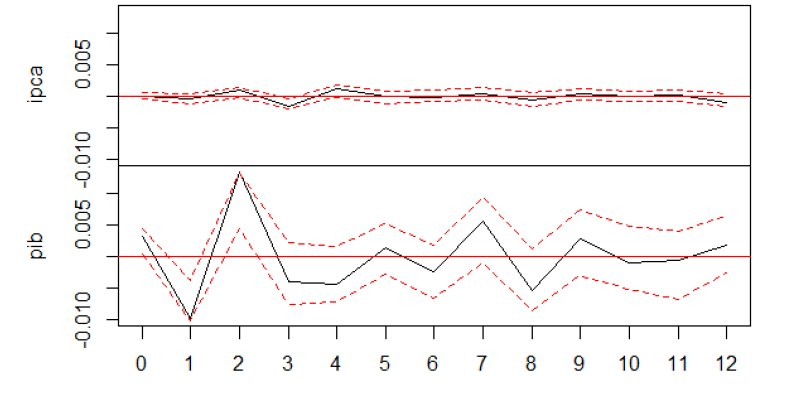
With stationary series, the VAR model was estimated and the impulse response function was analyzed, which illustrates the impact of a shock on the SELIC rate on the IPCA and GDP over a twelve-month horizon. The graphical representation of this impact is fundamental to understanding the transmission dynamics of monetary policy. Figure 1, below, details this relationship visually, allowing for a clear interpretation of the observed effects.
Figure 1. Graphical representation of the IPCA and GDP response function to an impulse on the SELIC rate in a 12-month horizon after the shock application
Source: Original research results
The analysis of Figure 1 revealed that a shock in the SELIC rate has low influence on the IPCA series, which varies little around the axis over the twelve months. This result suggests that the SELIC rate’s ability to control inflation, at least in the period and context analyzed, is limited. In contrast, GDP showed significant variation, predominantly below the axis, indicating a negative and contractionary impact on economic activity when the SELIC rate is high, which is in line with economic theory on the effects of interest rates on growth.
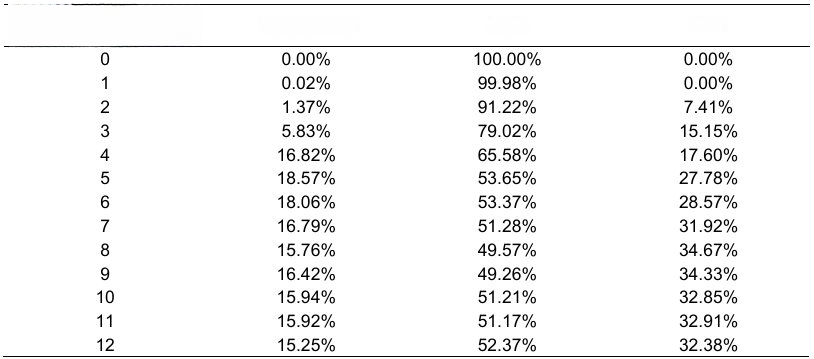
In addition to the impulse response function, the decomposition of the time series variance was analyzed to quantify how much each variable estimated in the VAR model explains the behavior of the others. Regarding the IPCA, Table 3 indicated that, at the end of twelve months, the variance of the IPCA forecast error was explained by only 15.25% by the SELIC rate and by 32.38% by GDP. This finding reinforces the idea that inflationary dynamics are influenced by multiple factors, not just by the basic interest rate, suggesting the presence of other determinants not captured in isolation by the SELIC.
Table 3. Results of the variance decomposition over 12 months in the 3 variables in relation to the IPCA
Regarding GDP, Table 4 showed that the SELIC rate explains 48.76% of the variance of the GDP forecast error behavior at the end of twelve months. This value is considerably higher than SELIC’s explanation for the IPCA, evidencing a more robust and direct relationship between monetary policy and economic activity. The explanatory capacity of GDP on itself, in turn, decreases from 100% in month zero to 33.82% in month twelve, while the contribution of IPCA to GDP variance reaches 17.42% in the same period.
Table 4. Variance decomposition results over 12 months for the 3 variables in relation to GDP
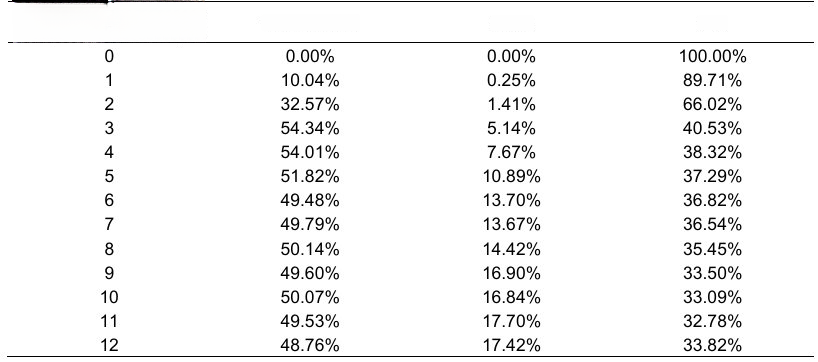
The greater explanatory power of the SELIC rate on GDP compared to the IPCA, as observed in the variance decomposition, is a significant finding. This suggests that the transmission mechanisms of monetary policy act more strongly on economic activity than on inflation in the analyzed period. The relevance of GDP as an explanatory factor for inflation also stands out, pointing to the complexity of macroeconomic interactions and the need to consider multiple channels of influence.
To deepen the analysis of causality relationships, the variables Credit Cost Indicator (ICC) and Credit Balance were included, and the Vector Autoregression (VAR) model was estimated following the methodology of Toda and Yamamoto (1995). This method is particularly suitable for systems with series of different orders of integration, dispensing with the need for pre-cointegration tests and preserving the long-term information contained in the levels of the series (Amiri, Ventelou, 2012).
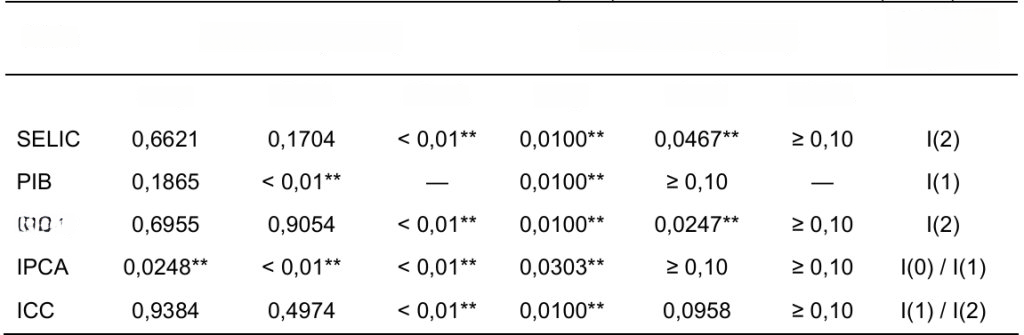
The unit root tests (ADF and KPSS), presented in Table 5, revealed heterogeneity in the integration orders of the series. The SELIC and the Credit Balance were classified as I(2), achieving stationarity only in the second difference. The GDP, in turn, proved to be I(1), stationary in the first difference. The IPCA and the ICC showed borderline results, with the IPCA being treated as I(1) and the ICC with a behavior on the border between I(1) and I(2), which justified the choice of the Toda-Yamamoto approach.
Table 5. Results of the Unit Root (ADF) and Stationarity (KPSS) Tests
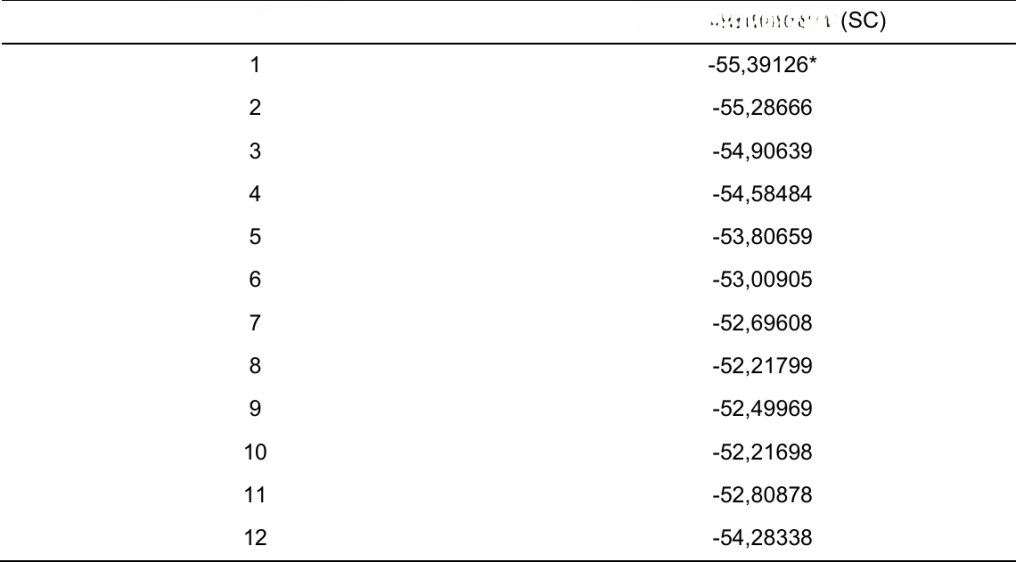
The selection of the optimal lag (k) for the level model was performed using the Schwarz Bayesian Information Criterion (SC), which penalizes the inclusion of additional parameters. Table 6 indicated that the SC criterion reached its minimum value (-55.39126) at lag one, establishing k = 1 as the ideal parsimonious specification for the autoregressive component of the system. This step is crucial to ensure the validity and efficiency of the econometric model.
Table 6. Bayesian Schwarz Criterion (SC)
Source: Original research results
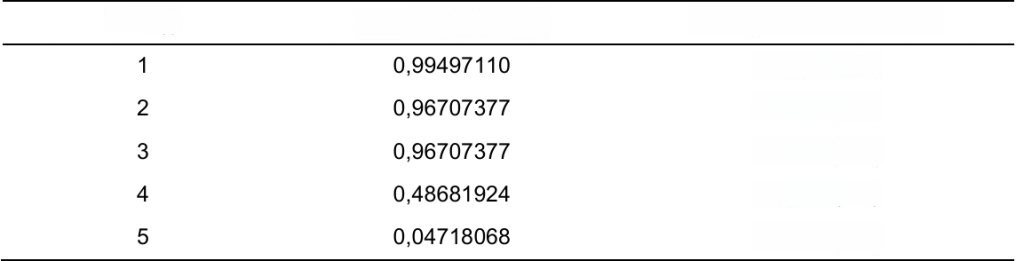
The dynamic stability of the system was verified through the roots of the characteristic polynomial, whose moduli must be strictly less than unity. Table 7 showed that all five roots had a modulus less than one, with a maximum value of 0.99497110. This confirmed that the system is dynamically stable and stationary, validating the application of the Toda-Yamamoto analysis and the asymptotic consistency of causal inference, even with the maximum root’s proximity to the unit circle.
Table 7. Roots of the Characteristic Polynomial for Dynamic Stability Verification
With the system stability confirmed, the modified Granger causality test, as proposed by Toda and Yamamoto (1995), was applied to the level VAR(3) model. The p-value matrix, presented in Table 8, revealed four statistically significant causality relationships at the 5% level. These findings are crucial for understanding the transmission channels of monetary policy in Brazil.
Table 8. Toda-Yamamoto Causality Test p-value Matrix
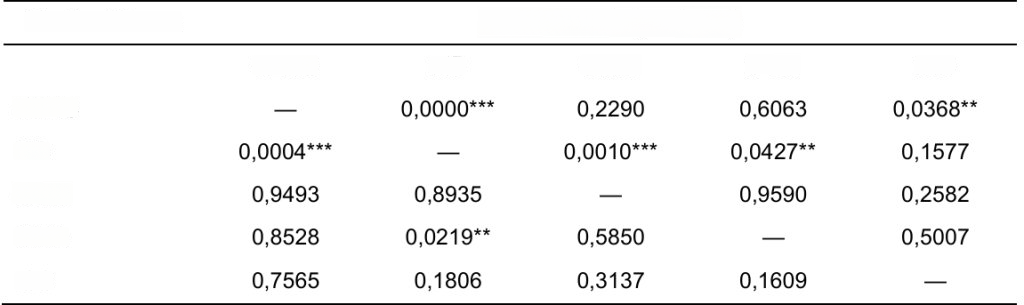
*** significant (rejection of the null hypothesis) of Granger non-causality at 1%
Source: Original research results
A bidirectional causality was observed between the SELIC rate and GDP, with p-values of 0.0000 and 0.0004, respectively, indicating that both variables mutually influence each other. Similarly, bidirectional causality was identified between GDP and IPCA, with p-values of 0.0427 and 0.0219. Additionally, unidirectional causality was found from GDP towards the Credit Balance (p = 0.0010) and from SELIC towards the Credit Cost Indicator (ICC), with p = 0.0368. The remaining tested relationships did not show statistical significance at the conventional 5% level, with no evidence of Granger causality in these pairs.
Causality results confirm a feedback dynamic between the SELIC rate and economic activity (GDP), as well as between economic activity and inflation (IPCA). The unidirectional effects of GDP on the Credit Balance and of the SELIC rate on the cost of credit (ICC) are compatible with the monetary policy transmission mechanisms discussed in the macroeconomic literature. These findings partially corroborate the consolidated literature on the role of SELIC in the Brazilian Inflation Targeting Regime (ITR), but also highlight the instrument’s limitations.
Regarding the relationship between the SELIC rate and the IPCA, the findings indicate that there is no direct statistical significance between these two variables in the Toda-Yamamoto causality test. This result partially aligns with Bacha’s (2017) analysis, which recognizes the centrality of monetary policy in inflation control but emphasizes that price stability does not depend exclusively on the interest rate, being conditioned by structural and institutional factors. The low explanatory power of the VAR model for the IPCA reinforces this perspective, suggesting that Brazilian inflation is influenced by multiple determinants, such as supply shocks and expectation dynamics.
Despite the absence of direct statistical significance between SELIC and IPCA in the causality test, the Central Bank tends to react to inflationary pressures by raising the interest rate, which generates a positive contemporaneous correlation between these variables. In other words, when IPCA increases, the Central Bank reacts by increasing SELIC. However, the model did not show statistical significance in this relationship, even though the SELIC rate is the main monetary policy instrument for inflation control, which points to the complexity of the interaction and the possible lag in the effects.
Regarding GDP, the results indicate a statistically significant relationship with the SELIC rate in both directions, both in the Toda-Yamamoto causality and in the variance decomposition of the VAR model. This finding is in agreement with the study by Delmondes (2024), which highlights the contractionary effects caused by a high interest rate on economic growth, through the reduction of private investments. The greater explanation of SELIC on GDP compared to IPCA, observed in the VAR model, reinforces the relevance of monetary policy for economic activity.
The absence of a significant relationship between the SELIC rate and the Credit Balance suggests limitations of the credit channel as a transmission mechanism of monetary policy in the analyzed period. This result can be interpreted in light of the institutional specificities of the Brazilian financial system, where the presence of directed and subsidized credit instruments, in addition to the strong role of the public sector, may reduce the sensitivity of credit volume to variations in the basic interest rate, limiting the effectiveness of this channel, as pointed out by Evangelista and Araújo (2018).
In contrast, the robust relationship observed between the SELIC rate and the Credit Cost Indicator (ICC) confirms the direct role of the basic rate in the formation of credit cost. This result is consistent with the theoretical framework of monetary policy and reinforces the empirical evidence that SELIC has a more immediate and direct influence on the financial conditions of the system, as illustrated in a special study by BACEN (2018), even though its effects on real variables are more diffuse and lagged. The unidirectional causality from SELIC to ICC corroborates this interpretation.
In summary, the results obtained reinforce the understanding that the SELIC rate is a central instrument in the conduct of Brazilian monetary policy, but its capacity to explain macroeconomic dynamics in isolation is limited. Although it has a significant impact on GDP and the cost of credit, its influence on inflation and credit balance proved to be less pronounced or statistically insignificant. This suggests that price stability and economic growth depend on an integrated economic policy approach, considering multiple factors and transmission channels.
4. Conclusion
This study empirically analyzed the relationship between the SELIC rate and its effects on the Broad Consumer Price Index (IPCA), Gross Domestic Product (GDP), Credit Balance, and Credit Cost Indicator (ICC) in Brazil, during the period from 2013 to 2019. It was found that the SELIC rate showed a statistically significant relationship with GDP and credit cost, evidencing the action of monetary transmission mechanisms on economic activity and financial conditions. A bidirectional causality was observed between SELIC and GDP, and a unidirectional causality from SELIC towards ICC, confirming the direct impact of the basic rate on credit cost formation. Variance decomposition reinforced that the SELIC rate explained a substantial portion of GDP behavior, but its explanatory power over IPCA was considerably lower. These findings contribute to a deeper understanding of Brazilian macroeconomic dynamics, highlighting the relevance of the SELIC rate as a central instrument, but also its limitations.
However, the analysis revealed that the SELIC rate’s capacity to solely explain inflationary dynamics proved statistically insignificant, suggesting the influence of multiple additional factors in the formation of the IPCA, such as supply shocks and expectations. Additionally, no significant relationship was observed between the SELIC rate and the Credit Balance, which may be attributed to the institutional specificities of the Brazilian financial system, where the presence of directed and subsidized credit instruments can reduce the sensitivity of credit volume. Such limitations indicate that, although the SELIC is a fundamental instrument, it is insufficient to explain the country’s macroeconomic complexity in isolation. The results reinforce the need for an integrated economic policy approach, which articulates monetary, fiscal, and structural instruments to promote stability and sustainable growth. For future studies, it is suggested to incorporate additional variables, such as the exchange rate and the unemployment rate, in order to deepen the understanding of the effects of monetary policy in the national context.
Bibliographic References
AMIRI, A., VENTELOU, B. 2012. Causalidade de Granger entre gastos totais na saúde e o PIB na OCDE: Evidência da abordagem de Toda-Yamamoto. Economics Letters, ed. 3, v. 16, p. 541-544. França.
BACHA, C. J. C. 2017. Entendendo a economia brasileira. 4ed. Átomo e Alínea, Campinas, SP, Brasil.
BANCO CENTRAL DO BRASIL [BACEN]. 2018. Efeito de mudanças da taxa SELIC nas taxas de juros das operações de crédito. Estudos Especiais do Banco Central, v. 11. Brasília, DF, Brasil.
BRITO, E. C.; ARAÚJO, E. C.; ARAÚJO, E. L. 2019. Inter-relações entre a dívida pública e política monetária no Brasil: uma análise histórica. Economia e Sociedade, v. 28, n. 1, p. 153-175. Campinas, SP, Brasil.
BUENO, R. L. S. 2012. Econometria de séries temporais. 2ed. Cengage Learning. São Paulo, SP. Brasil.
DELMONDES, L. 2024. Efeitos da política monetária no Brasil: Uma avaliação com modelos VAR dos impactos da SELIC sobre PIB e IPCA (2002 – 2024). Santa Maria, RS. Brasil.
EVANGELISTA, T. F.; ARAÚJO, E. C. 2018. A eficácia do crédito como canal de transmissão da política monetária no Brasil: estratégia de identificação da oferta e demanda de crédito. Revista de Economia Contemporânea, v. 22, p. 1-27. Rio de Janeiro, RJ, Brasil.
GIL, A. 2017. Como Elaborar Projetos de Pesquisa. 6ed. Editora Atlas, São Paulo, SP, Brasil.
SANTOS, G. C. 2022. O impacto da política monetária sobre a desigualdade de renda: uma análise da influência distributiva do regime de metas (1996-2019). Universidade Federal de Sergipe, SE, Brasil.
TODA, H. Y., YAMAMOTO, T. 1995. Inferência estatística em Vetores Autorregressivos com processos possivelmente integrados. Journal of econometrics, v. 66, n. 1-2, p. 225-250. Japão.
Article originating from the Final Course Work of the Specialization in Economics, Investments and Banking of the MBA USP/Esalq
To learn more about the course, click here and access the MBX Academy platform