
Production
February 13, 2026
National identification plan for cattle and buffalo (PNIB): sustainability and competitiveness of Brazilian beef
Maria Eduarda de Serra Machado Blaiklock; Mayara Ribeiro de Araujo
DOI: 10.22167/2675-6528-2025047
E&S 2026, 7: e2025047
Brazil has established itself as the world’s largest beef exporter, with an estimated herd of 197.2 million animals and the sale of 2.29 million tons (t) to 157 countries in 2023[1]. Despite its economic relevance and technological advancements, the national livestock sector faces increasing pressure related to sustainability, animal welfare, and productive efficiency, mainly due to the environmental impacts associated with the activity — such as greenhouse gas emissions and deforestation.
The demand for sustainability in the international market has resulted in stricter trade regulations, such as Regulation (EU) 2023/1115 — known as the European Union Deforestation [2] Regulation (EUDR) — which establishes mandatory requirements for the placing on the market and making available on the Union market (EU), as well as for export from the EU, of certain commodities associated with deforestation and forest degradation. The regulation applies directly to operators and traders active in the European market (importers, processors, exporters, and distributors), requiring the performance of due diligence to demonstrate that the covered products are “deforestation-free, have been produced in compliance with the legislation of the country of origin, and have geographical traceability with geolocation of the production areas. The EUDR (European Union Deforestation Regulation) covers seven commodities: cattle (and beef), cocoa, coffee, palm (palm oil), rubber, soy, and timber, as well as derived products listed in the annex of the regulation — such as leather, chocolate, furniture, paper, and certain industrialized items.
Such rules can function as non-tariff barriers, hindering access to important markets. In this scenario, traceability consolidates itself as a pillar of transparency in agri-food chains, evolving from a sanitary requirement to a strategic tool for product valorization, encompassing attributes of social and environmental sustainability.
Although there are initiatives to strengthen the traceability of the beef production chain in Brazil, the implementation of an effective system still faces difficulties such as insufficient public policies and resistance from small and medium-sized producers. Previous attempts, such as the Brazilian System for the Traceability of Cattle and Buffaloes (SISBOV), launched in 2002 and voluntary, did not achieve significant success due to low adherence and perceived costs by producers. In response to these challenges, in 2024, the Brazilian government developed the National Program for Individual Identification of Cattle and Buffaloes (PNIB), an initiative of the Ministry of Agriculture and Livestock (MAPA), through Administrative Rule SDA/MAPA No. 1,113, of May 14, 2024[3], which proposes the individual identification of each animal, from birth to slaughter. The PNIB aims not only to improve epidemiological surveillance but also to add value to Brazilian products, aligning them with global health and sustainability standards to meet demanding markets and mitigate economic risks.
The plan is based on essential traceability principles, such as unique and individual animal identification, continuous registration of events and movements throughout the productive life, linkage to origin and transit establishments, and consolidation of information in an interoperable central database. Furthermore, the PNIB directly relates to food safety by strengthening the capacity for rapid tracing and response to sanitary emergencies (including traceback actions), enabling more precise control over the origin, transit, and sanitary history of animals. According to the official implementation schedule (2025–2032), the PNIB foresees: in 2025, the construction of the computerized system and the Central Database; in 2026, the adaptation and integration of state systems (interoperability); between 2027 and 2029, the individual identification of animals linked to specific programs and sanitary/market protocols begins; and between 2030 and 2032, the gradual expansion of the requirement occurs, including the demand for identification before the first movement, with the goal of having the entire national herd identified by 2032.
This study aimed to analyze the challenges and opportunities related to the implementation of the PNIB, highlighting its potential to enhance and maintain the competitiveness of Brazilian beef in the international arena. In this study, the challenges and opportunities of the PNIB were analyzed in light of international demands for sustainability and transparency, considering the practical impacts of implementation for the main links in the livestock chain, especially small and medium-sized producers and the meatpacking industry, as well as for the public governance responsible for the plan’s execution. Thus, obstacles related to costs, adherence, training, institutional communication, and system integration were discussed, in addition to opportunities for strengthening sanitary security, mitigating non-tariff barriers, and enhancing the value of Brazilian beef in more demanding markets.
The developed research has an applied nature, with an exploratory and descriptive character, and used a mixed approach, combining qualitative and quantitative methods. To achieve the proposed objectives, two main methodological strategies were employed: (i) literature review; and (ii) field survey (survey), through a structured questionnaire.
The literature review was conducted in academic databases, including the Portal de Periódicos of the Coordenação de Aperfeiçoamento de Pessoal de Nível Superior (Capes), the Google Scholar and SciELO websites, and the digital collection of the University of São Paulo (USP), considering publications from the last ten years related to traceability, sustainability, public policies, and international trade of beef. This stage aimed to provide the theoretical and contextual basis for the research, allowing for the conceptual framing of the PNIB in the face of international market demands. In addition, a documentary analysis was carried out with reports and publications from international and national organizations, including the Agricultural Outlook 2021-2030 from the Organisation for Economic Co-operation and Development (OECD) and the Food and Agriculture Organization of the United Nations (FAO)[4] and the Brazilian Agricultural Research Corporation (Embrapa)[5],[6], as well as Regulation (EU) 2023/1115 – the European Union’s Anti-Deforestation Law[2] – and the PNIB[3] to investigate the articulation between the plan and other public policies, such as the Agro Brasil + Sustentável platform, and to identify sustainability guidelines and parameters applicable to the Brazilian livestock chain. Furthermore, the research incorporated the analysis of content from statements by leaders in the livestock sector, obtained in a collective interview and declarations published on December 19, 2024, on Portal DBO, the main technical-economic publication specialized in beef cattle farming in Brazil. The material gathered opinions from directors, representatives of class entities, producers, and business leaders on the perspectives and challenges of the PNIB. The objective of this analysis was to capture practical perceptions, divergences, and expectations of the sector regarding the new traceability policy.
The field survey, a survey, was conducted using a structured questionnaire administered to 37 agribusiness professionals, working in both public and private sectors, via the Google Forms tool, between January 6 and March 28, 2025. The questionnaire was developed from an analysis of specialized literature and comprised 13 questions—12 multiple-choice—, and the questions were categorized into analytical axes aimed at capturing: (i) expected benefits of individual traceability (health, transparency, and market access); (ii) adoption and implementation barriers (costs, resistance, and operational capacity, especially among small and medium-sized producers); and (iii) public policy instruments for enabling the plan (institutional communication, training, incentives, and bureaucratic simplification), incorporating factors recognized as critical in the literature, such as producer resistance and implementation costs[7], and the strategic role of traceability for access to and retention in more demanding markets[8].
Before the definitive application, the instrument was submitted to pre-validation tests with official veterinarians from the Ministry of Agriculture and Livestock (MAPA), specialists in animal health and traceability, ensuring the clarity and relevance of the questions, with adjustments incorporated into the final version. The sampling was by convenience (n=37), considering the specialized audience and the author’s technical network, with voluntary and anonymous participation; therefore, it is a non-probabilistic and non-representative sample of the entire Brazilian livestock chain, which limits the statistical generalization of the results. Thus, the questionnaire findings should be interpreted as exploratory and indicative evidence, useful for mapping qualified and complementary perceptions to other study sources.
The responses were analyzed through descriptive quantitative analysis (percentages and frequencies) and qualitative content analysis of open-ended responses, allowing for the identification of patterns, perceptions, and suggestions regarding the adherence and effectiveness of the PNIB. Based on the integrated results from the different stages, a SWOT matrix (Strengths, Opportunities, Weaknesses, and Threats) was developed, used to synthesize the internal and external factors influencing the competitiveness of Brazilian beef and to support strategic recommendations.
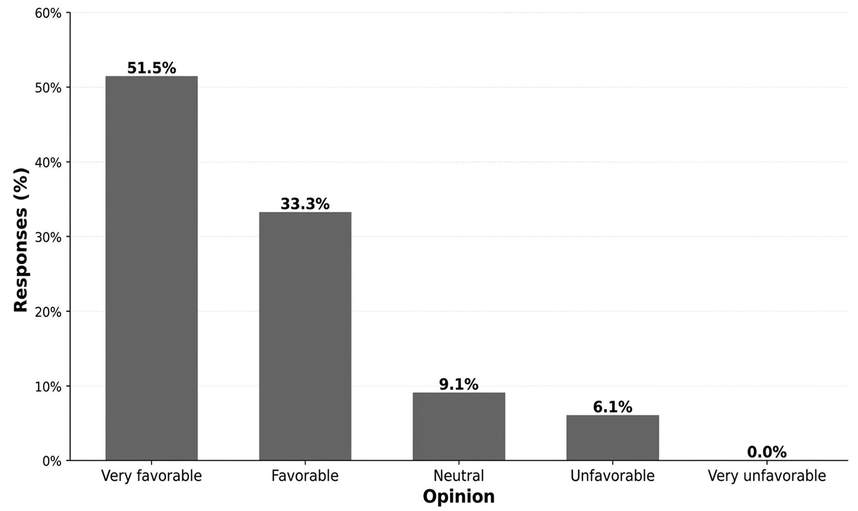
The integrated data analysis revealed insights, challenges, and opportunities related to the adoption of sustainable practices in beef cattle farming, with traceability as a central axis. The majority of questionnaire respondents (84.8%) were favorable or very favorable to the implementation of the PNIB (Figure 1), indicating recognition of the need for a system that attests to sustainability and sanitary safety.
Source: Own elaboration and AI assistance for graph generation based on a applied questionnaire.
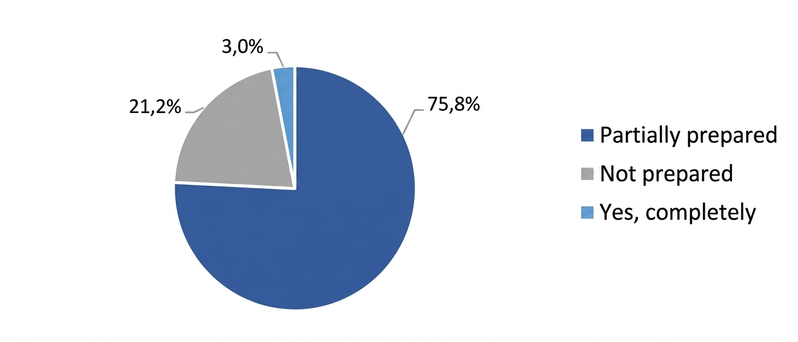
Despite the optimism, 75.8% of participants stated they believe the livestock sector is only partially prepared for the plan’s implementation, while 21.2% stated it is not prepared (Figure 2).
Source: own elaboration based on questionnaire applied.
The perception of partial readiness for the PNIB reinforces that traceability, although necessary, is difficult to implement in a heterogeneous chain. Regional and capacity differences among producers increase the risk of non-total adherence to the PNIB, potentially compromising its effectiveness as a public policy, thus requiring public sector support and coordination for the program’s success. Furthermore, factors such as costs, lack of credit, and technical assistance tend to reduce adoption, especially among small producers [7].
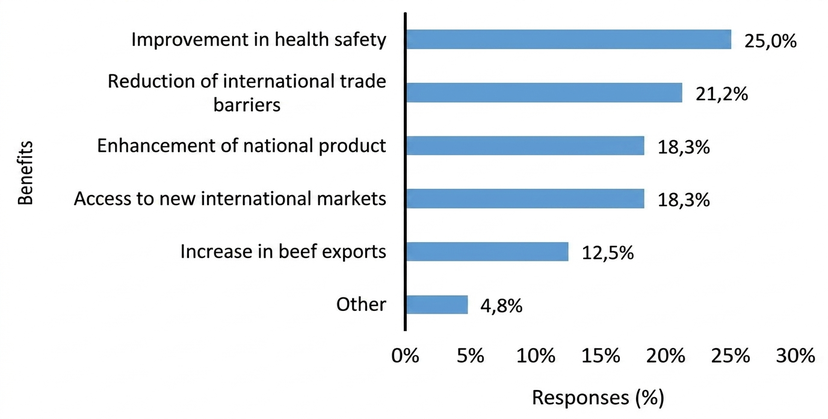
According to the respondents, the main expected benefits from the PNIB are: improvement of herd sanitary security (25.0%); reduction of trade barriers (21.2%); valorization of the national product (18.3%); and access to new markets (18.3%) (Figure 3).
Source: own elaboration based on questionnaire applied.
The most cited benefits show that the PNIB is seen as a tool to increase transparency, sustainability, and competitiveness in the beef cattle sector. Furthermore, by facilitating rapid tracking in health crises, it can reduce economic impacts and protect exports[8].
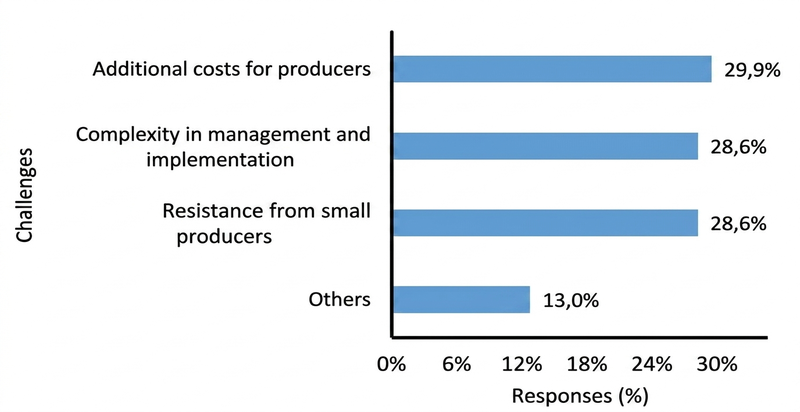
Regarding the challenges for the implementation of the PNIB, the most cited by respondents were: additional costs for producers (29.9%); complexity in management and implementation (28.6%); and resistance from small producers (28.6%) (Figure 4).
Source: Own elaboration based on questionnaire applied.
These data reflect limitations already observed in previous initiatives — such as SISBOV —, marked by low adherence due to high costs, unclear benefits, and communication failures. The literature points to cultural, bureaucratic, and economic barriers as recurring obstacles to traceability in Brazil[7],[8], and highlights that the adoption of sustainable practices requires investments that most strongly impact small and medium-sized producers[6]. Furthermore, the perception that small producers will be the most impacted was confirmed by 66.7% of respondents, suggesting that the success of PNIB will depend on practical support and incentives to enable adherence, and not just on the plan itself.
It is also observed that the opinions of industry leaders, published on a digital platform specializing in Brazilian agribusiness, also demonstrate divergent views. While some see the PNIB as a “great achievement,” others express concern about the costs and the mandatory nature of the system, which could discourage small producers. There is a consensus, however, that the integration of PNIB with socio-environmental compliance platforms — such as Agro Brasil + Sustentável — is a crucial challenge.
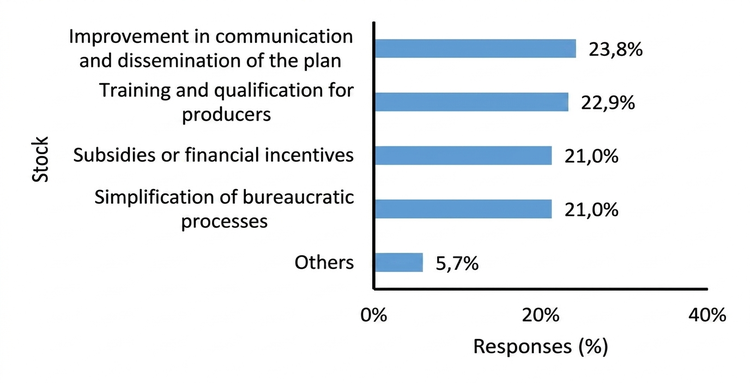
To facilitate adherence to the program, the consulted professionals pointed out as priority needs: improvement in communication and dissemination of the plan (23.8%); training and capacity building for producers (22.9%); subsidies or financial incentives (21.0%); and simplification of bureaucratic processes (21.0%) (Figure 5). Criticisms regarding the lack of institutional communication and the complexity of the program, evoking failures of previous systems such as SISBOV, highlight distrust regarding its viability.
Source: Own elaboration, based on questionnaire applied.
The priority actions pointed out by respondents are consistent with recommendations from literature and international organizations, which highlight the need to increase productive efficiency, reduce environmental impacts, and expand transparency and traceability through public policies and support for the adoption of technologies[4],[5],[6]. In this context, the SWOT matrix reinforces that the PNIB can convert external demands into competitive advantage, provided that it reduces process costs and strengthens producer confidence with technical support and system interoperability.
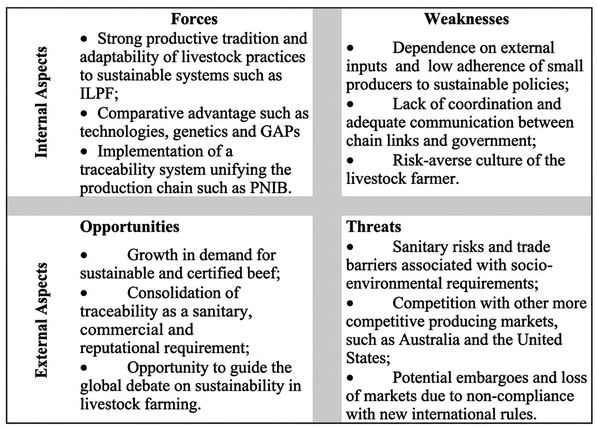
The SWOT analysis synthesizes the scenario (Figure 6), in which Brazil’s Strengths include its productive tradition and the implementation of a unified system like PNIB; and Weaknesses lie in the low adherence of small producers to sustainable policies, the lack of coordination between government and the production chain, and the risk-averse culture of the cattle rancher. External Opportunities, in turn, are the growth in global demand for sustainable meat, driven by regulations, consolidating traceability as a commercial requirement. Finally, Threats are the trade barriers associated with socio-environmental requirements and competition with markets more consolidated in traceability.
Source: Own elaboration.
To overcome weaknesses and mitigate threats, it is essential to invest in institutional communication, offer financial incentives and technical training, simplify bureaucracy, and foster public-private partnerships. These actions can transform the individual traceability of cattle and buffaloes into a strategic differential, adding value to the national product. The implementation of the PNIB represents a structuring milestone for Brazilian beef cattle farming by responding to international demands for transparency, traceability, and sustainability. By establishing the individual identification of cattle and buffaloes, the plan strengthens the country’s ability to demonstrate origin, history, and sanitary and socio-environmental compliance, reducing information asymmetries along the chain and increasing the confidence of importing markets. In this sense, individual traceability goes beyond control: it is a governance tool that improves sanitary risk management and increases regulatory predictability. With this, it helps to enhance the value of Brazilian beef in markets that require proven origin and reliability.
However, for this potential to materialize, it is necessary to face operational and adherence challenges, especially among small and medium-sized producers. Adaptation costs, logistical complexity, and institutional communication failures can reduce participation and compromise the plan’s effectiveness. Therefore, it is recommended to combine economic incentives and financing mechanisms with local technical assistance and continuous training. It is also essential to simplify and standardize procedures to reduce bureaucracy and facilitate implementation. Interoperability between federal and state systems must ensure integrated and easy-to-use data. Public-private partnerships can accelerate execution and expand reach, provided there is clear governance and auditing. Thus, the PNIB can consolidate itself as an instrument for productive inclusion, traceability, and sustainable competitiveness. This requires treating it as a structural and long-term policy for the modernization of Brazilian livestock farming.
REFERENCES
[1] Associação Brasileira das Indústrias Exportadoras de Carne (ABIEC). 2024. Beef Report 2024: perfil da Pecuária no Brasil. São Paulo. ABIEC, SP. Disponível em: https://abiec.com.br/publicacoes/beef-report-2024-perfil-da-pecuaria-no-brasil/.
[2] European Union. 2023. Regulation (EU) n.2023/1115, of 31 May 2023 of the European Parliament and of the Council on the making available on the Union market and the export from the Union of certain commodities and products associated with deforestation and forest degradation. Official Journal of the European Union. L150:206-246. Available at: http://data.europa.eu/eli/reg/2023/1115/oj.
[3] Ministério da Agricultura e Pecuária (MAPA). Brasil. 2024. Rastreabilidade: Ministro Fávaro lança Plano Nacional de Identificação Individual de Bovinos e Búfalos. Brasília. Disponível em: https://www.gov.br/agricultura/pt-br/assuntos/noticias/2024/ministro-favaro-lanca-plano-nacional-de-identificacao-individual-de-bovinos-e-bufalos.
[4] Organização para a Cooperação e Desenvolvimento Econômico [OCDE]/ Food and Agriculture Organization [FAO]. 2021, OECD-FAO Agricultural Outlook 2021-2030. Disponível em: https://doi.org/10.1787/19428846-en .
[5] Malafaia, G.C.; Azevedo, D.B.; Pereira, M.A.; Matias, M.J.A. 2019. A sustentabilidade na cadeia produtiva da pecuária de corte brasileira. In: Bungenstab, D.J.; Almeida, R.G.; Laura, V.A.; Balbino, L.C.; Ferreira, A.D. ILPF: Inovação com integração de lavoura, pecuária e floresta. Embrapa, Brasília, DF. Disponível em: https://www.alice.cnptia.embrapa.br/alice/handle/doc/1112915.
[6] Malafaia, G.C.; Contini, E.; Dias, F.R.T.; Gomes, R.C.; Moraes, A.E.L. 2021. Cadeia produtiva da carne bovina: contexto e desafios futuros. Embrapa, Campo Grande, MS. Disponível em: http://www.infoteca.cnptia.embrapa.br/infoteca/handle/doc/1132914.
[7] Harfuch, L.; Lobo G.D.; Cruz G.M. 2023. Sustentabilidade na cadeia da carne: caminhos para o Brasil e os aprendizados. Agroicone, São Paulo, SP.
[8] Sá, C.D.; Lemos, F.K.; Jank, M.S. 2023. Sistema de rastreabilidade e monitoramento completo na pecuária de corte brasileira. Comércio Internacional e Meio Ambiente. Insper Agro Global.
COMO CITAR
Sánchez, D.M.C.; Almeida, A.V. (2026). Plano nacional de identificação de bovinos e búfalos (PNIB): sustentabilidade e competitividade da carne bovina brasileira. Revista E&S; 7: e2025046.
ABOUT THE AUTHORS
 Maria Eduarda de Serra Machado Blaiklock – Specialist in Agribusiness. Mentor and Consultant in International Agribusiness. Pct José Figueiredo Fonseca, 175, 5DTO, Parede, 2755-316, Lisbon, Portugal.
Mayara Ribeiro de Araujo – Advisor professor. Associate Professional at Pecege Institute. Rua Cezira Giovanoni Moretti, 580, Santa Rosa, 13414-157, Piracicaba, São Paulo, Brazil.