
Agribusiness
Aquaculture Management
Fish
Production
Net Cages
July 13, 2021
Optimal slaughter weight of fish as a function of the market, costs, production yields, and processing – the case of tilapia
DOI: 10.22167/2675-6528-20210006
E&S 2021, 2: e.20210006
Gustavo Luiz Naslausky Bozano e José Eurico Possebon Cyrino
The productivity of an aquaculture system is “governed” by the factors variety (species), environment, and management, grouped under the aegies of production-determining factors, such as specific growth rate, carcass yield, and body composition, ambient temperature; production-limiting factors, such as the species’ foraging ability, feed conversion ratio, and water quality; and production-reducing factors, such as hardiness and adaptability, agonistic behaviors (dominance), natural enemies, etc. These factors are studied and summarized in the concepts of bioeconomics, such as carrying capacity (maximum biomass that the production system can sustain), economic biomass (that which maximizes the system’s return), and critical biomass (point of maximum weight gain as a function of biomass), which, once determined, allow for the evaluation of the maximum profitability of a production system, a practice that does not represent any novelty.
In summary, the “pace” of increase in the total biomass (production) of stocked fish reaches a maximum limit and then begins to decrease as a result of the natural reduction in the growth rate with age. At the same time, due to the reduction in space (environmental comfort) – greater biomass confined in the same space – confined stocks may begin to experience cases of morbid or severe mortality, which negatively affects the total production of the system. Thus, the economically ideal harvest time occurs when the profit from the production of fish sold in the market – fish price multiplied by fish yield minus the fish production cost – is at its maximum value (see R.R. Springborn et al., 1992)
The determination of economic biomass indicates to the producer the right time for harvesting for maximum business profitability, but the ideal economic weight for harvesting the fish is not always the ideal weight to optimize the processes “inside” the cold storage. Furthermore, it is necessary to understand certain market nuances that influence business profitability and to measure revenue variations as a function of prices for different fillet sizes and carcass yield at different fish weights.
Differential remuneration based on different fillet sizes is common practice in the marketing of fish abroad, but despite being common for whole fish in some regions, it has not yet been fully adopted in the country. However, most sales channels already work with pre-defined minimum and maximum sizes, and therefore, it is essential to understand the market to be served well to assess the best time for harvesting. In the case of tilapia, markets that sell directly to consumers generally prefer to market fillets above 120 g, which correspond to the slaughter of fish weighing more than 720 g (assuming a 33.3% carcass yield, i.e., 720 g x 33.3% = 240 g of fillet = two 120 g fillets) to meet the demand of customers who usually do not buy fillets by weight, but rather by unit (one fillet for each family member per meal, for example). Thus, the larger the fillet, the greater the quantity of fish to be marketed per customer. In turn, the size of the fillet marketed to restaurants and bars depends on the service system of each establishment. Restaurants specializing in oriental cuisine, which use tilapia fillets for “sashimi” cuts, prefer to purchase fillets weighing more than 180 g, from the processing of fish weighing over 1,080 g, as larger fillets provide higher cuts and lower product loss for dish preparation. Restaurants that operate à la carte normally prefer to purchase 100-120 g fillets, obtained from processing 600 to 720 g fish; when the establishment serves dishes for two people, the preference is for 200 g fillets, obtained from processing fish weighing an average of 1,200 g. Tilapia fillet is normally served whole on the plate, therefore, fillets outside these standards “force” restaurants to serve more fish per plate, reducing their profitability. Thus, although there are no differentiated prices by fillet size (weight), certain marketing channels simply do not purchase products that do not meet the required standard.
The relationship between carcass yield and fish size is another aspect to be considered. In research conducted on the subject, there are few reports of (significant) differences regarding the effect of fish size at harvest on carcass yield, and when there are, the result is attributed much more to the methodology (technique) used for filleting, the precision of the mechanization process, the genetics of the species produced, the commitment and training of employees, than to the size of the animals themselves. But however small, the financial impact of these differences must be evaluated. As an example, we will use the work published by Souza et al. (2005), in which it is reported that tilapia weighing between 601 and 700 g (average weight of 650 g) have a fillet yield similar to the group weighing between 701 and 800 g (average weight of 730 g), with a difference of 0.24% in favor of the larger fish group. Although it seems small, when evaluated from an economic point of view, the difference in yield is considerable. Considering the production volume of a plant with a processing capacity of 200,000 animals per month, a 0.24% higher fillet carcass yield means a monthly increase of 350 kg of fillet, which at an average price of R$ 25.00 per kg, represents an additional revenue of R$ 8,750.00 per month, which would correspond to almost 10% of the payroll related to the operation of a slaughterhouse of this size.
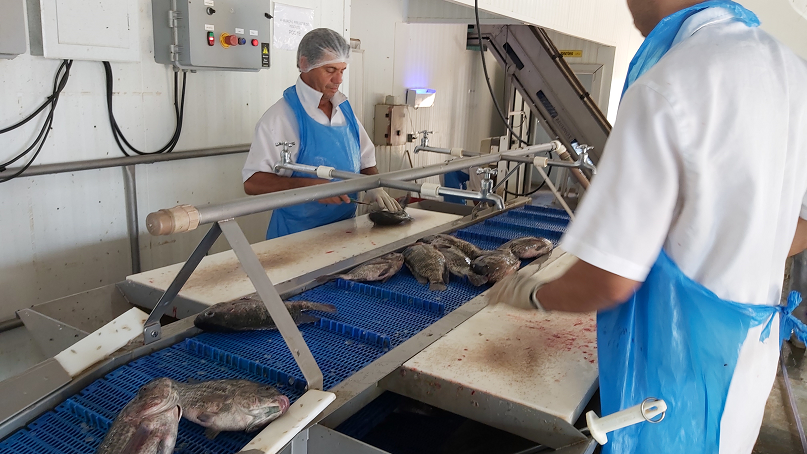
Productivity (in this case, total production per period) in fish processing as a function of animal weight should also be considered. In the case of employee productivity, for example, as a general rule, the higher the average weight of the fish, the more kilograms of fish employees can process per unit of time. A unit capable of processing 200,000 animals per month, using fish with an average weight of 650 g, processes 130,000 kg of fish per month (200,000 x 0.650 kg per animal = 130,000 kg of fish). If the same animals weighed an average of 730 g, in the same month and with practically the same effort, the slaughterhouse’s work would “yield” 146,000 kg (200,000 animals x 0.730 kg per animal = 146,000 kg of fish). For the smaller class of fish, considering an average yield of 33.3%, this would correspond to 43,290 kg of fillet for commercialization, with an average weight of 108.2 g. For the larger class of fish, the production, assuming the same yield of 33.3%, would be 48,618 kg of fillet, with an average weight of 121.5g. Even without a price difference between the different sizes (weights) of the fillets, the additional revenue of 5,328 kg of fillet (again considering a selling price of R$ 25.00 per kg) would be R$ 133,200.00 per month. The difference in results is greater than the operational profit of many production units of this size.

Lastly, the uniformity in weight and size of the deboned batch is considered. Weight variations are determined by competitiveness within the production environment, partially influenced by animal genetics. The fact is that size dispersion at the time of processing directly influences carcass yield, especially during skinning. Filleting equipment is regulated so that skinning is done with a superficial cut, so that the minimum possible muscle remains attached to the skin, with the minimum of skin scraps also attached to the fillet, thus facilitating the final trimming. If there is a very large variation in fish size, operators are forced to regulate the (filleting) equipment for the average size of the animals. Consequently, when a larger fish passes through the equipment, the skin cut is deeper than it should be, thus removing more meat from the fillet than necessary. On the other hand, if a smaller animal “passes” through the equipment, the cut will be more superficial than necessary, leaving a lot of skin on the fillet and increasing the time needed for final trimming. To minimize losses, in many cases, it is necessary to separate fish by size and adjust the equipment several times during the process, breaking the “rhythm” and increasing processing time and labor costs. Furthermore, in a batch with smaller average fish weight, there may be animals with a weight below the recommended minimum for processing, which not only increases discards with a consequent reduction in yield, but also directly affects profitability and, therefore, influences the recommendations for optimal system management.
There are still few agro-industrial systems that work with fish and have control over production, processing, and commercialization. With the entire structure working at maximum efficiency, it becomes simpler to evaluate the bottlenecks of the venture, define investment priorities, and project business growth and economies of scale in an orderly and assertive manner, allowing the accumulation of financial gains from each stage of the chain, making the business more profitable as a whole. The decision on when to harvest should consider all factors involved in the business; the topic is complex and probably the most difficult point for decision-making in vertically integrated units that work with fish production and processing. It is therefore fundamental that companies adopt management based on the interpretation of information in an integrated way between the commercial, technical, and marketing sectors. The integration of all these processes facilitates strategic business management and should be dynamic to allow monitoring of market changes.
References
Springborn, R.R.; Jensen, A.L.; Chang, W.Y.B.; Engle, C. 1992. Aquaculture and Fisheries Management, 23: 639-647.
Souza, M.L.R.; Viegas, E.M.M.; Sobral, P.J.A.; Kronka; S.N. 2005. Efeito do peso de tilápia do nilo (Oreochromis niloticus) sobre o rendimento e a qualidade de seus filés defumados com e sem pele. Ciência e Tecnologia de Alimentos, 25(1): 51-59.
Nota
Este artigo é derivado de dados discriminados e discutidos na tese de doutoramento do primeiro autor, que trata do gerenciamento e economia da produção de tilápias em tanques-rede no centro-oeste do Brasil, e já publicado em parte como: Bozano, G.L.N., e J.E.P. Cyrino. 2019. A definição do peso ótimo de abate de peixes em função do mercado e dos custos e rendimentos de produção e processamento. Revista da Associação Brasileira de Criadores de Camarão [ABCC] 21(2): 59-60.
Como citar
Bozano, G.L.N.; Cyrino, J.E.P. 2020. Peso ótimo de abate de peixes em função do mercado, custos, rendimentos de produção e do processamento – o caso da tilápia. Revista Estratégias e Soluções, 2: e.20210006.
Sobre os autores
Gustavo Luiz Naslausky Bozano, Doutor em Agronomia (Ciência Animal e Pastagem), sócio-diretor da Aqua Lagus Representação Agropecuária e da PartnerFish Consultoria
José Eurico Possebon Cyrino, Ph.D. – Professor Titular – Piscicultura; Departamento de Zootecnia, Escola Superior de Agricultura Luiz de Queiroz da Universidade de São Paulo
Editorado por: Edson Pereira da Mota
Link para download: https://cms.revistaes.com.br/wp-content/uploads/2021/07/4-1.pdf