
Compliance And Esg
September 15, 2026
Risk Management and Materiality as Tools for Municipal Public Governance
Luciane Iracet Nuglisch Leães; Carlos Alberto dos Santos Silva
DOI: 10.22167/2675-6528-202602265
Article derived from a Final Course Work (TCC), with content based on the student’s original work and adapted to the editorial format of the Revista E&S with the support of the ResumeAI tool, an artificial intelligence solution developed by the Pecege Institute for textual synthesis and organization.
Abstract
Brazilian municipal public management lacked tools that integrated the technical perception of public servants, the demands of the population, and the strategic vision of political leaders to guide resource allocation and policy formulation. The work adapted the concept of double materiality, originating from the private sector and IFRS S1 and S2 standards, to the public context, and proposed the Quadridimensional Public Materiality Matrix (MMP 4D). The research, with a mixed approach (quantitative and qualitative), was conducted in a large municipality in the interior of the state of São Paulo and collected data from technical public servants (N=23) using a Likert scale applied to 16 risk themes, from the population (N=209, of which 33 were municipal councilors) by choosing three priorities among 12 themes, and from governmental leaders (N=8) through a questionnaire with a Likert scale and decision vignettes. The results revealed absolute consensus around Water Health and Security as top priorities, while Urban Planning and Legal Insecurity emerged as invisible risks, perceived only internally. The qualitative analysis identified the uncontrolled inventory of over 430,000 items as a serious and neglected operational risk. The MMP 4D demonstrated the capacity to triangulate divergent perceptions and reveal perception gaps between groups, constituting a viable tool for budgetary planning and institutional shielding of municipalities.
Keywords: compliance; double materiality; ESG; SDG 16; public sector.
1. Introduction
Brazilian municipalities face an accumulation of fiscal, social, and environmental pressures for which traditional administration models were not prepared. The Fiscal Responsibility Law (Brazil, 2000) established rigorous budgetary controls, but did not guarantee effectiveness in delivering public value or institutional resilience in the face of complex crises. In contrast, the private sector has begun to adopt environmental, social, and corporate governance (ESG) frameworks and the principle of double materiality, formalized by the IFRS S1 and S2 standards of the International Sustainability Standards Board (ISSB, 2023a, 2023b). These standards require organizations to identify which sustainability issues are relevant to both the business and society.
Translating this logic to the public sector, however, is a path still little explored by national literature. In the municipal context, the materiality matrix traditionally used by corporations needs to be reinterpreted. Profit gives way to effectiveness in the delivery of essential services, and shareholders are replaced by citizens and control bodies (Matias-Pereira, 2022). ISO 31000 (ABNT, 2018) provides principles for risk management applicable to any organization, while ISO 37301 (ABNT, 2021) governs compliance systems that can be adapted to the public reality. The Federal Court of Accounts of Brazil (Brasil, 2014) already recommends the adoption of risk-based governance practices, and Sustainable Development Goal 16 (UN, 2015) of Agenda 2030 advocates for effective, responsible, and transparent institutions at all levels.
Despite these regulatory advances and existing recommendations, few studies have proposed operational tools that simultaneously integrate the technical perception of public servants, the priorities of the population, and the strategic vision of political leaders to guide the allocation of municipal resources. This gap hinders more transparent and effective public management, which can balance social demands with execution capacity and strategic priorities, resulting in budgetary and public policy decisions that may not reflect the multifaceted reality of the municipality.
Given this gap, this work aimed to develop and test a Quadridimensional Public Materiality Matrix (MMP 4D) model that triangulated the technical view of public servants (X-Axis), the social perception of the population (Y-Axis), the complexity and cost of interventions (Z-Axis), and the political-strategic alignment of leaderships (W-Axis), adapting the concept of double materiality to the municipal public management of a large municipality in the interior of the state of São Paulo.
2. Material and Methods
The research adopted a mixed approach, combining quantitative and qualitative methods in a single case study, conducted in a large municipality in the interior of the state of São Paulo, with an estimated population of over 400,000 inhabitants. The research design was based on data triangulation from multiple sources, following the guidelines of ISO 31000 (ABNT, 2018).
The research involved primary data collection with human beings and followed the ethical precepts established by Brazilian legislation. All participants from the three groups (employees, leaders, and population) received and consented to the Free and Informed Consent Form (FICF) before answering the questionnaires, being informed about the research objectives, the voluntariness of participation, and the guarantee of anonymity. The Ethical Direction Form (EDF) was completed and submitted according to the MBA USP/ESALQ guidelines, resulting in the waiver of review by the Research Ethics Committee (REC), under article 1, sole paragraph, of CNS Resolution no. 510/2016, in items I (public opinion surveys with unidentified participants) and VII (research aiming at the theoretical deepening of situations that emerge spontaneously and contingently in professional practice) (Brazil, 2016). The municipality’s name was not disclosed, and the data were treated in an aggregated manner, without individual identification of the respondents.
During the preparation of this work, the author used generative artificial intelligence tools Gemini (Google) and Claude (Anthropic) to assist with grammatical and spelling review, structural organization of the text, formatting of tables and graphs, and generation of data visualizations. The collection, analysis, and interpretation of primary data were performed entirely by the researcher, without AI intervention. No AI tools were used to generate data, elaborate critical analyses, or produce interpretations of the results.
The construction of the 16 risk themes deliberately excluded public safety in the strict sense, anchoring itself in the delimitation of municipal constitutional competencies. The core of SDG 16 (Peace, Justice and Effective Institutions) was incorporated into the Quadridimensional Public Materiality Matrix (MMP 4D) through the themes of Legal Uncertainty (T15) and Transparency (T14).
Three distinct instruments were applied, aimed at stakeholder groups of municipal management. The first, aimed at career technical servers (N=23), consisted of an electronic questionnaire with 16 risk themes evaluated on a Likert scale from 1 (very low risk) to 5 (very high risk), plus an open-ended question about operational risks not contemplated. The definition of intentional samples of servers and leaders was based on the principle of theoretical saturation, with the sample of servers (N=23) and leaders (N=8) exceeding the thematic saturation threshold (Guest et al., 2006). The second instrument was aimed at the general population and municipal councilors (N=209, of which 33 were councilors), who selected three priorities from 12 themes translated into citizen language. The normalization of choice frequencies to a scale of 1 to 5 was performed using the adapted Borda method. The third instrument reached governmental leaders in first and second-tier positions (N=8), including the same 16 themes on a Likert scale and three decision vignettes that simulated real dilemmas of governability, budget prioritization, and legal uncertainty. The data collection instruments used are included in Appendices A and B of the original TCC.
To enable public participation in Axis Y, a Semantic Equivalence Matrix, called the De-Para Model, was developed. This model translated the 16 technical risk themes, structured from global ESG frameworks (Global Reporting Initiative [GRI], Sustainable Development Goals [SDGs], and ISO standards), into accessible citizen language. This localization followed three stages: (1) mapping international normative sources and extracting applicable risk themes; (2) filtering by municipal constitutional competence; and (3) rewriting each technical theme in colloquial language, preserving the semantic core. Table 1 presents the correspondence between the technical themes and the citizen language used in the public questionnaire. Themes T13 (Urban Planning) did not have a direct correspondence in the citizen questionnaire due to their strictly technical nature, being evaluated only in the instruments for servers and leaders.
Table 1. Semantic Equivalence Matrix: translation of technical terms into citizen language
| Technical topic | Normative reference | Citizen translation (population questionnaire) |
|---|---|---|
| T1/T2 – Rivers and Water | GRI 303, 304 / SDG 6, 15 | Water and Rivers: Avoid lack of water at the tap and clean the city’s rivers |
| T8 – Health | GRI 403 / SDG 3 | Health: Solving the shortage of doctors, medicines, and queues at health centers |
| T7 – Education | SDG 4 | Schools and Daycares: Improve physical structure and increase vacancies |
| T5/T6 – Climate | SDG 11, 13 | Floods, Heat, and Parks: Creating green areas, reducing heat and floods |
| T10/T16 – Economy | GRI 201 / SDG 8 | Employment and Income: Attracting companies and generating job opportunities |
| T12 – Mobility | SDG 11 | Transportation and Traffic: Improve buses, bus stops, and flow |
| T3 – Waste | GRI 306 / SDG 12 | Waste and Cleaning: Improve street collection and cleaning |
| T14 – Transparency | GRI 205 / SDG 16 | Transparency and Honesty: Combating deviations and privileges |
| T15 – Compliance | ISO 37301 / SDG 16 | Agility and Less Bureaucracy: Unlock processes and modernize |
| T9 – Housing | SDG 11 | Housing: Solve homelessness and urbanize irregular areas |
| T4 – Energy | GRI 302 / SDG 7 | Energy and Lighting: Reduce waste and improve lighting |
| T11 – Diversity | GRI 405 / SDG 10 | Respect and Inclusion: Combat discrimination and ensure dignified service |
Source: Original research data
Quantitative data from servers and leadership were analyzed by arithmetic means and segmented by area of activity and length of service. Axis Z (complexity and cost) was calculated from the average of three subdimensions evaluated by planning area specialists (N=5): relative cost, implementation time, and dependence on external resources. The qualitative analysis of open responses and vignettes followed the content analysis technique, with thematic categorization.
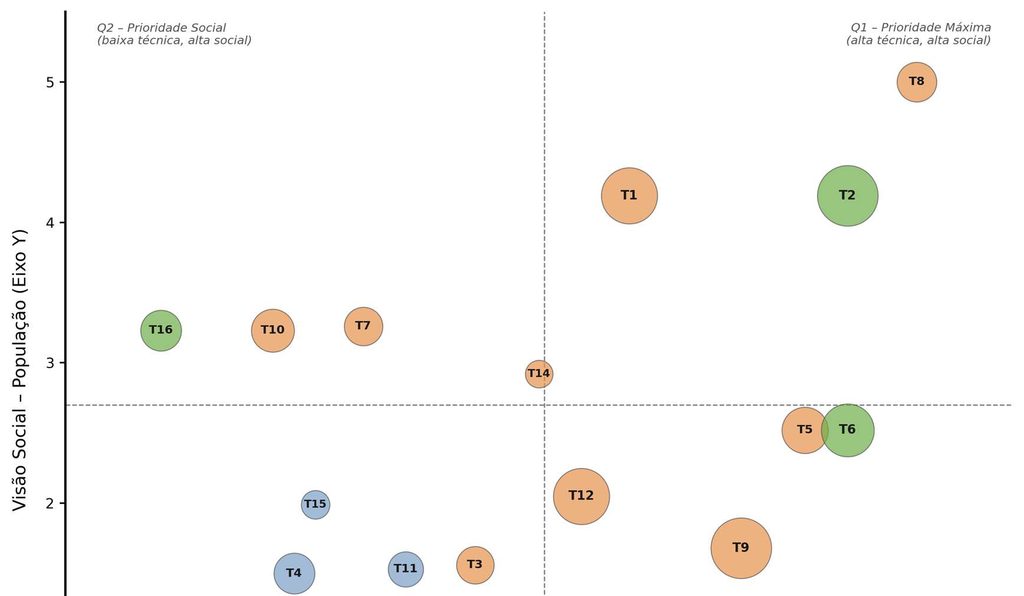
The construction of the 4D MMP used a bubble chart with four dimensions: horizontal position (average of servers), vertical position (normalized population score), bubble size (complexity/cost), and bubble color (leadership priority, classified into three bands: blue for low, orange for medium, and green for high priority). The quadrants were defined by the averages of the X (3.3) and Y (2.7) axes. Figure 1 presents the graphical representation of the 4D MMP, in which the horizontal position corresponds to the technical view, the vertical to the social view, the bubble size to complexity/cost, and the color to leadership priority. The dashed lines delimit the four strategic quadrants. The note in Figure 1 details: X-axis = technical view (servers); Y-axis = social view (population); bubble size = complexity/cost (Z-axis); color = leadership priority – W-axis (blue = low, orange = medium, green = high); dashed lines = averages of the X (3.3) and Y (2.7) axes.
Figure 1. Quadridimensional Public Materiality Matrix (MMP 4D)
Source: Original research results
3. Results and Discussion
Operational conceptual definitions
The data analysis allowed for the definition of essential operational concepts for the discussion. The perception gap was identified as the statistically measurable divergence between the criticality of a risk, according to the technical assessment of public servants (X-Axis), and the priority assigned by the population (Y-Axis), indicating parallel risk agendas. The “apagão das canetas” (shutdown of pens), a phenomenon already recognized in Brazilian public administration (Brazil, 2014), refers to the decision-making paralysis of managers due to fear of accountability, even with technical and legal support, and was empirically validated by the decision vignettes applied to leaders. The invisible risk, in turn, designates risks of high technical and legal criticality, but low social visibility, detectable through qualitative approaches or active listening of public servants. In the Quadridimensional Public Materiality Matrix (MMP 4D), these risks are located in the lower right quadrant (high technical score, low social score). Tropicalization consisted of adapting global corporate governance and ESG frameworks to the municipal reality, including the semantic translation of technical themes into language accessible to citizens, operationalized in three stages: mapping of normative sources, filtering by municipal constitutional competence, and colloquial rewriting of themes.
Perception of technical servers (X-axis)
The technical view of the servers (N=23) prioritized operational and continuity risks. Health (T8) obtained the highest average (4.00), followed by Water Security (T2) and Climate Events (T6), both with 3.87, forming a block of high criticality linked to essential infrastructure. Topics such as Nature-Based Solutions (T5, 3.79), Housing Deficit (T9, 3.67), and Urban Planning (T13, 3.54) were in the intermediate range, suggesting that these structural risks may go unnoticed by society. At the lower end, Business Attraction (T16, 2.58), Employment and Income (T10, 2.79), and Energy Efficiency (T4, 2.83) indicated that servers prioritized the maintenance of essential services over economic development.
Segmentation by area of activity revealed asymmetries. Social Development servers (N=3) presented the highest overall average (3.71), highlighting Urban Mobility (4.67) and Transparency (4.33). The Economic Development area (N=11) came in second position (3.52), with Health (4.27) and Urban Planning (4.00) as priorities. In contrast, the Institutional Management and Finance area (N=7) had the lowest overall average (2.94), assigning only 2.43 to Transparency (T14), a gap of 1.90 points compared to the Social area, suggesting a familiarity bias. The analysis by length of service complemented the diagnosis: servers with less than two years (N=4) showed greater sensitivity to immediate risks, such as Health (5.00), Climate Events (4.75), and Water Security (4.50). Those with more than ten years (N=10), on the other hand, prioritized Housing Deficit (3.60), Mobility (3.50), and Urban Planning (3.50), indicating a broader view on structural risks.
Population perception (Y-axis)
The population (N=209) elected Health as an absolute priority (61.7% of indications, normalized score 5.00), followed by Water Security and River Degradation (both with 4.19). Urban Planning (T13) obtained the lowest score (1.00), confirming its condition of invisible risk. Regional segmentation revealed territorialized patterns. The Center (N=76) reproduced the general pattern (Health 63.2%, Water 56.6%, Employment 38.2%). The North Zone (N=32) presented a triple tie for third place among Schools, Floods, and Transportation (31.2% each). The South Zone (N=27) was the only one where Employment and Income (59.3%) surpassed Health (55.6%). The East Zone (N=38) had the highest demand for Education (44.7%). The West Zone (N=30) was the only one where Transparency and Honesty reached second place (33.3%, tied with Employment). The Rural Zone (N=6) presented the most divergent profile, with Health falling to 16.7% and Schools, Floods, and Transparency (50% each) gaining prominence, indicating structural problems and distrust in public management. These regional findings highlighted the need for territorialized public policies.
Perception of municipal councilors: social control bias
The subsample of municipal council members (N=33) revealed distinct prioritization patterns from the general population, with greater emphasis on Transparency, configuring the phenomenon known as the Social Control Bias. In contrast, council members underestimated the urgency of improvements in Education (Schools and Daycares) and the topic of Diversity and Inclusion received only one vote, indicating that this agenda remained invisible even among the most engaged citizens. This data reinforced the need to triangulate the MMP 4D with the technical evaluation of public servants and the priorities of the general population to avoid the capture of the public agenda by local corporatism.
Perception of governmental leaderships (Axis W)
The leaders (N=8) assigned the highest scores to Water Security (3.88) and Business Attraction (3.75), reflecting an orientation towards themes of economic impact and political visibility. Health (3.13) fell below expectations, showing a perception gap compared to the population (5.00) and public servants (4.00). Diversity and Inclusion (1.88) and Energy Efficiency (2.50) received the lowest scores.
The three decision vignettes revealed behavioral patterns. In Vignette 1 (Governability versus Technique), 62.5% of leaders opted to maintain the rigorous technical solution, even with the risk of instability in the Chamber, while 37.5% preferred to postpone in order to seek political consensus, exposing the Executive’s dependence on the Legislative branch. In Vignette 2 (Budgetary Visibility), 87.5% of leaders chose the long-term, low immediate visibility structural intervention, such as sanitation, over high-visibility works, justifying the decision by the concept of legacy. The only manager who opted for immediate visibility justified it with “vote capture,” proving the electoral bias. Vignette 3 (Legal Uncertainty) showed that 62.5% would sign the waiver to guarantee public service, while 37.5% would block the process. The in-depth question revealed a contradiction between discourse and practice, with recognition of slowness in emergency procurement and transfer of responsibility, characterizing the phenomenon of the “pen blackout,” where personal fear of accountability superseded the delivery of results, in line with Matias-Pereira (2022). The 4D MMP made legal uncertainty (T15) visible as a critical risk, providing a basis for investments in training and governance, according to ISO 37301 (ABNT, 2021).
Complexity and cost of interventions (Axis Z)
Expert assessment (N=5) measured relative cost, implementation time, and dependence on external resources. Housing Deficit (T9) and Water Security (T2) tied as the themes with the highest complexity (Z=3.67). Water Security presented the highest relative cost (4.80 out of 5), while Housing Deficit registered the longest implementation time (3.80) and external dependence (3.40). Urban Planning (T13) and Mobility (T12) also showed high complexity (cost of 4.20), indicating budgetary challenges in heavy infrastructure.
At the opposite end, Transparency (T14) registered the lowest complexity (Z=1.67), with low cost (2.00), time (1.80), and external dependency (1.20). Legal Uncertainty (T15) presented a similar profile (Z=1.73). This finding was strategic, as these ESG Governance themes were those with the lowest resolution cost, depending on process review, training, and technology. Diversity and Inclusion (T11) also ranked among the smallest bubbles (Z=2.13). The Z-axis of the 4D MMP revealed a set of “quick wins”: low complexity themes (Z<2.5) with high social or technical relevance, such as Transparency, Compliance, and Diversity, which could generate short-term results with minimal budgetary expenditure, freeing up political capital and resources for long-term structural interventions.
4D Public Materiality Matrix: integrated synthesis
Table 2 consolidates the data from the four axes that make up the 4D MMP, ordered by the average of the X-axis.
Table 2. Consolidated Data from the 4D Public Materiality Matrix
| Topic | Description | X (Service) | Y (Population) | Z (Complementary) | W (Leader.) | W Band |
|---|---|---|---|---|---|---|
| T8 | Health | 4,00 | 5,00 | 2,40 | 3,13 | Average |
| T2 | Water. Res. | 3,87 | 4,19 | 3,67 | 3,88 | High |
| T6 | Climate Events | 3,87 | 2,52 | 3,20 | 3,63 | High |
| T5 | Sun. Nature | 3,79 | 2,52 | 2,80 | 3,13 | Average |
| T9 | Def. Habitation. | 3,67 | 1,68 | 3,67 | 3,00 | Average |
| T13 | Urban Plan. | 3,54 | 1,00 | 3,60 | 3,38 | High |
| T1 | Degrad. Rivers | 3,46 | 4,19 | 3,40 | 3,00 | Average |
| T12 | Mobility | 3,37 | 2,05 | 3,40 | 2,63 | Average |
| T14 | Transparency | 3,29 | 2,92 | 1,67 | 3,00 | Average |
| T3 | Residues | 3,17 | 1,56 | 2,27 | 3,00 | Average |
| T11 | Diversity | 3,04 | 1,53 | 2,13 | 1,88 | Low |
| T7 | School Info | 2,96 | 3,26 | 2,33 | 3,00 | Average |
| T15 | Legal Ins. | 2,87 | 1,99 | 1,73 | 3,38 | High |
| T4 | Energy Eff. | 2,83 | 1,50 | 2,47 | 2,50 | Low |
| T10 | Employment | 2,79 | 3,23 | 2,60 | 2,88 | Average |
| T16 | Business | 2,58 | 3,23 | 2,47 | 3,75 | High |
Source: Original research results
Note: X = average of servers (Likert 1-5); Y = normalized population score (adapted Borda); Z = average complexity/cost; W = average of leadership (Likert 1-5); W Ranges: Low (<2,6), Médio (2,6-3,2), Alto (>3.2)
Figure 2 presents the graphical representation of the 4D MMP, in which the horizontal position corresponds to the technical vision, the vertical to the social vision, the bubble size to the complexity/cost, and the color to the priority of the leadership. The dashed lines delimit the four strategic quadrants.
Figure 2. Four-Dimensional Public Materiality Matrix (4D PM)
Source: Original research results
Note: X-axis = technical view (servers); Y-axis = social view (population); bubble size = complexity/cost (Z-axis); color = leadership priority – W-axis (blue = low, orange = medium, green = high); dashed lines = averages of the X-axis (3.3) and Y-axis (2.7)
The analysis of the quadrants revealed four strategic categories. Quadrant 1 (maximum priority) concentrated Health (T8), Water Security (T2), and River Degradation (T1). Quadrant 2 (social priority with low technical perception) included Employment (T10), School Infrastructure (T7), and Business Attraction (T16). Quadrant 3 (invisible technical risk) housed Urban Planning (T13), Housing Deficit (T9), and Climate Events (T6). Quadrant 4 (monitoring) encompassed Energy Efficiency (T4) and Diversity (T11).
A finding that deserved special attention was the positioning of the Transparency theme (T14), located at the confluence of the four quadrants of the 4D MMP, with X = 3.29 (0.01 below the average of 3.3) and Y = 2.92 (slightly above the average of 2.7). This liminal position revealed that transparency occupied a zone of institutional ambiguity: public servants perceived it as a moderate risk, while the population increasingly valued it, especially municipal councilors. The most strategic data lay on the Z-Axis: Transparency presented the smallest bubble in the entire matrix (Z = 1.67), indicating that its resolution depended more on political will, review of internal processes, and investment in information technology than on substantial financial contributions. This profile configured T14 as the theme with the highest potential strategic return of the 4D MMP, capable of simultaneously meeting the demands for “accountability” from civil society, compliance requirements, and the strengthening of the ESG Governance pillar, operationalizing SDG 16 (Effective Institutions).
The cross-analysis of the four axes revealed patterns of convergence and divergence. Health (T8) and Water Security (T2) configured the only themes of absolute convergence: high technical criticality (Axis X), maximum social relevance (Axis Y), and high political support (Axis W). However, Water Security presented the highest matrix cost (Z=3.67), while Health had moderate complexity (Z=2.40). On the other hand, Legal Insecurity (T15) configured what can be called a silent “enabler”: low social perception (Y=1.99), moderate technical criticality (X=2.87), but high political priority (W=3.38) and very low complexity (Z=1.73). This meant that legal paralysis was recognized by leaders as hindering the machinery, was cheap to resolve, but remained invisible to society. This is the classic profile of a risk that, if not identified by triangulation, would never receive budgetary allocation in the PPA.
These results refer to the tragedy of the commons (Hardin, 1968), where shared resources without a visible responsible party are exploited. In municipal management, invisible risks such as Urban Planning (T13) and Legal Uncertainty (T15) behave similarly, eroding decision-making capacity without the citizen perceiving the origin of the slowness. MMP 4D acts as a governance mechanism to mitigate this tragedy, making the hidden costs of omission visible and forcing the inclusion of these issues in the budgetary debate, operationalizing SDG 16 (UN, 2015; IPEA, 2019).
Double materiality and the capital market: implications for the public sector
CVM Resolution No. 193/2023, which established the mandatory adoption of IFRS S1 and S2 standards for publicly traded companies starting in 2026, strengthened the thesis that municipalities without governance based on double materiality may lose competitiveness and access to external financing. The Business Attraction theme (T16), with the highest leadership score (3.75) and positioned in Quadrant 2, gained expanded strategic relevance, connecting local economic development to compliance with international sustainability standards. The risk of Extreme Weather Events (T6), in Quadrant 3 (high technical risk, low social perception), requires structuring based on the pillars of the Task Force on Climate-related Financial Disclosures (TCFD, 2017). The 4D MMP met the pillars of strategy and risk management, providing a map for allocating climate mitigation resources, which can position the municipality at the forefront of climate adaptation and facilitate access to green funds.
Qualitative findings: emerging risks
Content analysis of open-ended server responses identified five categories of operational risks not captured by the structured instrument. The most serious finding was the asset mismanagement of over 430,000 items, reported by a senior server, with the absence of specific legislation and exposure to sanctions from the Court of Accounts. The second category referred to the obsolescence of the water supply network, with negative pressure in the pipes and intrusion of contaminants, connecting Water Security (T2), Health (T8), and Urban Planning (T13). The third category encompassed the technological deficit and data fragmentation, with a lack of integration between secretariats and loss of historical information, feeding the risk of Transparency (T14). The fourth category involved chronic budget contingency, describing a city growth crisis without infrastructure monitoring. The fifth category referred to the precariousness of building maintenance and lack of training. The analysis by length of service confirmed that servers with less experience (less than 2 years) showed greater sensitivity to immediate operational risks, while the more experienced ones (more than 10 years) perceived risks of compliance, administrative discontinuity, and asset control, reinforcing the need to value institutional memory (ISO 37301, ABNT, 2021).
The research demonstrated that adapting the concept of double materiality to the municipal public sector is a viable approach for building more transparent governance. The Quadridimensional Public Materiality Matrix (MMP 4D) integrated perceptions from public servants, the population, and leaders, revealing invisible risks and reducing perception gaps. Triangulation among the four axes helped identify consensuses (Health and Water), technical risks ignored by the population (Urban Planning, Legal Uncertainty), social demands underestimated by the bureaucracy (Employment, Education), and governance “quick wins” (Transparency and Compliance). The mixed methodology was indispensable for detecting risks such as uncontrolled assets, obsolescence of the water network, technological deficit, and the “pen blackout” (apagão das canetas), which only emerged through open-ended responses and decision vignettes. The Semantic Equivalence Matrix ensured the democratic participation of the population, proving that the “tropicalization” of international concepts is an essential condition for participatory governance. The tool has immediate practical application for municipal budgetary and integrity planning, and can be transformed into a digital platform for predictive governance, with the potential for artificial intelligence integration to automate data collection and generate interactive real-time risk “dashboards”, enabling national-scale replication and the creation of a network for comparative public materiality diagnostics among Brazilian cities.
4. Conclusion
The study aimed to develop and test a Quadridimensional Public Materiality Matrix (MMP 4D) model that triangulated the technical view of public servants, the social perception of the population, the complexity and cost of interventions, and the political-strategic alignment of leadership in municipal public management. It was found that the MMP 4D demonstrated the capacity to integrate diverse perceptions, revealing consensuses such as the highest priority assigned to Health and Water Security. Invisible risks were also identified, such as Urban Planning and Legal Uncertainty, which had high technical criticality but low social visibility. The mixed research approach was crucial for detecting emerging operational risks, such as the asset control of over 430,000 items and the obsolescence of the water network, which would not be captured by purely quantitative methods. It was observed that Transparency and Legal Uncertainty constituted governance “quick wins”, presenting low complexity and high potential for strategic return. The “pen blackout” phenomenon was empirically validated, evidencing the decision-making paralysis of managers due to fear of accountability.
The Quadridimensional Public Materiality Matrix (MMP 4D) constitutes a viable tool for budget planning and institutional shielding of municipalities, offering a map for resource allocation and the formulation of public policies more aligned with the multifaceted needs of management. Its main contribution lies in its ability to reduce perception gaps between different actors and to operationalize Sustainable Development Goal 16, promoting effective and transparent institutions. Although the study was conducted in a single large municipality, it revealed the need for territorialized public policies due to regional disparities and the bias of social control among councilors, who underestimated topics such as Education and Diversity and Inclusion. It is suggested that the research be repeated biennially to monitor the evolution of perceptions and the effectiveness of actions, as well as the incorporation of objective indicators to increase the predictive robustness of the model. The MMP 4D has the potential to be transformed into a digital platform for predictive governance, with the integration of artificial intelligence, enabling its replication on a national scale and the creation of a network of comparative public materiality diagnostics among Brazilian cities.
Bibliographic References
Associação Brasileira de Normas Técnicas [ABNT]. 2018. ABNT NBR ISO 31000: gestão de riscos – diretrizes. ABNT, Rio de Janeiro, RJ, Brasil.
Associação Brasileira de Normas Técnicas [ABNT]. 2021. ABNT NBR ISO 37301: sistemas de gestão de compliance – requisitos com orientações para uso. ABNT, Rio de Janeiro, RJ, Brasil.
Brasil. 2000. Lei Complementar nº 101, de 4 de maio de 2000. Estabelece normas de finanças públicas voltadas para a responsabilidade na gestão fiscal. Diário Oficial da União, Brasília, 05 mai. 2000. Seção 1.
Brasil. 2014. Governança pública: referencial básico de governança aplicável a órgãos e entidades da administração pública. TCU, Brasília, DF, Brasil.
Brasil. 2016. Resolução nº 510, de 7 de abril de 2016. Dispõe sobre as normas aplicáveis a pesquisas em Ciências Humanas e Sociais. Diário Oficial da União, Brasília, 24 mai. 2016. Seção 1, p. 44-46.
Guest, G.; Bunce, A.; Johnson, L. 2006. How many interviews are enough? An experiment with data saturation and variability. Field Methods 18(1): 59-82.
Hardin, G. 1968. The tragedy of the commons. Science 162(3859): 1243-1248.
Instituto de Pesquisa Econômica Aplicada [IPEA]. 2019. ODS 16: paz, justiça e instituições eficazes. Ipea, Brasília, DF, Brasil.
International Sustainability Standards Board [ISSB]. 2023a. IFRS S1: general requirements for disclosure of sustainability-related financial information. ISSB, London, UK.
International Sustainability Standards Board [ISSB]. 2023b. IFRS S2: climate-related disclosures. ISSB, London, UK.
Matias-Pereira, J. 2022. Governança no setor público: foco na melhoria da gestão, transparência e qualidade dos serviços públicos. In: Encontro da Anpad, 2022, online. Anais…
United Nations [UN]. 2015. Transforming our world: the 2030 Agenda for Sustainable Development. UN, New York, NY, USA.
Task Force on Climate-related Financial Disclosures [TCFD]. 2017. Recommendations of the TCFD: final report. FSB, Basel, Switzerland.
Article originating from the Final Course Work of the Specialization in Compliance and ESG from MBA USP/Esalq
To learn more about the course, click here and access the MBX Academy platform