
Neuroscience And Learning In Education
September 09, 2026
Executive Functions in Pará Basic Education: an Analysis of Guiding Documents and Educational Indicators
Eliene Baltazar Costa; Adriessa Santos
DOI: 10.22167/2675-6528-202602204
Article derived from a Final Course Work (TCC), with content based on the student’s original work and adapted to the editorial format of the Revista E&S with the support of the ResumeAI tool, an artificial intelligence solution developed by the Pecege Institute for textual synthesis and organization.
Abstract
Teaching and learning processes have been increasingly analyzed from the perspective of neuroscience, which offers consistent bases for explaining human development. This study aimed to analyze the extent to which the guiding documents and educational indicators of Basic Education in the state of Pará contemplated elements related to the development of executive functions. It was based on the assumptions of neuroscience applied to education, considering skills such as working memory, inhibitory control, and cognitive flexibility as essential for learning. A documentary research with a qualitative approach was carried out, using the content analysis technique. State official documents were analyzed, such as the Curricular Document, the Strategic Plan, and the State Plan, in addition to educational indicators (QEdu, INEP) and pedagogical practices shared in the journal “Entre Saberes”. The results indicated that, although executive functions were not explicitly mentioned, the implicit presence of competencies such as autonomy, critical thinking, problem-solving, and self-regulation was observed. It was concluded that there is a gap in the explicitness of these functions in official documents, which may limit pedagogical intentionality. However, the potential for articulating neuroscience in official guidelines and teacher training for the strengthening of basic education in Pará was evidenced.
Keywords: Learning; Cognition; Neuroscience; Educational policies.
1. Introduction
Teaching and learning processes have been increasingly discussed and analyzed based on neuroscience knowledge (Ribeiro and Johnson, 2023). Although it is a growing research field in the educational context, this area has solid foundations for explaining processes involving human development and learning. Teachers’ understanding of how the brain and nervous system function can better support their pedagogical strategies and practices, considering aspects such as student learning, memory, decision-making, and well-being (Queiroz et al., 2020; Ribeiro and Johnson, 2023).
Executive functions, a good example of this intersection, refer to a family of mental processes that allow the subject attention, focus, reasoning, and problem-solving. They include the exercise of choice, discipline, and self-control to avoid impulses, the ability to visualize scenarios and events from different perspectives, the consideration of mental alternatives, the perception of how ideas and facts relate, reflection on the past or imagined future, and flexibility to adjust to changes or new information (Diamond, 2013; 2020). They are cognitive skills that assist in the regulation of thoughts, emotions, and actions.
The three main dimensions of executive functions are working memory, inhibitory control, and cognitive flexibility (Diamond, 2013; 2020). Working memory is crucial for temporarily maintaining and manipulating information, being essential for reasoning and learning. Inhibitory control, in turn, enables the control and filtering of thoughts, as well as mastering attention and behavior. Cognitive flexibility refers to the ability to shift perspectives when thinking and acting, considering different angles in decision-making (Diamond, 2020; Scientific Committee of the Childhood Science Nucleus, 2016). These skills are considered essential for cognitive, social, and psychological development, impacting mental and physical health, and influencing students’ development and learning.
Regarding the research context, the state of Pará is the second largest federative unit in Brazil, with a vast geographical and territorial space characterized by heterogeneous sociocultural and environmental conditions. However, the region faces significant educational challenges. The indicators demonstrate a worrying scenario in Pará’s public education, with students presenting learning difficulties in the early years of Elementary School and a high dropout rate in High School, where about one in five adolescents between 16 and 17 years old is out of the classroom (QEdu, 2026).
Although multiple factors contribute to dropout and learning difficulties, the development of executive functions in teaching practices and training processes emerges as a relevant strategy to face these challenges. A preliminary literature review reveals a low scientific production on the theme of executive functions with a focus on the Pará region. The problem lies in the fact that, despite the importance of executive functions in the teaching and learning process, the official guiding documents and educational indicators of Basic Education in the state of Pará do not explicitly contemplate them.
This gap in the explicitation of executive functions in official documents may limit pedagogical intentionality, although there is an implicit presence of competencies related to autonomy, critical thinking, problem-solving, and self-regulation. The articulation of neuroscience in official guidelines and in teachers’ training processes represents a potential for strengthening basic education. Thus, the present research seeks to analyze the presence and possible relationships between skills associated with executive functions and the official guiding documents and educational indicators of Basic Education in the state of Pará.
2. Material and Methods
The research was classified as a basic study (Gil, 2022), of a documentary nature, with a qualitative, exploratory, and descriptive approach. The state of Pará was the unit of analysis, and the object was the indicators and official documents related to Early Childhood Education, Elementary School (early and late years), and High School. The objective was to identify and describe the presence of terms and concepts of executive functions in these documents and their relationship with state indicators, interpreting them through the theoretical framework of neuroscience and learning, with a focus on the contributions of Adele Diamond, and their pedagogical implications.
The investigation adopted documentary research with secondary data analysis, using official public archive documents and dissemination material as sources (Gil, 2022). The sources included State Curricular Guidelines, State Education Plan, reports from the Pará State Secretariat of Education [SEDUCPA], data from the Anísio Teixeira National Institute for Educational Studies and Research [INEP], and the QEdu platform. The selection of these documents was based on institutional relevance, public access availability, and relation to the organization and evaluation of Pará’s Basic Education.
For the data analysis, Bardin’s (1977) content analysis technique was used, structured in three stages: 1) Pre-analysis, with a floating reading of the documents and definition of analysis categories; 2) Material exploration, for identifying excerpts related to executive functions, considering the categories of working memory, inhibitory control, and cognitive flexibility; and 3) Treatment and interpretation, articulating the findings with the theoretical framework to understand the explicitation or implication of the concepts and their pedagogical implications. The search descriptors used to identify executive functions in the documents are presented in Figure 1. The validity of the analysis was ensured by the articulation between the information extracted from the documents and the discussions in the specialized literature.
Figure 1. Descriptors used for the identification of EFs in the analysis documents (2026)
| Category | Descriptors |
|---|---|
| Working Memory | Maintain information; Manipulate; Retrieve prior knowledge; Organization of thought; Integration of knowledge; Logical reasoning; Task planning. |
| Inhibitory Control | Self-control; Impulse control; Attention; Focus; Rule adherence; Behavior regulation; Discipline; Decision-making. |
| Cognitive Flexibility | Change; Adaptation; Critical thinking; Problem solving; Multiple perspectives; Creativity. |
Source: elaborated by the authors based on original research results
Regarding ethical aspects, the project was exempted from submission to the Research Ethics Committee [CEP], according to the recommendations of the National Commission for Ethics in Research [CONEP] and the CEP for research in Human and Social Sciences. This exemption was based on the study’s classification under the sole paragraph of Article 1 of CNS Resolution No. 510, of April 2016, in items “II. research that uses publicly accessible information, as per Law No. 12,527, of November 18, 2011”; and “III. research that uses public domain information”.
3. Results and Discussion
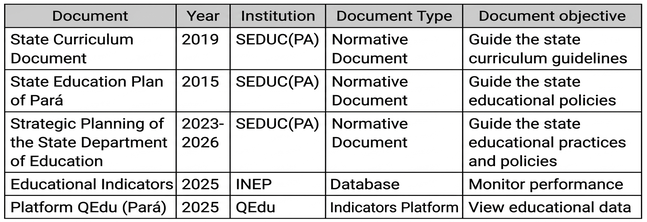
The data were extracted from official documents and educational indicators from the state of Pará, selected for their institutional relevance, public availability, and relationship with the organization and evaluation of basic education in Pará. The analysis did not seek to measure the development of executive functions (EF) in students, but rather to identify their consideration in the analyzed documents. The first stage involved a floating reading of the documents, which were characterized according to Figure 2.
Figure 2: characterization of the documents collected for analysis (2026)
Source: elaborated by the authors based on original research results
The documents listed in Figure 2, such as the State Education Plan (PEE), the State Curricular Document (DCEPA), and the Strategic Planning of the State Department of Education (PESEDUC), offer pedagogical guidelines. Complementarily, the Educational Indicators (INEP) and data from the QEdu platform provide quantitative information on student performance and retention in the network, revealing educational trends.
Executive functions in the State’s teaching guidelines documents
In the State of Pará Curricular Guidelines (DCEPA, 2019), published in 2019, the terms “working memory”, “inhibitory control”, and “cognitive flexibility” are not explicitly mentioned. However, their skills appear implicitly, articulated with the recommendations of the National Common Curricular Base (BNCC), through general learning competencies, active methodologies, evaluative forms that demand self-regulation, and the curricular organization itself.
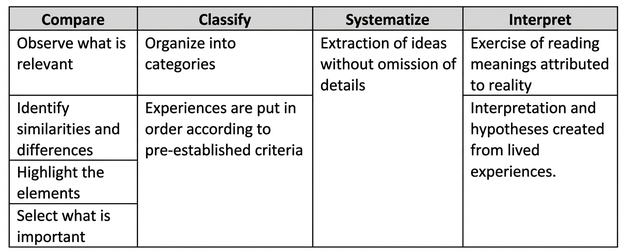
The DCEPA (2019) guides actions that promote the development of cognitive and self-regulatory processes, such as the 10 general competencies of the BNCC. The executive function of working memory can be associated with the document’s intentions for students to articulate knowledge, follow instructions, and integrate learning. The document also values Amazonian diversity and the ways of life of local peoples, incorporating Paulo Freire’s method in Early Childhood Education for the generation of mental action products, as illustrated in Figure 3.
Figure 3: mental actions recorded in the Curricular Document of the state of Pará (2019)
Source: elaborated by the authors based on the Curricular Document of the state of Pará, 2019, p. 61
DCEPA (2019) encourages the child to connect new information to prior experiences, developing the ability to understand and use different forms of communication. This approach relates to working memory, which allows for the storage and manipulation of information for reasoning, event retrieval, and thought organization (Diamond, 2013; Boer and Elias, 2022). Pages 112 and 113 of the document, in sub-axes 1 and 2, demonstrate this relationship by addressing interaction with the environment and the meanings of languages in the social space.
Although the manifestations of executive functions are implicit in various passages of the document, they become clear in the general competencies, which guide the use of prior knowledge in problem-solving and the progressive organization of learning. Inhibitory control, which develops and matures throughout life (Diamond, 2013), is reflected in the state curriculum through aspects of organization, school coexistence, respect, adherence to rules, and active participation, aligning with the need to respect social norms and ethical standards (Cosenza and Guerra, 2011).
The concern in stimulating the student to review hypotheses, reformulate ideas, and adjust procedures in the face of new challenges (p. 176) suggests the consideration of cognitive flexibility. This executive function is driven by teaching strategies that favor activity planning, goal setting, information seeking, identification of important issues, inference, generalization, error detection, and fault correction (Cosenza and Guerra, 2011). The state curriculum also addresses self-regulation, proposing actions that stimulate critical awareness, intellectual and emotional autonomy, aligned with the BNCC. Pages 23 and 24 highlight the relationship with behavior monitoring, strategy adjustments, and emotional regulation, through terms such as “reflect on their desires and goals,” “organize themselves,” “set goals,” and “plan.” Problem-solving emerges in various parts of the curriculum, such as on page 69, which proposes challenges that require organization, anticipation of actions, and decision-making, characteristics of the development of EF.
The analyses indicate that the DCEPA does not directly use the term “executive functions”, but consistently presents pedagogical concepts, practices, and expectations that involve skills such as working memory, inhibitory control, mental flexibility, self-regulation, and planning. This is mainly due to the encouragement of autonomy, continuous assessment, problem-solving, and intentional organization of pedagogical activities.
The State Education Plan (PEE), published in 2015, serves as a benchmark for the state’s educational policies, valuing Amazonian diversities and the development of historical subjects. It emphasizes skills for thinking, deciphering signs, establishing relationships between phenomena, and social emancipation. Although the PEE’s principles dialogue with FE skills, there are no direct mentions of them.
The Strategic Planning of the State Secretariat of Education (PESEDUC, 2023) is a central tool for organizing priorities and addressing educational challenges, based on evidence and the region’s weaknesses and potentialities. Developed in the post-pandemic context, the document presents strategies to support decisions aligned with the demands of Paraense education. PESEDUC was organized into 10 stages, including planning, mapping, document analysis, interviews, collaborative construction, workshops, project development, and strategic monitoring.
The state’s mission to reposition Pará’s basic education, focusing on improving learning, implies the expansion of cognitive and emotional demands. Learning is seen as a construction in which students actively participate in planned actions. However, the document does not explicitly state how this protagonism will be effectively developed (PESEDUC, 2023, p. 35). In this context, the role of cognitive functions must be included in the educational debate, public policies, training, and development. The analysis of educational indicators reinforces the importance of strategies that develop these skills in schooling processes, considering the diverse realities of students and teachers.
The literature on neuroscience points out that teachers’ understanding of the nervous system’s functioning broadens the possibilities for applying practices that develop students’ potential (Queiroz et al., 2020). Although not cited in the state’s planning, the articulation of teacher training and the valorization of their demands are essential. SEDUC’s planning mentions the commitment to welcoming, safe, and well-structured school environments, and the continuous improvement of practices (PESEDUC, 2023, p.37), indicating a movement to enhance the educational environment.
QEdu data from 2023, based on a survey with 10,581 basic education teachers, revealed that 48% agree that the advantages of the profession outweigh the disadvantages, but 56% disagree that the profession is valued by society, and 50% wish to quit. These indicators show the challenges of teaching work and the interconnection between teacher satisfaction and the development of student learning (Ferreira et al., 2022). SEDUC’s strategic planning, despite initiatives for integral development and learning improvement, does not explicitly address the cognitive processes involved, especially executive functions. Mentions are indirect, focusing on life planning, learning monitoring, and goal setting, without addressing the development of these skills in students and teachers. The development of EFs is crucial for teacher self-regulation and student development.
Educational Indicators of Pará Basic Education
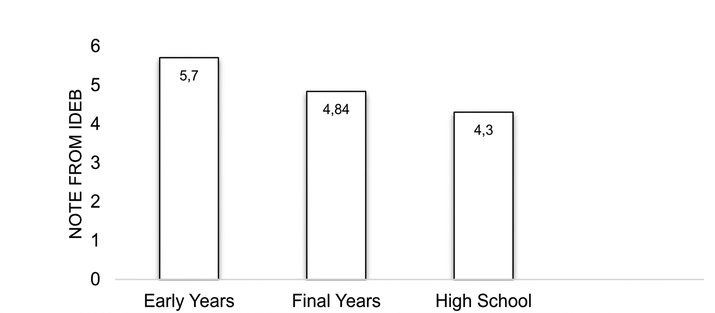
Data from the Basic Education Development Index (IDEB) indicate that Pará’s public education is in a state of alert, with low learning rates in the initial years of Elementary School and low school retention, with about 20% of 16/17-year-olds out of school (QEdu, 2026). Despite recent advances, the region still faces difficulties related to local characteristics, infrastructure, working conditions, professional and educator training, and teacher appreciation (Pará, 2025). Figure 4 shows the most recently recorded rates.
Figure 4: IDEB of the state of Pará by stage of basic education with the most recent registered data from 2023
Source: Elaborated by the authors based on data from QEdu (2024)
Figure 4 shows a decline in the 2023 IDEB indexes in the state as the stages of education advance, with higher values in the Initial Years and lower values in High School. This pattern is observed in several Brazilian regions due to social inequalities, which lead many young people, children of workers, to the need for early work to supplement family income (Rodrigues and Silva, 2023). These results reinforce the importance of strategies that develop cognitive skills in the schooling processes, considering the diverse realities of students and teachers in the region.
Relationships between executive functions and local educational practices
Interventions for the development of FE have been explored in various Brazilian contexts (Assis et al., 2020; Oliveira and Ramos, 2020; Moreira and Barreto, 2026), especially in the digital environment, with the use of games and media. These practices include cognitive challenges, organizational stimuli, and emotional regulation (Castro et al., 2025). To complement the analysis and identify possible teaching practices, the editions of the journal “Entre Saberes: relato de experiência em foco” from 2018 to 2025 were considered, which disseminates quality educational experiences and values the work of Pará education professionals.
Since its first publication, the journal “Entre Saberes” has presented 15 volumes of experience reports from educators in the state who developed pedagogical practices focused on various Amazonian skills, recognition, belonging, and identity. The journal is an initiative of the Center for Training of Basic Education Professionals of the State of Pará (CEFOR). The most recent edition, nº 15 of 2025, highlighted practices on environmental education, sustainability, and climate, including projects on afforestation, selective collection, waste reuse, gardens, planting, digital map construction, and discussions on ecosystems. Previous editions, although with varied themes, share the purpose of socializing practices, generating reflections, and stimulating creativity for meaningful and reflective learning.
Executive functions can be allies in these reflections. Attentional difficulties are associated with attention, cognitive flexibility, and school performance (Boer and Elias, 2022). Such skills are essential for mental and physical health, school success, and cognitive, social, and psychological development (Diamond, 2013). Most reports demonstrate teachers’ commitment to promoting dialogue among local diversities, stimulating student leadership, recognizing culture and identity, developing critical thinking, and literacy. These dimensions approach the construct of EF, especially cognitive flexibility, which involves the ability to “think outside the box”, change perspective and focus (Diamond, 2013).
Dois relatos da revista se destacam. O primeiro, de Antônio Francisco de Sales Júnior (2025, nº 14), “Escutar para Transformar: A Tutoria como Caminho para o Protagonismo Juvenil na Escola de Tempo Integral”, descreve sua atuação como tutor no ensino médio, promovendo o protagonismo juvenil, liberdade de escolha responsável, discussões sobre projeto de vida, escuta ativa e empatia, usando metodologias ativas. Essa ação favoreceu a construção de vínculos de confiança, autoconhecimento e planejamento. O segundo relato, das professoras Évila Roseanne Silva, Geovania Paiva e Patrícia de Oliveira (2021, nº 6), “Live: uma alternativa possível para superar distâncias entre as escolas da Unidade SEDUC na Escola – USE 8 e as comunidades”, descreve o uso de lives durante a pandemia como estratégia pedagógica para reduzir a evasão e manter o engajamento, construindo vínculos e cuidando da dimensão emocional de professores e alunos. Esses relatos evidenciam a imersão na cultura digital e as turbulências do período.
Most of the practices socialized in the journal implicitly dialogue with the development of executive functions. Skills such as inhibitory control, which allows choosing how to react and controlling thoughts and actions (Diamond, 2013), are evident. EFs develop gradually in childhood and adolescence, with a strong impact of environmental factors on nervous system modifications (Cosenza and Guerra, 2011). Teachers’ reports demonstrate the integration of strategies to promote the development of these skills in students, including emotional aspects. However, there are few mentions of neuroscience as a formative component. EFs enable the subject’s interaction with the world, influencing behavior organization, based on experiences, knowledge, memory, expectations, self-assessment, and self-regulation. They allow projecting, executing, and monitoring actions (Diamond, 2013; Cosenza and Guerra, 2011). Greater integration of EFs in guiding documents and teacher training in Pará can be an ally for improving education.
The analyses developed allowed us to identify that the guiding documents and educational indicators of basic education in the state of Pará contemplate elements related to executive functions. Although there are no explicit mentions of these skills, it was possible to identify principles, objectives, goals, skills, and pedagogical practices that directly dialogue with the development of executive functions. In the guiding documents, the State of Pará Curricular Document, the State Education Plan, and the Strategic Planning value competencies such as autonomy, problem-solving, critical thinking, planning, and self-regulation. These characteristics are aligned with the development of executive functions, such as working memory, cognitive flexibility, and inhibitory control, according to Adele Diamond. However, the absence of the neuroscience framework may indicate a gap that limits pedagogical intentionality in the development of these skills, even indirectly. The data from educational indicators highlight persistent challenges in Pará’s basic education, especially in students’ academic performance and retention, reinforcing the need to broaden the debate on cognitive and emotional processes and recognize executive functions as important components for integral development and the improvement of education quality. The analysis of pedagogical practices shared in the journal “Entre Saberes” demonstrated that, even without the use of the term executive functions, many teaching experiences incorporate strategies that favor the development of these skills, such as student protagonism, problem-solving, the use of active methodologies, and valuing the sociocultural context, approaching the development of executive functions.
4. Conclusion
This study sought to analyze the extent to which the guiding documents and educational indicators of Basic Education in the state of Pará contemplated elements related to the development of executive functions. It was found that, although the terms “working memory”, “inhibitory control”, and “cognitive flexibility” were not explicitly mentioned in the official documents, such as the State Curriculum Document of Pará, the State Education Plan, and the Strategic Planning of the State Secretariat of Education, the implicit presence of competencies and pedagogical practices that directly dialogue with the development of these skills was observed. It was identified that the Curriculum Document, for example, encourages actions that promote cognitive and self-regulatory processes, aligned with the general competencies of the National Common Curricular Base, which involve autonomy, critical thinking, problem-solving, and self-regulation. The pedagogical practices socialized in the journal “Entre Saberes” also demonstrated that many educators indirectly incorporate strategies that favor student protagonism, problem-solving, and the use of active methodologies, approaching the construct of executive functions. However, the absence of an explicit neuroscience framework in the analyzed documents indicates a gap that may limit pedagogical intentionality in the development of these skills.
The persistent challenges in basic education in Pará, evidenced by low learning rates and high school dropout rates, reinforce the importance of broadening the debate on cognitive and emotional processes, recognizing executive functions as crucial components for the integral development of students and the improvement of educational quality. The main contribution of this work lies in pointing out the potential for articulating neuroscience in official guidelines and in the training processes of teachers, suggesting the need for investments in continuing education that address the fundamentals of executive functions and strategies for their development in the school context. As a limitation, the study was restricted to the analysis of publicly accessible documents and to the state level. It is suggested that future research advance in the empirical investigation of these skills in the educational context of Pará, considering the sociocultural specificities of the region to deepen the understanding of their application and impact.
Bibliographic References
Antônio Francisco de Sales Júnior, 2025 [Referência completa não encontrada no documento original]
Assis, É.F.; Nogues, C.P; Corso; L.V; Dorneles, B.V; Corso; H.V. 2021. Relações entre a compreensão de leitura, resolução de problemas de raciocínio quantitativo e funções executivas. Ciência & Educação, 27 (e21004): 1-16.
Bardin, L. 1977. Análise de conteúdo. 70ed. Lisboa.
Boer, J.D.C; Elias, L.C.S. 2022. Social skills, executive functions and academic performance: systematic review. Revista Psicopedagogia, 39(119): 270-284.
Castro, T.A.; Vassão, E.M.V.; Borges, M.C.; Melo, D.G.S. 2025. Neurociências e funções executivas no desempenho escolar de estudantes do ensino fundamental II. Unisanta Humanitas, 14(1): 24-33.
Comitê Científico Do Núcleo Ciência Pela Infância. 2016. Funções executivas e desenvolvimento na primeira infância. São Paulo, SP, Brasil.
Cosenza, R.M.; Guerra, L.B. 2011. Neurociência e educação: como o cérebro aprende. Artmed, Porto Alegre, RS, Brasil.
Diamond, A. 2013. Executive functions. Annual Review of Psychology, 64: 135-168.
Diamond, A. 2020. Executive functions. p. 225-240. In: Gallagher, A.; Bulteau, C.; Cohen. D.; Michaud, J.L. Handbook of Clinical Neurology: Neurocognitive Development: Normative Development. Elsevier, Amsterdam, Europa.
Ferreira, E.A.; Costa, E.B.; Silva, A.N.B.; Ramos, M.F.H. (2022). Satisfação no trabalho e saúde docente. p. 93-104. In: Ramos, M.F.H.; Pereira, E.C.C.S.; Silva, E.P. Teoria Social Cognitiva: saúde e bem-estar profissional. Editora Dialética, São Paulo, Brasil.
Gil, A.C. 2022. Métodos e técnicas de pesquisa social. 7ed. Atlas, São Paulo, Brasil.
Moreira, M.A.S.; Barreto, M.R.N. 2026. Desafiando o cérebro: funções executivas e as novas formas de pensar e aprender. Revista Tecnia, 11(1): e11018-e11018.
Oliveira, M.C.; RAMOS, D.K. 2020. Jogos cognitivos na escola: percepção das crianças sobre o aprimoramento das funções executivas. Eccos Revista Científica, 56: 1-26.
Pará. 2019. Documento Curricular do Estado do Pará: Educação Infantil e Ensino Fundamental. Secretaria de Estado de Educação. Belém, PA, Brasil.
Pará. 2023. Planejamento Estratégico da Secretaria de Estado de Educação. Governo do Estado do Pará. Belém, PA, Brasil.
Pará. 2025. Plano Estratégico de Longo Prazo do Estado do Pará. Governo do Estado do Pará. Belém, PA, Brasil.
QEDU. 15-Pará: desigualdades educacionais no Brasil. Disponível em: https://qedu.org.br/desigualdades/15-para. Acesso em: 1 fev. 2026.
Queiroz, N.L.N.; Kunz, E.; Lima, M.F.C. 2020. Contribuições das neurociências para o desenvolvimento e aprendizagem humana. Revista Psicopedagogia, 37(113): 1-10.
Ribeiro, L.L.S.; Johnson, L.F. 2023. Neurociência aplicada à educação: uma abordagem inicial. Communitas, 7(17): 117-132.
Rodrigues, M.I.B.; Da Silva, G.P. 2023. Estado, trabalhadores e políticas públicas educacionais: A educação básica no estado do Pará e as contradições da qualidade. Revista Ibero-Americana de Estudos em Educação, 18: 023016-e023016.
Article originating from a Final Course Work on Neuroscience and Learning in Education
To learn more about the course, click here and access the MBX Academy platform