
Digital Business
September 09, 2026
Between the Physical and the Digital: The Role of the Bank Branch as a Trust Hub in the Adoption of Digital Services by Elderly Customers
Emerson Mota Santos; Natan de Souza Marques
DOI: 10.22167/2675-6528-202602206
Article derived from a Final Course Work (TCC), with content based on the student’s original work and adapted to the editorial format of the E&S Magazine with the support of the ResumeAI tool, an artificial intelligence solution developed by the Pecege Institute for textual synthesis and organization.
Abstract
The digitalization of banking services has transformed the interaction between clients and financial institutions, revealing challenges for the digital inclusion of vulnerable populations, such as elderly clients. The relationship between digital literacy and trust in digital banking services, and its influence on the adoption of these services, was analyzed, considering the physical bank branch as a digital trust hub. The research was characterized as exploratory and descriptive, with a quantitative approach. Structured questionnaires were administered in person to 91 clients aged 50 or over, in a municipality in the interior of Ceará. The results showed moderate to low levels of digital literacy, contrasting with high trust and significant adoption of digital services. It was found that trust acted as a central element for the use of digital channels, even with operational limitations. It was observed that the physical bank branch presented the highest level of perceived relevance, standing out as a space for support, guidance, and security. It was concluded that banking digitalization occurs in an integrated manner, sustained by the interaction between physical and digital channels, with the branch playing a strategic role in mediating the digital experience.
Keywords: Technology adoption; Trust; Digital literacy; Omnichannel; Digital banking.
1. Introduction
The digitalization of banking services has intensified significantly in recent decades, driven by the advancement of digital technologies, the expansion of internet access, and the pursuit of greater operational efficiency and improved customer experience by financial institutions. In Brazil, this movement is already widely consolidated: data from the Brazilian Federation of Banks indicate that more than eighty percent of banking transactions are carried out through digital channels, such as mobile applications, internet banking, and ATMs (FEBRABAN, 2023).
From the perspective of digital transformation, this movement is not limited to the incorporation of new technologies, but involves a broader reconfiguration of the logic of value creation and the relationship with customers. As Rogers (2016) argues, digital transformation requires strategic changes in how organizations understand their customers, use data, and structure their value propositions, reinforcing the need for continuous adaptation of financial institutions to the new dynamics of digital consumption.
Despite technological advancements and the expansion of digital channels, the adoption of these services does not occur homogeneously across all population segments. Elderly customers, in particular, tend to face greater difficulties related to digital literacy, understanding technological interfaces, and perceiving security in the use of digital financial services. Data from IBGE (2022) indicate relevant differences in technology access and use among age groups, especially among individuals with lower educational attainment. Furthermore, factors such as fear of fraud, less familiarity with digital devices, and cognitive or motor limitations can negatively influence the use of these channels (FEBRABAN, 2023). From this perspective, trust emerges as a central element, acting as a mechanism for reducing uncertainty in the use of digital services, as highlighted by Gefen et al. (2003).
In parallel with the advancement of digitalization, a reconfiguration of the role of physical bank branches is observed. Data from the Central Bank of Brazil (2023) indicate a significant reduction in the number of bank branches in the country over the last decade, from approximately 23,000 units in 2014 to about 17,000 in 2023. This movement is corroborated by recent data pointing to a reduction of approximately 37% in the number of branches in Brazil over a ten-year period, reflecting the migration of operations to digital channels and the emergence of new business models. However, this trend does not occur homogeneously in all contexts. While in Brazil a retraction of physical units is observed, in countries like the United States, financial institutions have been expanding or reconfiguring their branches, reinforcing their strategic role in customer relationships (FOLHA DE SÃO PAULO, 2026). It is evident that the physical channel does not lose relevance but is undergoing a process of redefinition, aligning with hybrid models that integrate digital and in-person experiences.
In this context, the bank branch tends to cease being a predominantly transactional space to assume functions of relationship, guidance, and customer support. From the perspective of omnichannelity, as discussed by Verhoef et al. (2015), the integration between physical and digital channels allows the branch to be understood as a strategic space for mediation and digital trust building, especially for audiences that require greater support in the process of adapting to technologies, such as elderly customers.
The realization of this study is justified by the need to deepen the understanding of how digital literacy and trust influence the adoption of digital banking services by elderly customers, considering the mediating role of the physical bank branch in this process. From an academic point of view, the research contributes to the field of Digital Business by exploring the integration between physical and digital channels from the perspective of inclusion and trust. From a managerial point of view, it offers subsidies for the development of strategies more sensitive to the needs of this audience, favoring a more inclusive and accessible digitalization.
In light of the theory of diffusion of innovations proposed by Rogers (2003), it is understood that the adoption of new technologies occurs as a process of uncertainty reduction over time, in which digital literacy can be associated with the knowledge phase, while trust acts as a central element in the formation of favorable attitudes towards use. Given this context, the general objective of this study is to analyze the relationship between digital literacy and trust in digital banking services and their influence on the adoption of these services by elderly clients, considering the physical bank branch as a digital trust hub.
2. Material and Methods
The research was characterized as applied, seeking to generate knowledge with potential for practical application in the banking sector, focusing on the digitalization of financial services, digital literacy of elderly clients, and the role of the physical bank branch as a mediator.
A predominantly quantitative approach was adopted, with complementary support from qualitative elements. The quantitative approach used a structured questionnaire to measure perceptions of digital literacy, trust, and adoption of digital banking services. Qualitative aspects were considered from observations and open-ended responses.
The study has a descriptive and exploratory character, aiming to identify and analyze patterns of behavior, perception, and use of digital banking services among participants, and to explore the integration between digital literacy, trust, and omnichannel for the elderly.
The research was conducted in the context of the Brazilian banking sector, in the vicinity of a bank branch in a small municipality in the interior of Ceará, an environment selected to analyze the phenomenon in a specific regional reality.
The population consisted of clients from a banking institution aged 50 years or older, considered elderly or aging individuals. The choice of this demographic was justified by particularities in the adoption of digital technologies, such as lower digital literacy, higher risk perception, and the need for support.
The sample consisted of 91 respondents, selected by non-probabilistic convenience sampling, considering the accessibility and availability of participants during data collection.
Data collection occurred in person, in the vicinity of the bank branch, during the unit’s operating hours. Participants were approached at different times during banking service, respecting the operational dynamics of the branch.
The data collection instrument was a structured questionnaire, organized into thematic blocks on respondent profile, digital literacy level, perception of trust in digital banking services, degree of adoption of digital channels, and the role of the physical bank branch as a support space. The questions were predominantly in a five-point Likert scale, complemented by multiple-choice questions and an open-ended question to capture perceptions about difficulties and suggestions. The instrument was pre-tested with 12 participants with characteristics similar to the target population to assess clarity, language adequacy, and response time, resulting in specific adjustments.
The collected data were organized in an electronic spreadsheet and analyzed by descriptive statistics, using measures of absolute and relative frequency, and calculation of construct means. Exploratory cross-tabulations between variables were performed to identify associations between digital literacy, trust, adoption of digital banking services, and the role of the physical branch. The qualitative data from the open-ended question were analyzed in a complementary manner, with an illustrative character, to contextualize the quantitative results and understand the participants’ experiences.
Regarding the ethical aspects, respondents’ participation was voluntary, with a guarantee of anonymity and confidentiality of information. No direct identification data was collected, and the data were used exclusively for academic purposes. The identification of the banking institution was not mentioned to preserve organizational secrecy and ensure information confidentiality, in accordance with good research practices.
3. Results and Discussion
Respondent Profile
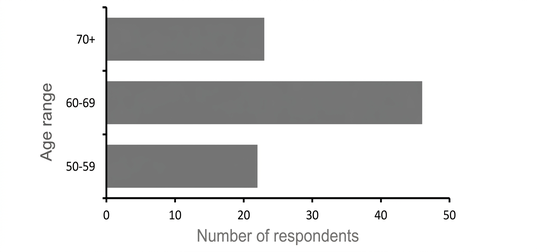
The final sample consisted of 91 respondents aged 50 years or older, characterizing a predominantly older demographic in more advanced life cycle stages. The age distribution indicated a higher concentration in the 60 to 69 years range, representing approximately 51% of the sample. Following this, the 70 years or older bracket accounted for 25%, and the 50 to 59 years bracket for 24% of the participants. This age distribution, as illustrated in Figure 1, highlights the presence of individuals in advanced stages of aging, a group often associated with greater challenges in adapting to digital technologies due to generational differences in access and familiarity with technological resources.
Figure 1. Age distribution of respondents
Source: Original research results
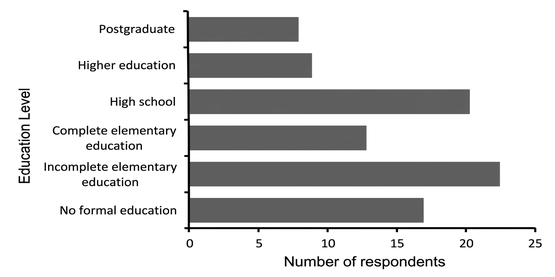
Regarding gender, a predominance of the female sex was observed, corresponding to about 62% of respondents, while male participants represented approximately 38% of the sample. In relation to educational level, the data revealed a significant concentration of respondents with lower levels of formal education. A significant portion of participants declared not having formal education or having only incomplete or complete elementary education. In smaller proportions, respondents with high school, higher education, and postgraduate degrees were observed, as detailed in Figure 2.
Figure 2. Educational level of respondents
Source: Original research results
This educational profile reinforces the presence of potential limitations related to the understanding and use of digital technologies, an aspect directly associated with the concept of digital literacy, which involves not only technical skills but also the ability to interpret, evaluate, and use information in digital environments (van Deursen and van Dijk, 2014). The sociodemographic characterization of the sample, with factors such as age and schooling, suggests a context conducive to the existence of barriers in the use of digital banking services, especially regarding autonomy and understanding of technological interfaces. From the perspective of the diffusion of innovations theory (Rogers, 2003), individuals with less technological familiarity tend to present greater initial resistance to adoption, due to the increased perceived uncertainty. In this context, institutional support and interpersonal interaction become fundamental to facilitate the adoption process, especially among more vulnerable groups.
Digital Literacy of Respondents
The analysis of respondents’ digital literacy revealed moderate to low levels of perceived ability in using digital banking technologies. The observed average for this construct was approximately 2.87 on a scale of 1 to 5, indicating that participants do not fully perceive themselves as capable of using, understanding, and resolving demands related to digital banking channels. This self-perception of digital competence falls below the midpoint of the scale (3.0), reinforcing the existence of relevant limitations in this domain. These limitations are particularly evident in the autonomy for using digital banking channels, including mobile applications, internet banking, and self-service terminals, as well as in understanding the information presented on digital interfaces and in the ability to handle potential difficulties while using the services. The low perceived ability to identify suspicious messages or potential digital fraud highlights a critical point related to information security, an aspect relevant in the banking context, where trust and a sense of security are determining factors for the adoption and continuous use of digital services (Gefen et al., 2003).
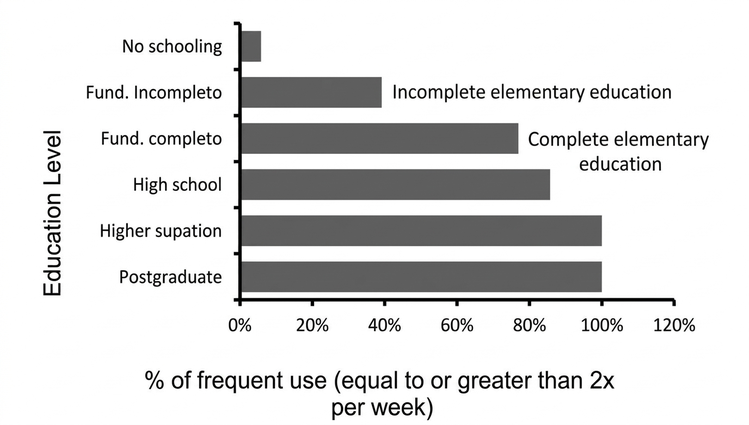
In order to deepen the analysis of the relationship between sociodemographic characteristics and the use of digital services, an exploratory cross-tabulation was performed between the respondents’ educational level and the frequency of use of digital channels, as shown in Figure 3.
Figure 3. Education level X frequency of digital services use
Source: Original research results
Note: Only respondents who used digital channels two or more times per week were considered.
The cross-tabulation analysis indicates that respondents with higher levels of education tend to use digital services more frequently, while those with lower levels of education demonstrate less usage or greater reliance on support for banking operations. This result reinforces the relationship between digital literacy and technology adoption, highlighting that educational factors directly influence the ability to use and autonomy in the digital environment (van Deursen and van Dijk, 2014). Additionally, it was observed that, even with reduced levels of digital literacy, participants are not entirely excluded from the digital environment, suggesting the presence of compensatory mechanisms, such as third-party support or institutional mediation, which can facilitate access to and use of digital banking services. This finding is consistent with Rogers’ perspective (2003), according to which the adoption of innovations can be influenced by interpersonal interactions and support mechanisms that contribute to reducing uncertainty throughout the adoption process. Thus, the results indicate that digital literacy, although relevant, does not act in isolation as a determinant of digital service adoption, and it is necessary to consider the influence of other factors, such as trust and the support offered by the financial institution.
Trust in Digital Banking Services
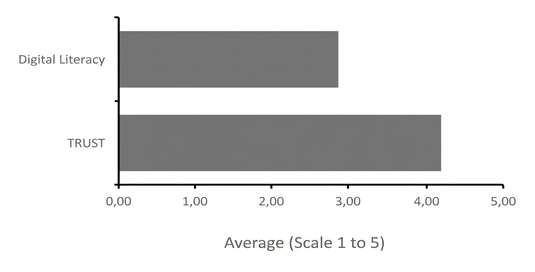
The analysis of variables related to trust in digital banking services showed high levels of perceived security and reliability by the respondents. The observed average for this construct was approximately 4.19 on a scale of 1 to 5, indicating that, overall, participants demonstrate high trust in the digital channels offered by financial institutions. This result is significantly above the midpoint of the scale (3.0), reinforcing the consistency of this perception among respondents. In contrast to moderate levels of digital literacy, the results show a high level of trust in digital banking services by the respondents. This relationship reveals that the use of digital channels is not necessarily conditioned by full technical mastery of the tools. Although participants acknowledge limitations in their ability to use and understand the systems, trust remains high, suggesting that factors such as the financial institution’s credibility, prior experience with the bank, and the perception of available support exert a decisive influence on the decision to use digital services. Even when faced with difficulties related to understanding how the systems work and the fear of making mistakes or suffering financial losses, respondents demonstrated a high perception of security in transactions and the protection of their personal data. This result highlights a possible disconnect between “knowing how to use” and “trusting to use,” indicating that trust can override operational limitations in the adoption process. Such evidence aligns with studies that point to trust as one of the main predictors of the intention to use financial technologies in contexts of higher perceived risk (Gupta et al., 2019). In the context of this research, trust acts as a mechanism that allows the user to overcome their digital literacy limitations, favoring the adoption of services even when facing operational difficulties. The literature on digital technology adoption highlights trust as one of the main determinants of online service use, especially in contexts involving perceived risks, such as the banking sector (Gefen et al., 2003; Rogers, 2003). Another relevant aspect concerns the perception of security regarding transactions and data protection. Respondents demonstrated belief that their information is protected and that digital channels are secure for conducting banking operations. This perception may be directly related to the institutional role of banks, traditionally associated with reliability and security, which contributes to building a digital environment perceived as safe. Additionally, the influence of the physical bank branch in building this trust is noteworthy. The presence of a physical channel, associated with the possibility of guidance and support, tends to reinforce the sense of security in using digital services, especially among customers with lower levels of digital literacy. This aspect highlights the importance of integrating physical and digital channels, in the context of omnichannel, where different contact points act complementarily in building the customer experience. To demonstrate the relationship between digital literacy and trust in digital banking services, Figure 4 is presented, which compares the averages of the two analyzed constructs.
Figure 4. Comparison between digital literacy and trust in banking services
Source: Original research results
A significant difference is observed between the levels of digital literacy (2.87) and trust in digital services (4.19), indicating that, even with limitations in the perception of digital capability, respondents demonstrate high trust in digital channels. This result reinforces the idea that trust can act as a mediating element in the adoption process, reducing the uncertainty associated with the use of technologies (Gefen et al., 2003; Rogers, 2003). Thus, the results indicate that trust plays a central role in the relationship between elderly customers and digital banking services, functioning as a mediating element that enables the adoption of these services even in the presence of limitations related to digital literacy. This pattern can be understood as a mediated digital adoption process, in which the use of services does not stem exclusively from user autonomy, but from the presence of support and trust mechanisms.
Adoption of Digital Banking Services
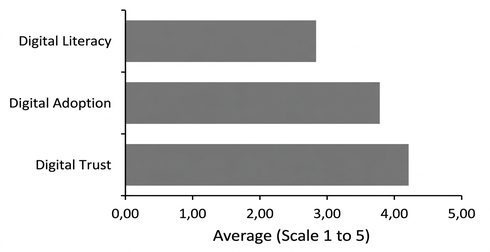
The analysis of variables related to the adoption of digital banking services indicated moderate to high levels of utilization by respondents. The observed average for this construct was approximately 3.78 on a scale of 1 to 5, suggesting that, overall, participants do use digital channels, although not in a fully intensive or completely autonomous manner. This value is positioned above the midpoint of the scale (3.0) and between the levels of digital literacy (2.87) and trust (4.19), evidencing an intermediate behavior between perceived capability and security in using the services. This result highlights a relevant aspect when compared to the previously identified levels of digital literacy. Despite the perceived limitations in the ability to use and understand digital services, respondents demonstrated engagement in using these channels, especially for simpler operations. Such behavior suggests that the adoption of digital banking services does not depend exclusively on technical mastery of the tools, being influenced by other factors, such as trust, convenience, and available support. According to the technology acceptance model proposed by Davis (1989), the use of digital systems is associated with the perception of usefulness and ease of use. In the context of this study, even if ease of use is not fully perceived by respondents, the usefulness of digital banking services – such as the possibility of avoiding travel, reducing queues, and performing operations more quickly – may act as a determining factor for adoption. Complementarily, the UTAUT model (Venkatesh et al., 2003) highlights that technology adoption is influenced by factors such as performance expectancy, effort expectancy, and facilitating conditions. In this sense, the presence of institutional support, such as guidance offered by the bank branch, can be understood as a facilitating condition that contributes to the use of digital services, even among users with lower levels of digital literacy. From the perspective of the diffusion of innovations theory (Rogers, 2003), the adoption of new technologies occurs gradually, as perceived uncertainty is reduced. In this context, trust and interpersonal support play a relevant role in facilitating the transition from assisted use to autonomous use, especially among individuals with less technological familiarity. Another relevant point refers to the intention of continuity in the use of digital services. Respondents showed a predisposition to maintain or expand the use of these channels, especially when adequate guidance is offered. This finding reinforces the importance of support and training strategies capable of reducing perceived barriers and increasing user confidence in the digital environment. Furthermore, it is observed that the adoption of digital services occurs, in many cases, with assistance, either through the support of family members or the guidance of bank branch employees. This behavior shows that the use of digital channels occurs predominantly as part of a gradual transition process, in which the user migrates from in-person to digital service with the support of third parties. The analysis of variables related to autonomy in the use of digital channels and the need for assistance from third parties allows for the identification of a relevant pattern in respondents’ behavior. It is found that a significant portion of participants who claim to use digital banking services also indicate a frequent need for help, whether from family members or financial institution employees. This result suggests the existence of a phenomenon that can be characterized as mediated adoption, in which the user accesses digital services, but not in a fully autonomous manner, depending on third-party support for performing operations. Given this scenario, the elderly customer is not necessarily configured as an independent digital user, but as an assisted user. This finding has relevant implications, as it shows that the digitalization of banking services, while expanding access, does not eliminate the dependence on human support. On the contrary, it can generate new forms of dependence, especially in contexts of lower digital literacy. Furthermore, this dynamic raises important questions related to privacy and information security, as the sharing of data and credentials with third parties can expose users to additional risks. The following figure summarizes the relationship between the analyzed constructs, comparing the averages of digital literacy, adoption of digital banking services, and trust.
Figure 5. Comparison between digital literacy, adoption, and trust in digital banking services
Source: Original research results
It is observed that adoption (3.78) is positioned between the levels of digital literacy (2.87) and trust (4.19), suggesting that usage behavior results from a balance between capacity limitations and high levels of trust. This result reinforces the interpretation that trust acts as a mediating element in the adoption process, especially in contexts of lower digital literacy, contributing to the reduction of uncertainty associated with technology use (Gefen et al., 2003; Rogers, 2003). Thus, the results indicate that the adoption of digital banking services among elderly clients occurs progressively and in a mediated manner, being influenced by factors that go beyond digital literacy, such as trust in the channels and the support offered by the financial institution. This scenario reinforces the need for integrated approaches that consider both technological aspects and human and institutional factors in the digitalization process of banking services.
Role of the Banking Agency as a Digital Trust Hub
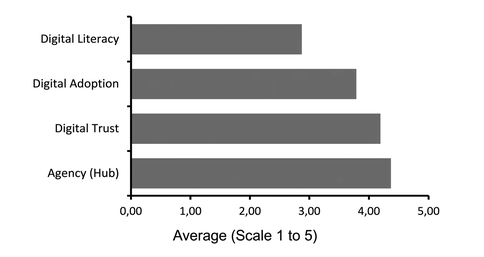
The analysis of variables related to the role of the physical bank branch revealed a high perception of relevance of this channel in the adaptation and utilization process of digital services. The observed average for this construct was approximately 4.37 on a scale of 1 to 5, representing the highest value among the constructs analyzed in the study. This result highlights the centrality of the physical branch in the investigated context, surpassing the levels of trust in digital channels (4.19), adoption (3.78), and, more markedly, digital literacy (2.87). This finding indicates that respondents attribute a central role to the bank branch not only in providing traditional services but, above all, as a space for support, guidance, and trust-building in the use of digital channels. Such a perception reinforces the idea that, even in a context of increasing digitalization, the physical presence of the branch continues to play a strategic role in the relationship between customers and financial institutions. The high valuation of the physical environment becomes even more significant when analyzed in conjunction with the observed levels of digital literacy in the sample. Considering that respondents demonstrated limitations in their ability to fully utilize digital services, the branch emerges as a mediating element, capable of reducing cognitive and operational barriers, facilitating the transition to the use of digital channels. From the perspective of the diffusion of innovations theory (Rogers, 2003), this result can be interpreted in light of the role of interpersonal interactions in the technology adoption process. Rogers emphasizes that uncertainty reduction occurs largely through interpersonal communication channels, especially in the persuasion and decision phases. In this sense, the physical bank branch can be understood as a privileged channel of human interaction, contributing to trust-building and the adoption of digital services by customers with less technological familiarity. In this context, the branch’s role can also be understood in light of the concept of omnichannelity, in which the integration between physical and digital channels provides a more fluid and consistent customer experience. As discussed by Verhoef et al. (2015), omnichannel strategies aim to integrate multiple touchpoints, allowing consumers to move between channels in a complementary manner. In the context of this study, the physical bank branch does not compete with digital channels but acts as support for their use. To synthesize the relationship between the analyzed constructs, Figure 6 is presented, which compares the averages of digital literacy, trust, adoption, and the role of the physical bank branch.
Figure 6. General comparison of the analyzed constructs
Source: Original research results
The comparative analysis shows that the physical bank branch presents the highest level of perceived relevance among the constructs, positioning itself even above trust in digital channels. This result allows us to infer that, even in a highly digitized environment, physical support plays a determining role in sustaining the use of digital services. In other words, the data indicate that the advancement of digital, in the analyzed context, is not sustained in isolation, being structurally supported by physical mechanisms of support, guidance, and trust-building. Thus, it is observed that, in an increasingly digital environment, the physical element – represented by the bank branch – remains a fundamental basis for building trust and enabling the adoption of digital services. Additionally, it is noted that the guidance offered by branch employees directly influences customers’ trust in digital services. This human support contributes to reducing the uncertainty and fear associated with using technologies, especially among users with less digital familiarity. Another relevant aspect refers to the perception of the in-person structure as a point of security in the customer relationship. The possibility of resorting to a physical space in case of doubts or problems strengthens trust in digital services, acting as a “safety net” that supports the use of these channels. In this sense, it is observed that the analysis of open-ended responses and variables related to support reveals a relevant pattern in respondents’ behavior, indicating that digital channels are preferably used for routine operations, while the physical bank branch is accessed in situations considered more complex or critical. This behavior suggests that the branch is no longer perceived as the primary space for conducting everyday transactions, but rather as an environment for problem-solving, making more sensitive decisions, and managing exceptional situations. Examples reported by respondents include, for instance, difficulties in adjusting transaction limits or resolving blockages, situations that motivate a visit to the branch. This finding reinforces the understanding that physical and digital channels do not act as substitutes but as complements, assuming distinct roles throughout the customer journey. Thus, the bank branch can be interpreted as an “operational security” mechanism, activated in moments of greater uncertainty or complexity, which aligns with the logic of omnichannelity, where different channels are used according to the nature of the demand. Furthermore, qualitative data show that the bank branch can play a relevant role in supporting the infrastructure for accessing digital services. Respondent reports indicate that many users prefer to use digital channels near the branch, where they feel safer or have the possibility of seeking assistance in case of technical difficulties. This behavior suggests that the branch can act not only as a service space but also as an environment that facilitates digital inclusion, offering technical support and safer conditions for using digital services. In this sense, the branch approaches an educational and operational support role, contributing to the gradual development of users’ digital autonomy. Therefore, the results indicate that the physical bank branch plays a fundamental role as a digital trust hub, acting as a link between customers’ digital literacy and the adoption of digital banking services. This mediating role highlights that the digitalization of financial services does not imply the replacement of physical channels, but rather their redefinition within an integrated logic, in which the physical and digital coexist complementarily.
Synthesis of Results
The results obtained in this study highlight consistent and relevant patterns in the relationship between digital literacy, trust, and adoption of digital banking services by elderly customers. In general, it was observed that respondents exhibit moderate to low levels of digital literacy, contrasting with high levels of trust in digital services and significant adoption of these channels. This mismatch between perceived ability and usage behavior reveals a central aspect of the analyzed dynamic. This scenario indicates that the use of digital banking services is not exclusively conditioned by technical mastery of the tools, being strongly influenced by factors such as trust in financial institutions, perceived usefulness of the services, and the availability of support. In this context, trust emerges as a key element, acting as a bridge between digital literacy limitations and the effective use of digital channels. Furthermore, the role of the physical bank branch as a structuring element of this process is emphatically highlighted. The results demonstrate that the branch acts as a true digital trust hub, offering support, guidance, and security to customers, especially those with less technological familiarity. This role not only reduces perceived barriers but also practically enables the integration of these users into the digital environment. One of the study’s most relevant findings lies in the evidence that, even in a context of increasing digitalization, the physical environment remains a support base for the use of digital services. In other words, the data indicate that the advancement of digital does not occur autonomously but is sustained by physical structures that offer support, security, and mediation to the user. From this perspective, the results reinforce the importance of omnichannel banking, demonstrating that the integration between physical and digital channels not only expands access to services but also promotes a safer, more assisted, and inclusive experience. In this scenario, the bank branch does not lose relevance but is redefined, assuming a strategic role as a mediator of the digital experience and as a facilitator of technology adoption.
4. Conclusion
This study analyzed the relationship between digital literacy and trust in digital banking services, and its influence on the adoption of these services by elderly customers, considering the physical bank branch as a digital trust hub. It was found that respondents presented moderate to low levels of digital literacy, contrasting with high trust in digital services and significant adoption of these channels. It was observed that trust acted as a central element, mediating the limitations of digital literacy and enabling the use of digital channels, even in the face of operational difficulties. It was concluded that the physical bank branch played the role of greatest perceived relevance, functioning as an essential space for support, guidance, and building security for users. This scenario highlighted that banking digitalization occurs in an integrated manner, sustained by the interaction between physical and digital channels, with the branch exercising a strategic function in mediating the digital experience. The research contributes to the field of Digital Business by exploring the integration between physical and digital channels from the perspective of inclusion and trust, offering managerial subsidies for strategies more sensitive to the needs of vulnerable populations, promoting a more inclusive and accessible digitalization.
As a limitation, the geographical scope of the research stands out, concentrated in a municipality in the interior of Ceará, and the use of convenience sampling, which may restrict the generalization of the results. In this sense, it is suggested that future studies broaden the scope of the investigation to different regional contexts and socioeconomic profiles, as well as deepen the analysis through qualitative approaches. Additionally, future research can investigate the evolution of the role of bank branches in digital transformation, analyzing how different service models — in-person, digital, and hybrid — articulate along the customer journey, aiming at the development of more effective channel integration strategies, strengthening user trust, and promoting a safer, more accessible, and customer-centric digital experience.
Bibliographic References
BACEN – BANCO CENTRAL DO BRASIL. Relatório de Economia Bancária 2023. Brasília: Banco Central do Brasil, 2023.
DAVIS, Fred D. Perceived usefulness, perceived ease of use, and user acceptance of information technology. MIS Quarterly, v. 13, n. 3, p. 319–340, 1989.
FEBRABAN – FEDERAÇÃO BRASILEIRA DE BANCOS. Pesquisa FEBRABAN de Tecnologia Bancária 2023. São Paulo: FEBRABAN, 2023.
FOLHA DE SÃO PAULO. Brasil perde 37% das agências bancárias em dez anos. São Paulo, 2026. Disponível em: https://www1.folha.uol.com.br/mercado/2026/03/brasil-perde-37-das-agencias-bancarias-em-dez-anos.shtml. Acesso em: 29 mar. 2026.
GEFEN, David; KARAHANNA, Elena; STRAUB, Detmar W. Trust and TAM in online shopping: an integrated model. MIS Quarterly, v. 27, n. 1, p. 51–90, 2003.
GUPTA, A.; Dogra, N.; George, B. Trust and adoption of fintech services: the role of perceived risk and customer innovativeness. Journal of Financial Services Marketing, v. 24, n. 3-4, p. 102-114, 2019.
IBGE – INSTITUTO BRASILEIRO DE GEOGRAFIA E ESTATÍSTICA. Acesso à internet e à televisão e posse de telefone móvel celular para uso pessoal 2022. Rio de Janeiro: IBGE, 2022.
ROGERS, David L. The digital transformation playbook: rethink your business for the digital age. New York: Columbia Business School Publishing, 2016.
ROGERS, Everett M. Diffusion of innovations. 5. ed. New York: Free Press, 2003.
VAN DEURSEN, Alexander J. A. M.; VAN DIJK, Jan A. G. M. The digital divide shifts to differences in usage. New Media & Society, v. 16, n. 3, p. 507–526, 2014.
VENKATESH, Viswanath et al. User acceptance of information technology: toward a unified view. MIS Quarterly, v. 27, n. 3, p. 425–478, 2003.
VERHOEF, Peter C.; KANNAN, P. K.; INMAN, J. Jeffrey. From multi-channel retailing to omni-channel retailing. Journal of Retailing, v. 91, n. 2, p. 174–181, 2015.
Article originating from the Final Course Work of Specialization in Digital Business from the MBA USP/Esalq
To learn more about the course, click here and access the MBX Academy platform