
School Management
October 07, 2026
Value-Based Organizational Culture: Employee Engagement and the Role of Leadership in a Confessional School
Simone Aparecida Ferreira Soares; Marcos César Rodrigues de Miranda
DOI: 10.22167/2675-6528-202603650
Article derived from a Final Course Work (TCC), with content based on the student’s original work and adapted to the editorial format of the Revista E&S with the support of the ResumeAI tool, an artificial intelligence solution developed by the Pecege Institute for textual synthesis and organization.
Abstract
The school environment depends on effective pedagogical practices and an organizational culture capable of promoting alignment between institutional values and the behavior of professionals. The study analyzed the influence of a values-based organizational culture on employee engagement in a Catholic confessional educational institution, considering the role of leadership in consolidating this culture and building the work environment. The research was characterized as descriptive, with a qualitative approach, developed through a case study. Literature review, document analysis, and data from an organizational climate questionnaire applied to employees in 2026 were used. The results showed that the presence of clear and shared institutional values, associated with the performance of leadership, contributed to strengthening employees’ sense of belonging, cooperation, and commitment. A predominance of positive perceptions was observed in the analyzed dimensions, with emphasis on the high level of engagement. However, points of attention were identified related to internal communication, team integration, and openness to dialogue, especially in the work environment dimension. It was concluded that a values-based organizational culture is a relevant element for promoting employee engagement in the school environment, although its sustainability depends on the integrated action of leadership and the continuous strengthening of management practices.
Keywords: Work environment; Institutional climate; Organizational culture; Engagement; Leadership.
1. Introduction
Education is a fundamental pillar for human, social, and cultural development, contributing to the formation of critical, ethical individuals aware of their role in society. In this context, educational institutions transcend the mere transmission of knowledge, assuming responsibility for integral formation, which includes the construction of values, the development of socio-emotional skills, and the promotion of meaningful human relationships in the school environment.
The school, as a complex social space, inextricably articulates human relations, institutional organization, and pedagogical processes, directly influencing the quality of teaching and the development of the individuals involved (Libâneo, 2013). For this process to be effectively realized, it is fundamental that the institutional environment promotes cooperative work relations, alignment among the organization’s members, and the engagement of professionals working in the educational context.
In this sense, organizational culture emerges as a central element, as it guides behaviors, practices, and relationships within institutions. It can be understood as a set of shared values, beliefs, norms, and assumptions that influence how individuals perceive, interpret, and act in the workplace. According to Schein and Schein (2022), organizational culture is built over time from the organization’s collective experiences, being transmitted and reinforced through institutional practices and leadership actions.
In the school environment, this dimension acquires even greater relevance, especially in confessional institutions, where values are structuring elements of institutional identity. In these contexts, organizational values not only guide pedagogical practices but also directly influence interpersonal relationships, organizational climate, and the level of employee engagement. Organizations that develop a value-based culture tend to promote greater alignment between institutional objectives and employee expectations, fostering a stronger sense of belonging, motivation, and commitment (Barrett, 2017). This alignment becomes even more significant when associated with the performance of leadership, which is responsible for translating institutional values into concrete practices in the organizational daily life.
Employee engagement, in turn, constitutes an essential element for the functioning of educational institutions, being directly related to motivation, commitment, and the quality of practices developed in the school environment (Dutra, 2017). Recent studies, such as those by Madruga (2023), highlight that engagement is directly associated with the experience lived in the work environment, being influenced by factors such as organizational culture, management practices, internal communication, and the quality of interpersonal relationships.
Given this context, the following research question arises: in what way does a values-based organizational culture, associated with leadership performance, influence employee engagement in the school environment? The relevance of this study lies in its contribution to understanding the role of organizational culture and leadership in school management, especially in faith-based institutions, where values play a structuring role in the organization of work and institutional relations. The objective of this study was to analyze the influence of a values-based organizational culture on employee engagement in a Catholic faith-based educational institution, also considering the role of leadership in consolidating this culture and in building the work environment.
2. Material and Methods
The research was characterized as descriptive, with a qualitative approach, developed through a case study in a Catholic confessional educational institution. The investigated institution is a private school that serves Early Childhood Education and Elementary and Middle School – Early and Late Years, with 269 students and 58 collaborators.
The methodological procedures included literature review, document analysis, and analysis of data from an organizational climate questionnaire. The literature review provided theoretical grounding on organizational culture, institutional values, employee engagement, and the role of leadership.
The documentary analysis focused on the Political-Pedagogical Project and the Internal Regulations (Colégio Santa Clara, 2025b), both in effect during the research period. These documents were subjected to systematic and interpretive reading, focusing on the identification of categories related to organizational culture, institutional values, educational mission, and operating guidelines. For this analysis, the content analysis approach was used, according to Bardin (2011), aiming to organize the information into thematic categories aligned with the research objectives and to support the interpretation of the organizational climate questionnaire data.
Additionally, data from an organizational climate questionnaire applied by the institution’s management to employees in February 2026 were analyzed. The questionnaire aimed to promote listening to professionals and to understand their perceptions of the institutional environment. Participation was anonymous, without individual identification of respondents. The data were made available for this research and analyzed in an aggregated manner, preserving the anonymity of the participants.
The questionnaire instrument included questions structured on a Likert scale and an open-ended question, addressing aspects of organizational culture, institutional values, employee engagement, and work environment. Of the institution’s total of 58 employees, 36 responded to the questionnaire, including professors and technical-administrative staff. It should be noted that this was the first application of the instrument in the institutional context, with no historical data for comparison, which constitutes a limitation of the research.
The data analysis was performed interpretatively, seeking to establish relationships between empirical data and the theoretical framework. The results were organized into analytical categories, comprising: organizational culture, institutional values, employee engagement, work environment, analysis of data and open responses from the organizational climate questionnaire, and the role of leadership in consolidating organizational culture.
3. Results and Discussion
The organizational culture of the institution under analysis, as defined by Fleury and Fischer (2009) and Schein and Schein (2022), is a system of shared meanings that guides practices and behaviors. In the institution studied, this culture is a structuring element of its identity, built over a century-long trajectory and influenced by foundational values and its educational mission.
The institution, founded in 1922 by German Franciscan nuns, established an educational proposal based on human, religious, and intellectual formation, with a “pedagogy of love” (Menezes, 1981). Its mission is to “Educate, through excellence in education, supportive, competitive students with a high sense of critical thinking, dynamic, imbued with Christian Evangelical, Franciscan values”. The Political-Pedagogical Project (Colégio Santa Clara, 2025a) and the Internal Regulations (Colégio Santa Clara, 2025b) reinforce these values, aligning with national educational documents and promoting a comprehensive education that seeks the human, social, cultural, artistic, religious, and ethical development of students.
Institutional values and their presence in daily school life
Organizational values, understood as fundamental principles that guide behavior (Chiavenato, 2014), are particularly significant in confessional institutions, as they connect directly to the mission. Barrett (2017) highlights that value-based management promotes alignment between individual and organizational purposes, strengthening employee engagement.
At the institution, evangelical and Franciscan values are linked to Christian tradition and mission. They are manifested in institutional practices such as pedagogical meetings, formative and religious moments, and solidarity actions, which incorporate principles of integration, participation, solidarity, and spirituality. The pedagogical proposal emphasizes “learning to live together,” fostering autonomy, socialization, and teamwork, and valuing attitudes such as solidarity, responsibility, and respect for differences. These values, when experienced, influence relationships and commitment, contributing to a cohesive and collaborative educational environment.
Employee engagement and commitment in the school environment
Employee engagement is essential for the functioning of educational institutions, influenced by organizational culture, environment, and management practices (Dutra, 2017; Madruga, 2023). The research data indicated that engagement in the institution is associated with identification with the organizational mission and values. A high level of engagement was observed, with approximately 85% agreement, as well as 76% for institutional values and 74% for organizational culture.
The open-ended questionnaire responses reinforced these results, highlighting terms such as welcome, respect, spirituality, fraternity, and a sense of belonging. Management’s performance is strategic for sustaining this engagement, promoting practices consistent with the values, strengthening internal communication, and creating conditions for employee participation and recognition.
Relationship between value-based organizational culture and employee engagement
Organizational culture directly influences attitudes and behaviors at work, including commitment and engagement (Oliveira and Tamayo, 2004). In confessional institutions with a consolidated tradition, organizational values guide practices and collective commitment to the educational mission. A values-based culture creates a coherent work environment, where institutional principles direct decisions and relationships, strengthening the sense of belonging and commitment.
Barrett (2017) points out that organizations with a culture structured around shared values promote greater alignment between institutional expectations and individual motivations. In the analyzed institution, evangelical and Franciscan values, present in the mission and pedagogical proposal, contribute to a humanistic and supportive culture. This is corroborated by the high agreement rates in the dimension of institutional values (approximately 76%) and organizational culture (about 74%). The appreciation of respect, cooperation, solidarity, and commitment to integral formation strengthens relationships and the organizational climate. The institution’s historical tradition and the continuity of its educational project reinforce the sense of institutional identity, resulting in greater dedication and commitment from professionals.
Analysis of the organizational climate questionnaire data
The organizational climate questionnaire, applied in February 2026 to 36 out of 58 employees, sought to identify perceptions about the work environment, values, and engagement. The instrument, using a Likert scale, addressed four dimensions: organizational culture, institutional values, employee engagement, and work environment. The questionnaire’s application was a recent initiative, with no historical data for comparison, which constitutes a limitation of the study.
Table 1 summarizes the main results obtained.
Table 1. Synthesis of the organizational climate questionnaire results
| Dimension | Main highlight | % Fully agree (average) | Interpretation |
|---|---|---|---|
| Organizational Culture | Strong identification with mission and values | ~74% | Consolidated culture |
| Institutional Values | Coherence between discourse and practice | ~76% | Experienced values |
| Employee Engagement | High level of commitment and belonging | ~85% | High engagement |
| Work Environment | Consolidated respect, but with integration challenges | ~66% | Point of attention |
Source: Original research results
The results showed a predominance of responses in the categories “Strongly agree” and “Partially agree” in all dimensions, indicating a predominantly positive perception of the institutional environment. In the Organizational Culture dimension, 91.6% of collaborators (74.4% strongly and 17.2% partially agreed) with the knowledge and internalization of the mission and values, indicating a perception of belonging (Schein and Schein, 2022). In the Institutional Values dimension, 83.3% strongly agreed and 2.8% partially agreed with the promotion of respect, solidarity, and cooperation, reinforcing the coherence between values and practices (Barrett, 2017).
The Employee Engagement dimension presented the most significant results, with 85.5% total agreement and 6.7% partial agreement, indicating a high level of dedication and identification with the mission. A practical example was the choice of 9 out of 15 employees with school-aged children to enroll them in the institution itself, suggesting confidence. However, economic factors and scholarship policies also influence these decisions (Robbins, 2005; Dutra, 2017). The turnover rate, with 6 resignations in 2023, 3 in 2024, and 4 in 2025, within a workforce of 68-69 employees, is relatively low, suggesting stability, but should also be analyzed considering external and individual factors.
The Workplace dimension, in turn, showed greater variability in the responses. Table 2 details this dimension.
Table 2. Distribution of responses from the Work Environment dimension (%)
| Question | Statement | DT (%) | DP (%) | N (%) | CP (%) | CT (%) |
|---|---|---|---|---|---|---|
| Q15 | The environment favors collaboration among professionals | 2,8 | 8,3 | 5,6 | 22,2 | 61,1 |
| Q16 | I feel respected in the workplace | 2,8 | 0,0 | 5,6 | 16,7 | 77,8 |
| Q17 | There is dialogue and openness to listen to collaborators | 2,8 | 5,6 | 8,3 | 19,4 | 63,9 |
| Q18 | The teams work in an integrated manner | 5,6 | 11,1 | 5,6 | 16,7 | 61,1 |
Source: Original research results
It was observed that the highest agreement rates were concentrated in the perception of interpersonal respect. However, aspects related to team integration, communication, and dialogue showed greater dispersion, evidencing opportunities for improvement. This suggests that, although the institution has solid cultural foundations, there are still daily challenges related to internal communication and integrated work. Table 3 presents an overview of the distribution of responses across all dimensions.
Table 3 – Distribution of organizational climate questionnaire responses (%)
| Question | Dimension | DT | DP | N | CP | CT |
|---|---|---|---|---|---|---|
| 1 | Culture | 2,8 | 2,8 | 0,0 | 16,7 | 77,8 |
| 2 | Culture | 2,8 | 2,8 | 2,8 | 25,0 | 66,7 |
| 3 | Culture | 2,8 | 2,8 | 5,6 | 16,7 | 72,2 |
| 4 | Culture | 2,8 | 2,8 | 5,6 | 19,4 | 69,4 |
| 5 | Culture | 2,8 | 2,8 | 0,0 | 8,3 | 86,1 |
| 6 | Values | 2,8 | 2,8 | 2,8 | 11,1 | 80,6 |
| 7 | Values | 2,8 | 0,0 | 2,8 | 2,8 | 83,3 |
| 8 | Values | 2,8 | 2,8 | 2,8 | 25,0 | 66,7 |
| 9 | Values | 2,8 | 0,0 | 5,6 | 16,7 | 75,0 |
| 10 | Engagement | 5,6 | 2,8 | 5,6 | 16,7 | 69,4 |
| 11 | Engagement | 2,8 | 2,8 | 2,8 | 2,8 | 88,9 |
| 12 | Engagement | 2,8 | 0,0 | 2,8 | 8,3 | 86,1 |
| 13 | Engagement | 2,8 | 0,0 | 2,8 | 0,0 | 94,4 |
| 14 | Engagement | 0,0 | 2,8 | 2,8 | 5,6 | 88,9 |
| 15 | Environment | 2,8 | 8,3 | 5,6 | 22,2 | 61,1 |
| 16 | Environment | 2,8 | 0,0 | 5,6 | 16,7 | 77,8 |
| 17 | Environment | 2,8 | 5,6 | 8,3 | 19,4 | 63,9 |
| 18 | Environment | 5,6 | 11,1 | 5,6 | 16,7 | 61,1 |
Source: Original research results
The predominance of agreement responses in all dimensions, especially in engagement, reinforces the evidence from the documentary analysis about the influence of organizational culture on engagement. However, the greater dispersion in the work environment dimension and the research limitations (absence of historical data and partial participation) indicate the need for continuity of institutional listening practices for more consistent future analyses.
Analysis of open-ended responses
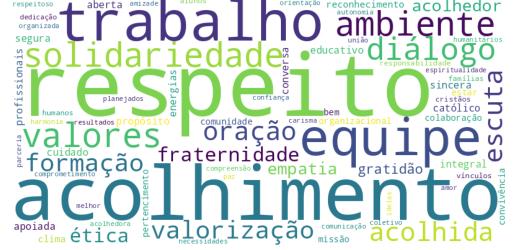
The open-ended question on the questionnaire invited collaborators to identify the aspects of culture and values that most contribute to engagement. Qualitative analysis of the responses allowed for the identification of relevant patterns, illustrated in Figure 1.
Figure 1. Word cloud of the open-ended responses from the organizational climate questionnaire
Source: Original research results
The recurrence of terms such as welcoming, respect, institutional values, teamwork, and spirituality indicates that engagement is strongly associated with relational and symbolic dimensions. The emphasis on “welcoming,” linked to positive interpersonal relationships and care, reinforces the importance of the relational environment (Chiavenato, 2014). Terms like values, solidarity, fraternity, listening, and empathy suggest that institutional principles are experienced in daily life (Schein and Schein, 2022).
The frequency of words such as team, collaboration, training, valorization, dialogue, and communication highlights the importance of collective interactions. However, the variability in quantitative data for these dimensions suggests that, although recognized, such practices still require strengthening. The mention of spirituality, prayer, fraternity, and gratitude reflects the confessional identity and a sense of shared purpose (Dutra, 2017), where work transcends functional aspects.
The role of leadership in consolidating organizational culture and engaging employees
Leadership plays a fundamental role in building and strengthening organizational culture, translating values into practices (Lück, 2009). The school regulations explicitly state that it is the principal’s responsibility to “plan, direct, coordinate, and evaluate the College’s activities”, relating leadership to the realization of the philosophical and educational principles of the institutional culture.
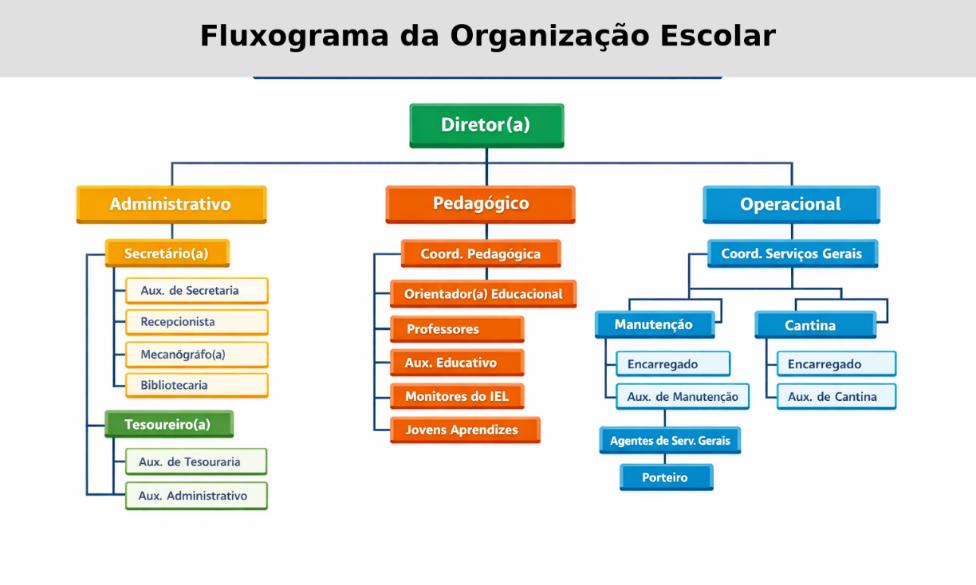
Figure 2 illustrates the organizational structure of the institution.
Figure 2. Organizational structure of the institution.
Source: Original research results.
Leadership in the institution is decentralized, distributed across administrative, pedagogical, and operational levels. This shared leadership configuration demands coherence among different leaders for the effectiveness of the institutional culture (Schein and Schein, 2022). Pedagogical leadership, for example, plays a central role in mediating between values and educational practices, influencing teacher engagement.
However, the existence of multiple leadership levels also implies challenges, especially in communication, integration between sectors, and articulation of practices, as evidenced by the greater variation in responses from the work environment dimension. Strengthening integration among leaders, through intersectoral meetings, dialogue spaces, and participatory management practices, is strategic for improving the work environment and consolidating a more integrated organizational culture.
The research results indicate that the institution’s organizational culture, based on evangelical and Franciscan values, shows strong alignment with employee perceptions, reflected in high engagement rates. This alignment is evident in both quantitative data and qualitative responses, which reinforce the presence of elements such as welcoming, respect, spirituality, and a sense of belonging. On the other hand, the analysis also highlights areas of concern related to the work environment dimension, especially regarding internal communication, team integration, and openness to dialogue, indicating the need for improvement in these areas. In this context, the strategic role of leadership, with coordinated action aligned with institutional values, is fundamental for maintaining positive aspects and addressing the identified challenges, constituting a central element for the continuous strengthening of the institutional environment.
4. Conclusion
This study analyzed the influence of value-based organizational culture on employee engagement in a Catholic confessional educational institution, considering the role of leadership in consolidating this culture and building the work environment. It was found that the institution’s organizational culture, deeply rooted in evangelical and Franciscan values, constitutes a structuring element of its identity, guiding both pedagogical practices and interpersonal relationships. The results showed a high level of employee engagement, associated with strong identification with the institutional mission and values, as indicated by a predominance of positive perceptions in the analyzed dimensions. It was observed that the practice of principles such as welcoming, respect, spirituality, and fraternity contributed significantly to the professionals’ sense of belonging, cooperation, and commitment. The main contribution of this work lies in demonstrating that a solid organizational culture, aligned with shared and lived values, is fundamental to promoting engagement in the school environment, offering a diagnosis that reinforces the importance of value-based management for institutional sustainability.
However, the research identified points of attention in the workplace dimension, especially regarding internal communication, team integration, and openness to dialogue, aspects that showed greater variability in responses and indicate daily challenges. Leadership’s performance, although decentralized, proved strategic in translating values into practices, but the need for greater articulation between different management levels was pointed out as crucial for improving the work environment. Limitations of the study include the first application of the organizational climate questionnaire, without historical data for comparison, and the partial participation of employees. For future studies, it is suggested to continue institutional listening practices and systematically monitor the organizational climate through new questionnaire applications, in order to allow comparative analyses and a deeper understanding of institutional dynamics and the impacts of improvement strategies.
Bibliographic References
Bardin, L. 2011. Análise de conteúdo. Edições 70, São Paulo, SP, Brasil.
Barrett, R. 2017. A organização dirigida por valores. Alta Books, Rio de Janeiro, RJ, Brasil.
Chiavenato, I. 2014. Gestão de pessoas. Manole, Barueri, SP, Brasil.
Colégio Santa Clara. 2025a. Projeto Político-Pedagógico. Goiânia, GO, Brasil.
Colégio Santa Clara. 2025b. Regimento Interno. Goiânia, GO, Brasil.
Dutra, J. S. 2017. Gestão de pessoas: modelo, processos, tendências e perspectivas. Atlas, São Paulo, SP, Brasil.
Fleury, M. T. L.; Fischer, R. M. 2009. Cultura e poder nas organizações. Atlas, São Paulo, SP, Brasil.
Libâneo, J. C. 2013. Organização e gestão da escola: teoria e prática. Heccus, São Paulo, SP, Brasil.
Lück, H. 2009. Dimensões da gestão escolar e suas competências. Positivo, Curitiba, PR, Brasil.
Madruga, R. 2023. Employee experience, gestão de pessoas e cultura organizacional. Atlas, São Paulo, SP, Brasil.
Menezes, M. L. 1981. O Colégio Santa Clara e sua influência educacional em Goiás. Goiânia, GO, Brasil.
Oliveira, A. F.; Tamayo, A. 2004. Inventário de perfis de valores organizacionais. Revista de Administração, São Paulo, SP, Brasil.
Robbins, S. P. 2005. Comportamento organizacional. Pearson Prentice Hall, São Paulo, SP, Brasil.
Schein, E. H.; Schein, P. A. 2022. Cultura organizacional e liderança. Atlas, São Paulo, SP, Brasil.
Article originating from the Final Course Work of the Specialization in School Management of the MBA USP/Esalq
To learn more about the course, click here and access the MBX Academy platform