
Production Engineering
November 06, 2026
Development and Technical Validation of a Pilot Data Acquisition System in an Open-end Spinning Mill
Thiago Da Mota Souza; Danilo Rennó
DOI: 10.22167/2675-6528-202603645
Article derived from a Final Course Work (TCC), with content based on the student’s original work and adapted to the editorial format of the E&S Magazine with the support of the ResumeAI tool, an artificial intelligence solution developed by Instituto Pecege for textual synthesis and organization.
Summary
The textile industry faces a scenario of increasing competitiveness, with demands for higher quality, cost, and lead time. In this context, operational failures in open-end spinning mills can compromise production efficiency and yarn quality. Given the limitation of high-cost proprietary solutions, a pilot data acquisition system for an Autocoro 9 open-end spinning machine was developed and technically validated. The research was characterized as a case study, conducted in a real production environment, with passive access to the machine’s CAN bus. An Arduino microcontroller and Python software were used to capture and organize operational data, without interfering with the equipment. Failures and parameter changes were induced for manual analysis of the records. The results demonstrated the feasibility of passive connection and data capture, without interference in the machine’s operation. Manual analysis allowed associating failure 123, related to yarn breakage, with the obtained records. However, no conclusive correlation was established for other failures or parameters, due to the complexity of the proprietary protocol and the volume of data. It was concluded that the pilot system represents an initial step towards increasing production process visibility, supporting managerial decisions, and underpinning future developments in industrial monitoring and automatic data interpretation, aligning with the principles of Lean Manufacturing and Industry 4.0.
Keywords: Data acquisition; Quality control; Productive efficiency; Open-end spinning; IoT.
1. Introduction
The textile industry plays a significant role in the Brazilian economy, contributing to job creation and encompassing a vast production chain. The Institute of Industrial Marketing Studies (IEMI, 2024) highlights that Brazil has the largest complete textile chain in the West, with approximately 25.3 thousand formal companies and over 1.3 million direct jobs in 2023, demonstrating the sector’s relevance to national industrial activity.
However, the textile sector faces an increasingly competitive environment, with ever-greater demands regarding cost, quality, lead time, and stability of production processes. In open-end spinning, operational failures such as yarn breaks, excessive splices, cuts due to quality issues, and spindle stops can negatively impact machine efficiency, the regularity of the yarn produced, and waste generation. Monitoring these events is crucial for production management and for identifying losses on the factory floor.
In this context, Lean Manufacturing emerges as a relevant approach for management, focused on waste reduction, process stability, and continuous improvement. Womack and Jones (1996) associate lean production with the elimination of activities that do not add value to the customer. Dennis (2008) emphasizes the importance of standardization and process monitoring for the systematic reduction of losses. The Jidoka principle, according to Ohno (1997), complements this vision by focusing on the identification of anomalies and prevention of uncontrolled failures, which is directly applicable to the detection of events that affect efficiency and quality in open-end spinning.
In parallel, digital transformation, driven by Industry 4.0, has expanded the possibilities for industrial monitoring. This integration of physical and digital systems, with technologies such as the Internet of Things, cyber-physical systems, cloud computing, data analytics, and artificial intelligence (Kagermann, Wahlster, Helbig, 2013), allows for the collection and analysis of information from the factory floor, strengthening data-driven decision-making (Buer, Strandhagen, Chan, 2018). In Brazil, the National Confederation of Industry (CNI, 2016) points to digitalization as an opportunity to increase productivity and competitiveness, and studies indicate that digital technologies can contribute to automation, control, and improvement of productive performance in the Brazilian textile segment (Falani, Aguiar, Dal Forno, 2020).
Despite the potential of these technologies, the implementation of digital solutions still faces barriers in many companies, such as the high cost of proprietary systems and dependence on specialized labor. In the studied scenario, the difficulty lies in the need to monitor operational events of an Autocoro 9 machine, used in open-end spinning. Although the equipment has its own control and signaling systems, the creation of an accessible and organized database can contribute to historical analysis, identification of recurrences, and support for decision-making. The observed gap is in the need to verify whether operational data from the machine can be captured and organized passively, securely, and compatibly with the company’s technical and economic reality, without depending exclusively on local observation or high-cost proprietary solutions.
Given this context, the present research is justified by the need to increase the visibility of the production process, support future managerial decisions, and create a basis for developments aimed at automatic data interpretation and industrial monitoring, aligning with the principles of Lean Manufacturing and Industry 4.0. Thus, this work aims to technically develop and validate a pilot data acquisition system applied to an Autocoro 9 open-end spinning machine, using information from the equipment’s industrial communication network.
2. Material and Methods
The study was characterized as an applied case study, carried out in a textile company in the interior of Pernambuco, specialized in open-end spinning. The research focused on the spinning stage, using an Autocoro 9 machine, with 216 spindles, for the transformation of cotton sliver into yarn.
The objective was to technically develop and validate a pilot system for acquiring and recording data from the machine’s internal communication network, operating passively, without sending commands or altering the equipment’s operating parameters.
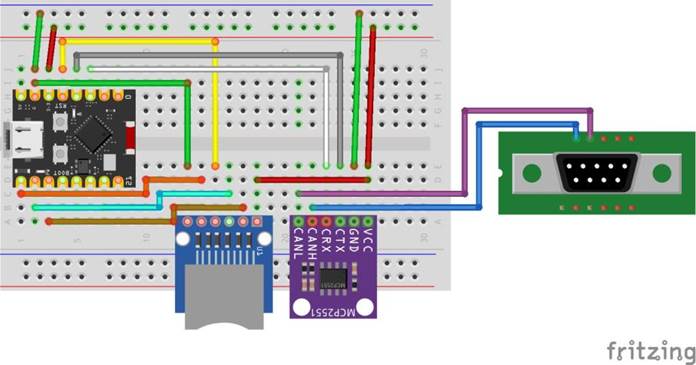
The data acquisition system was structured with access to the CAN (Controller Area Network) bus of the Autocoro 9, using a CAN Bus interface, Arduino microcontroller, DB9 connection, and a sniffer/datalogger monitoring feature. A computer with software developed in Python was used for support. The architecture was designed to passively listen to data traffic, due to the sensitivity of the machine’s electronic system, especially the Informator module.
The captured data were recorded by the software in Python and exported to spreadsheets for manual organization and analysis. At this stage, the data were stored locally, without integration with databases, dashboards, cloud platforms, or alert systems.
Figure 1. Device assembly diagram for data acquisition
Source: The author (2026)
Before the collections, a preliminary validation of the connection was performed: the machine was turned off, the device connected to the communication point, and the equipment turned back on. The objective was to verify the passive connection to the CAN bus, without sending commands or operational interference.
The experimental phase occurred between December 2025 and March 2026, in five distinct sessions, totaling approximately 25 hours of testing (an average of five hours per session). The collections were carried out under real production conditions on the same Autocoro 9, with 216 active spindles, producing 16/1 yarn (100% cotton) and 8/1 yarn (cotton textile waste).
The collections were made in blocks, not continuously. In each block, a specific operational change or failure was defined and provoked to facilitate comparison with the recorded data. During the tests, one team member captured the data on the computer, while another made the parameter changes and induced the failures in the machine.
Controlled changes were made to five operational parameters of the Autocoro 9 (draft, yarn twist, rotor speed, opening roller speed, and winding tension), directly in the Informator, at levels that would not compromise yarn quality or operational stability.
Known operational failures, described in the machine manual, were also physically induced in different spindles. The failure codes evaluated were: 123 (yarn breakage), 125 (maximum splicing attempts), 128 (splicing return failure), 143 (maximum yarn search), 148 (breakage after splicing), 700 (opening cylinder failure), and 702 (opening cylinder start-up failure).
Each record captured on the CAN network corresponded to a row in the spreadsheet, containing fields such as message identifier (ID), data from PLD0 to PLD7, data length (DLC), timestamp, and a classification column. This classification column was filled manually, comparing the moment of failure induction and the tested time zone with the captured records.
The data processing involved the organization of records in electronic spreadsheets and manual analysis of events. Due to the proprietary communication protocol of Autocoro 9 and the absence of technical documentation, reverse engineering was used, comparing events triggered in the machine with the captured CAN data. The validation criterion was the identification of recurring associations between known operational events and changes in the records.
The project had a pilot nature, with technical and exploratory validation, focusing on the feasibility of connecting, capturing, and organizing data, and not on the implementation of an automatic monitoring system. Automatic interpretation algorithms, dashboards, SQL database, alerts, or cloud storage were not implemented in this stage.
During the study, operational .silf files generated by Autocoro 9, containing production data per spindle, were identified. However, as they were discovered after the main testing phase via the CAN bus, they were not used as the basis for the experimental methodology, being considered for future development stages.
3. Results and Discussion
The results of this study focused on the initial technical validation of a pilot system for data acquisition on an Autocoro 9 machine, using the CAN bus. The analysis sought to verify the feasibility of passive connection, communication stability, obtaining structured records, and the ability to associate captured data with known operational events.
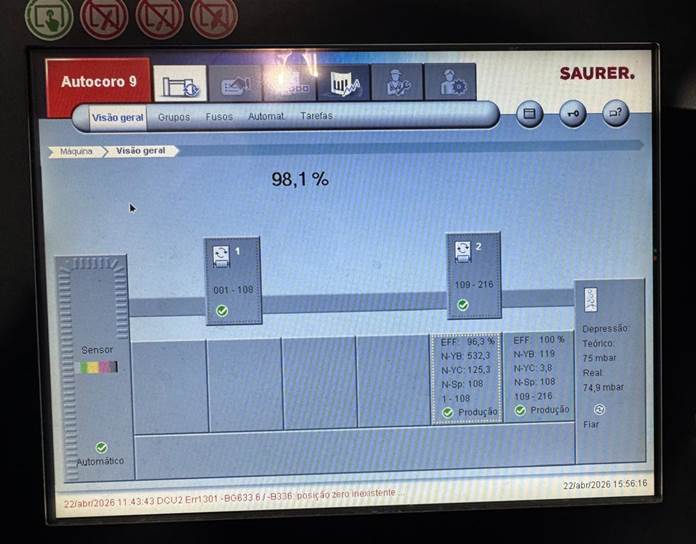
The first relevant proof was the viability of the passive connection of the device to the Autocoro 9. In preliminary tests, the apparatus was connected to the communication port of the turned-off machine and, after it was turned back on, no alarms, error messages, screen freezes, reboots, or shutdowns were observed. The device acted in passive mode, without sending commands, confirming the possibility of maintaining the connection without interfering with the machine’s electronic system, especially the Informator module, which manages and supervises the equipment. Figure 2 illustrates the Autocoro 9’s Informator.
Figure 2. Autocoro 9 Informer
Source: The author (2026).
The data acquisition device is visualized in Figure 3. The experimental sessions were conducted between December 2025 and March 2026, totaling approximately 25 hours of testing across five distinct sessions, with an average duration of five hours each. Data collection occurred under real production conditions, always on the same Autocoro 9, which has 216 active spindles. During the tests, the machine produced 16/1 (100% cotton) and 8/1 (cotton textile waste) yarns, covering different processing conditions and shift change moments. Figure 4 presents the Autocoro 9 machine used in the study.
Figure 3. Data acquisition device
Source: The author (2026).
Figure 4. Autocoro 9 machine used in the study
Source: The author (2026).
Data collection was performed by software developed in Python, which recorded the raw data from the CAN network. These records, totaling hundreds of thousands, were exported to spreadsheets for manual analysis. Each record included the message identifier (ID), data in PLD0 to PLD7, message length (DLC), timestamp, and a manually added classification column. This manual classification was based on the comparison between the time of failure induction and the captured records. Figure 5 illustrates an example of these records, with the identification of failure 123.
Figure 5. Record of data obtained from the autocoro with failure 123 identified
Source: The author (2026).
Table 1 summarizes the main results of the experimental phase. It highlights the execution of five testing sessions between December 2025 and March 2026, totaling approximately 25 hours, on the Autocoro 9 machine with 216 active spindles. During the tests, cotton and textile waste yarns were produced. Five operational parameters were altered, and seven fault codes were evaluated. Technical validation was positive regarding passive connection, device stability, and obtaining structured records. However, of the seven fault codes evaluated, only fault 123 showed an identifiable association in the manual analysis, indicating a limitation in generalizing the interpretation of the machine’s different fault codes at this stage.
Table 1. Synthesis of the main experimental results
| Evaluated Item | Observed result |
| Experimental sessions carried out | 5 |
| Test period | December 2025 to March 2026 |
| Average session duration | Approximately 5 hours |
| Total test time | Approximately 25 hours, including validation, observation, block sampling, and fault induction |
| Machine used | Autocoro 9 |
| Number of time zones | 216 |
| Machine condition | Normal production, with active spindles |
| Threads produced during testing | 16/1 100% cotton and 8/1 cotton waste |
| Operational parameters changed | 5 |
| Evaluated failure codes | 7 |
| Failures with identified association in manual analysis | 1, code 123 |
| Failures without conclusive correlation | 6 |
| Interference in the Informant | Not observed |
| Data storage at this stage | Local, on computer and spreadsheet |
| Automatic classification of failures | Not implemented |
Source: The author (2026).
During the tests, controlled changes were made to five operational parameters of the Autocoro 9 (draft, yarn twist, rotor speed, opening roller speed, and winding tension) to verify their association with the captured data. However, it was not possible to establish a conclusive correlation between the modified parameters and the analyzed records. This limitation stemmed from the Autocoro 9’s proprietary communication protocol, the high volume of messages, and the absence of open technical documentation for decoding. Additionally, seven operational fault codes (123, 125, 128, 143, 148, 700, and 702) were induced, with hundreds of occurrences, to facilitate pattern identification in the data.
Among the failure codes evaluated, only failure 123, related to wire breakage, was identifiably associated with the captured records. This association was made through subsequent manual analysis, comparing the moment of failure induction and the specific spindle with the spreadsheet data. Failures 125, 128, 143, and 148, related to splicing cycle events, and failures 700 and 702, linked to the opening cylinder, did not show a conclusive correlation with the records. Although the system captured raw data, the complete decoding of messages to automatically identify the spindle and failure type still requires technical deepening and the development of automated filtering and interpretation methods.
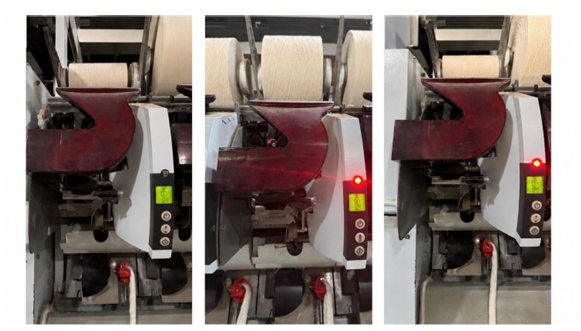
From an operational point of view, the Autocoro 9 Informator consolidates aggregated information and indicators, such as efficiency and breakdown rates. However, specific events per spindle, such as stoppages due to failure, are signaled locally on the individual spindle display or by a red light, requiring the operator’s physical presence. Figure 6 shows an example of the signaling of failures 123, 125, and 143. In a machine with 216 spindles, this dependence on local observation makes systematic anomaly identification difficult, especially during shifts with less labor. The pilot system, by capturing and organizing data, demonstrates potential for providing information remotely, which can optimize management and operation.
Figure 6. Example of signaling of failures 123, 125 and 143
Source: The author (2026).
Although integration with cloud, database, or dashboards was not implemented in this stage, the prototype represents an initial phase of an Internet of Things architecture for the industrial environment. The data, stored locally, indicate the possibility of future evolutions, such as integration with an SQL database, monitoring panels, and remote alerts. The proposal proved to be compatible with the company’s technical and economic reality, offering a more accessible and adaptable alternative compared to proprietary solutions. The expected practical contribution lies in the ability to transform operational data into support for decision-making, allowing the identification of patterns and recurring causes of failures, such as quality cuts or frequent ruptures, before they affect the final product. This aligns the proposal with the principles of Lean Manufacturing, seeking waste reduction and continuous improvement.
The pilot system approach aligns with the Jidoka principle, by seeking to expand the identification of anomalies in the production process. Although the Autocoro 9 machine already automatically handles events such as yarn breakage, the pilot system allows for the capture and organization of data associated with these events, creating a basis for monitoring and decision support. Furthermore, during the study, the existence of operational files in the .silf format, generated by the Autocoro 9 itself, was identified. These files contain individualized data per spindle, such as efficiency, splices, and breaks. Although not used in the main methodology, these files represent a complementary source for future stages, offering an alternative or complementary route for obtaining indicators and the continuity of the project.
In summary, the prototype proved technically feasible for passive connection to Autocoro 9, enabling the capture of raw data from the CAN network and an initial manual analysis of operational events. However, the study also highlighted significant limitations, such as the complexity of the proprietary protocol, the high volume of data, and the conclusive identification of only one of the evaluated failures, in addition to the absence of automatic interpretation. Thus, this work represents an initial technical validation that demonstrates the potential of the solution and points to the next steps towards a more comprehensive and automated industrial monitoring system.
4. Conclusion
The present work aimed to technically develop and validate a pilot data acquisition system applied to an Autocoro 9 open-end spinning machine, using information from the equipment’s industrial communication network. The feasibility of passively connecting the device to the machine’s CAN bus, without interfering with its operation, and its ability to capture and organize raw operational data were verified. Manual analysis of the records allowed associating failure 123, related to yarn breakage, with the obtained data, demonstrating the system’s potential to increase the visibility of the production process. This approach represents a practical contribution by offering a more accessible and adaptable technical alternative compared to high-cost proprietary solutions, establishing a foundation for supporting managerial decisions and future developments in industrial monitoring, in line with the principles of Lean Manufacturing and Industry 4.0.
However, the study showed important limitations, such as the complexity of Autocoro 9’s proprietary communication protocol, the high volume of messages, and the absence of open technical documentation, which hindered conclusive correlation for other fault codes and operational parameters. Automatic data interpretation was not implemented at this stage, and manual analysis proved to be laborious. For future studies, it is recommended to deepen the development of filtering, comparison, and classification algorithms to automate message interpretation. It is also suggested to explore the operational files in .silf format, generated by the machine itself, as a complementary data source, and to integrate the system with databases and monitoring dashboards for more comprehensive and real-time tracking.
Bibliographic References
BUER, Sven-Vegard; STRANDHAGEN, Jan Ola; CHAN, Felix T. S. The link between Industry 4.0 and lean manufacturing: mapping current research and establishing a research agenda. International Journal of Production Research, v. 56, n. 8, p. 2924-2940, 2018. DOI: 10.1080/00207543.2018.1442945.
CONFEDERAÇÃO NACIONAL DA INDÚSTRIA. Desafios para a indústria 4.0 no Brasil. Brasília, DF: CNI, 2016. 34 p. Disponível em: https://static.portaldaindustria.com.br/media/filer_public/d6/cb/d6cbfbba-4d7e-43a0-9784-86365061a366/desafios_para_industria_40_no_brasil.pdf. Acesso em: 20 jun. 2026.
DENNIS, Pascal. Produção lean simplificada: um guia para entender o sistema de produção mais poderoso do mundo. Tradução de Rosalia Angelita Neumann Garcia. 2. ed. Porto Alegre: Bookman, 2008.
FALANI, Leila Araújo; AGUIAR, Catia Rosana Lange de; DAL FORNO, Ana Julia. Mapeamento da literatura sobre as tecnologias da indústria 4.0 no segmento têxtil brasileiro. Brazilian Journal of Development, Curitiba, v. 6, n. 7, p. 42437-42452, jul. 2020. DOI: 10.34117/bjdv6n7-019.
INSTITUTO DE ESTUDOS E MARKETING INDUSTRIAL. Brasil Têxtil 2024: relatório setorial da indústria têxtil brasileira. São Paulo: IEMI, 2024.
KAGERMANN, Henning; WAHLSTER, Wolfgang; HELBIG, Johannes. Recommendations for implementing the strategic initiative Industrie 4.0: securing the future of German manufacturing industry: final report of the Industrie 4.0 Working Group. Frankfurt am Main: Acatech, 2013. Disponível em: https://en.acatech.de/publication/recommendations-for-implementing-the-strategic-initiative-industrie-4-0-final-report-of-the-industrie-4-0-working-group/. Acesso em: 19 jun. 2026.
O autor, 2026 [Referência completa não encontrada no documento original]
OHNO, Taiichi. O sistema Toyota de produção: além da produção em larga escala. Porto Alegre: Artes Médicas, 1997.
WOMACK, James P.; JONES, Daniel T. Lean thinking: banish waste and create wealth in your corporation. New York: Simon & Schuster, 1996.
Article originating from the Final Course Work of the Specialization in Production Engineering at POLI USP PRO
To learn more about the course, click here.