
Esg
May 08, 2025
Identification of stakeholders in the Water Conservation Program
DOI: 10.22167/2675-6528-2025008
E&S 2025, 6: e2025008
Lucas de Camargo Reis e Andrea Cristina Deis Rodrigues
In recent years, water-focused forest restoration programs have become increasingly important worldwide, due to the growing need for reforestation to combat the impacts of climate change, protect biodiversity, and ensure water security, as current deforestation significantly harms hydrological cycles and leads to water scarcity, floods, soil erosion, and ecological imbalance[1,2].
In general terms, water-focused restoration programs, such as the 20×20 Initiative in Latin America[3], and the Bonn Challenge goal of restoring millions of hectares of degraded forests, aim to rehabilitate critical ecosystem services, including water flow regulation and aquifer recharge[4]. The Water Conservator is the first Brazilian program in the payment for environmental services (PES) model, where environmental restoration and preservation actions are promoted on private properties, with provisions for remuneration or tax benefits for participating owners.
The Water Conservation Program emerged in 2005 as a public initiative by the municipality of Extrema, in Minas Gerais, focused on the conservation and sustainable management of water resources, especially in rural areas[5], operating in the headwaters of the Cantareira system, the main reservoir for Brazil’s largest metropolitan region. It addresses a crucial and increasingly urgent issue worldwide: the preservation of watercourses, springs, and aquifers, which are fundamental for the survival of healthy ecosystems and for the supply of drinking water to human communities[6].
Stakeholder management, also known as stakeholder management, is a process that aims to increase the chances of success of an undertaking by ensuring that stakeholders (individuals, groups, or entities that have an interest in, influence on, or are affected in some way by the outcome or performance of the activity in question) understand their goals and the risks, objectives, and benefits[7]. The objective in question is to ensure that the needs, expectations, and concerns of all relevant stakeholders are considered and integrated into the decisions and actions related to the program or organization[8], being fundamental for the success and sustainability of any initiative, as stakeholders play important roles in supporting or opposing, allocating resources, obtaining funding, public acceptance, and many other aspects[9].
The Water Conservator requires a more in-depth approach to program stakeholder management, as it is a necessary strategy to ensure the initiative’s sustainability and continuity in the coming years. This work was dedicated to offering an initial step in this process, identifying the stakeholders within the scope of the Water Conservator, using bibliometric analysis and expert consultation for this purpose, aiming to provide information for the planning of stakeholder management in the aforementioned program.
The initial data collection instruments were the search of official program documents and the author’s own experience with the initiative, in which they have been acting as a researcher since 2014, associated with a bibliometric analysis, performed through a systematic review guided by the PRISMA protocol (Preferred Reporting Items for Systematic Reviews and Meta-Analyses)[10].
To this end, a search for articles and journals was conducted on the platforms “Scopus” and “Web of Science”, two of the most renowned scientific databases on the planet. The terms used in the searches were “partes interessadas”, “restauração ambiental” and “recursos hídricos”, as well as, “stakeholders”, “environmental restoration” and “water resources“. After selecting the articles, all stakeholders pointed out in each work were listed, and these were then allocated into representative groups, due to similarities in their areas of action.
Subsequently, with the objective of identifying the most suitable stakeholders, an exploratory survey was conducted with experts. The approach consisted of applying semi-structured questionnaires, directed at an intentionally selected group of experts active in the areas of environment, public policies, natural resource management, and ecological restoration, including university students and postgraduates in environmental sciences, university professors, researchers, technical representatives from public bodies, both from the Environment Department of Extrema/MG, and from state and federal environmental agencies, not directly related to the Water Conservator. Although inspired by the Delphi method, the survey did not aim to reach consensus, but rather to explore the diversity of visions and experiences of the respondents.
The intention of this approach was to validate the stakeholders identified in the research, both groups and individuals, as well as to understand the influence and interest of these stakeholders for the program. Once this validation phase was completed, the results were analyzed through the Stakeholder Matrix, making it possible to recommend actions for the management of interested parties.
As results of the bibliometric analysis, initially 375 scientific works were found, in which the refinement methods proposed by the PRISMA protocol were applied, thus selecting 17 articles (Table 1).
Quadro 1. Artigos obtidos pela análise bibliométrica e pelo protocolo Prisma
| Amblard, 2023[11] | Brunacini, 2023[12] | Burroughs, 1999[13] |
| Cho et al., 2023[14] | Druschke & Hychka, 2015[15] | Goodspeed et al., 2019[16] |
| Graversgaard et al., 2017[17] | Haghi & Karamidehkordi, 2023 (18) | Hassanzadeh et al., 2019[19] |
| Heldt et al., 2016[20] | Henkel et al., 2023[21] | Maioli et al., 2021[22] |
| Neverre et al., 2022[23] | Palmer et al., 2021[24] | Shultz & Soliz, 2007[25] |
| Supangat et al., 2022[26] | Urcuqui-Bustamante et al., 2021[27] |
An initial interesting aspect that the bibliometric analysis evidenced was the increase in interest in the theme of identification of stakeholders associated with water-focused restoration programs, mainly in the last ten years (Figure 1), with five articles published in 2023 involving the theme, almost 30% of the total.
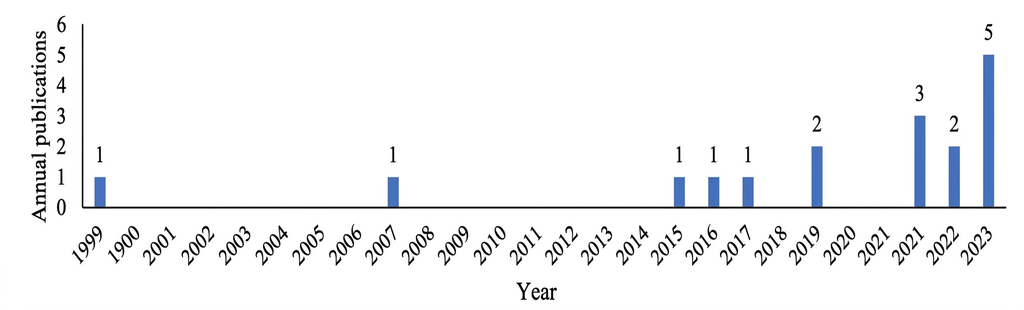
Source: Original research data.
Thus, the bibliometric analysis identified 30 different stakeholders in environmental restoration or conservation works related to water resources. Some of these elements appeared several times in the articles, while others were less recurrent or appeared only once (Figure 2).
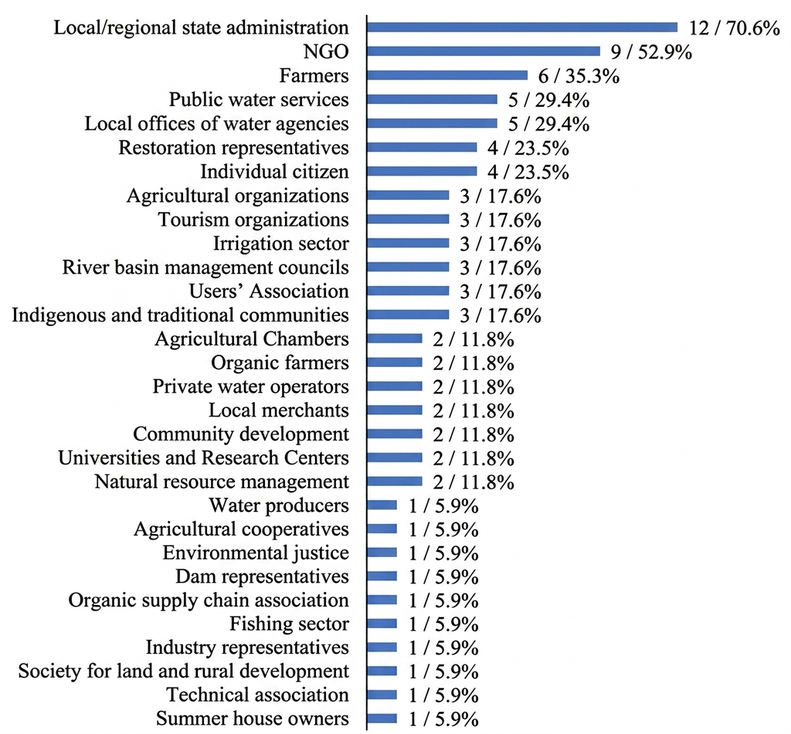
Source: Original research data.
Aiming for a better classification of the stakeholders found in the bibliometric analysis, a grouping was then performed, seeking the generation of more comprehensive groups, and this rearrangement resulted in seven groups of stakeholders (Table 2).
Quadro 2. Alocação dos stakeholders obtidos na revisão bibliométrica em grupos abrangentes
| Public Administration | Watershed management advice | Private sector | Organic supply chain association |
| Local/regional/state administration | Tourism organizations | ||
| Local offices of water agencies | Local merchants | ||
| Natural resources management | Irrigation sector | ||
| Restoration representative | Fishing sector | ||
| Environmental justice | Industry representatives | ||
| Common user | Individual citizen | Water sector | Public water services |
| User association | Private water operators | ||
| Owners of vacation homes | Dam representatives | ||
| Indigenous peoples and traditional communities | Rural sector | Water producers | |
| Scientific sector | Universities and research centers | Agricultural organizations | |
| Technical association | Agricultural chambers | ||
| NGOs | Society for land and rural development | Regional group of organic farmers | |
| Community development entity | Agricultural cooperative | ||
| Local NGOs | Farmers |
The clustering also allowed us to observe that there are more representative groups, while others appear few times in academic works (Figure 3). This results already allow us to infer which groups of stakeholders are pointed out as more influential in scientific publications.

Source: Original research data.
Once the stakeholders groups were determined, an analysis of the potential impacts (Table 1) was elaborated, in which aspects of each group (positive and negative) can be verified. This approach aimed to subsequently assist in the evaluations regarding the interest and power of each individual stakeholder that would still be determined.
Tabela 1. Análise das características positivas e negativas dos grupos de stakeholders
| Interested parties | Positive | Negatives |
| Public Administration | • Funding, infrastructure and logistical support | • Bureaucracy |
| • Increased program legitimacy | • Political changes can affect program continuity | |
| Rural sector | • Knowledge of local water resources | • Resistance to new technologies |
| • Cooperating in conservation | • Need for training and capacity building for adaptation | |
| • Practical and locally adapted solutions | ||
| NGOs | • Awareness of sustainable practices | • Uncertain resources |
| • Experience in community programs | • Limitations in the creation of public policies | |
| • Adaptation to local needs | • Objectives may not align with stakeholders | |
| Private sector | • Source of funding | • Focus on profits can conflict with social and environmental objectives |
| • Possibility of forming sustainable partnerships | ||
| Scientific sector | • Training of stakeholders | • Theoretical solutions that are difficult to apply in practice. |
| • Scientific foundation for management decisions and practices. | • Possible lack of connection with local reality | |
| Water sector | • Technical knowledge | • Conflicts between commercial and public objectives |
| • Experience in water systems management | ||
| Common user | • Final consumer needs being considered | • Reconcile diverse interests and opinions |
| • Water awareness and conservation | • Need to invest in education and training for effective engagement |
In the next stage, an exploratory consultation was carried out with specialists through the application of semi-structured questionnaires in an electronic form for different groups, with the objective of evaluating the stakeholders suggested by the methodology, estimating that 100 people, whose professional background or activity placed them in a position to evaluate the stakeholders of the Conservador das Águas program, were consulted, resulting in 16 complete responses.
When asked about the relevance of the suggested groups as stakeholders within the scope of the Conservative Water Program, the specialists’ evaluation was highly positive (Table 2), with the indication being classified as “very correct” or “correct” in at least 66% of cases by the respondents.
Tabela 2. Avaliação dos grupos de stakeholders gerados através da pesquisa consulta exploratória com especialistas
| Group | Very correct | Correct | Moderately correct | Incorrect | Very incorrect |
| —————————————————— In percentage (%) —————————————————— | |||||
| Public Administration | 50,0 | 50,0 | 0,0 | 0,0 | 0,0 |
| Rural sector | 72,0 | 17,0 | 11,0 | 0,0 | 0,0 |
| NGOs | 44,0 | 39,0 | 17,0 | 0,0 | 0,0 |
| Private sector | 33,0 | 39,0 | 22,0 | 0,0 | 6,0 |
| Scientific sector | 61,0 | 39,0 | 0,0 | 0,0 | 0,0 |
| Water sector | 61,0 | 33,0 | 6,0 | 0,0 | 0,0 |
| Common user | 44,0 | 22,0 | 28,0 | 6,0 | 0,0 |
In a second block, respondents were asked about which group(s) was/were of greatest or least importance in the actions of the Water Conservator (Figure 4), with the possibility of selecting one or more options.

Source: Original research data.
The private sector and the common user were the only groups classified by some evaluators as “incorrect” or “very incorrect”. However, when the results are thoroughly examined, it is found that from the program’s perspective, these groups have essential roles as financiers (private sector) and beneficiaries (common user), with at least 66% of evaluators considering the inclusion as “correct” or “very correct”.
In the exploratory consultation with specialists, public administration (61.1%), the scientific sector (50.0%), and the rural sector (44.4%) (Figure 4a) were assessed as most essential to the program, while the least important considered were the private sector (50.0%) and the common user (38.9%; Figure 4b). Distrust regarding the participation of the private sector, often accused of “greenwashing” when associated with environmental restoration practices, and the lack of perceived societal engagement in processes involving the Water Conservator program may explain why these groups are considered less important. However, these groups are essential for the success and longevity of an environmental initiative[28,29].
Considering the stakeholders groups generated from the academic works consulted, the documentation provided by the Extrema city hall, and the author’s prior knowledge of the program’s dynamics, the potential individual stakeholders within the scope of the Water Conservator were identified. A list of individual stakeholders, specific to the program, was presented and approved in the exploratory consultation with specialists, with only one inclusion, the National Water Agency (ANA), at the suggestion of the participants, and as a result, 18 stakeholders were identified.
Finally, considering the positive and negative characteristics of each group of stakeholders, the evaluations generated in the exploratory consultation with specialists and the particularities of each individual stakeholder allowed for the production of the interest and influence assessment (Table 3).
Tabela 3. Avaliação de interesse (envolvimento (A) e importância (B)) e de influência (poder de decisão (C), impacto (D) e recursos disponíveis (E)), com notas de 0 a 10 para cada stakeholder individual
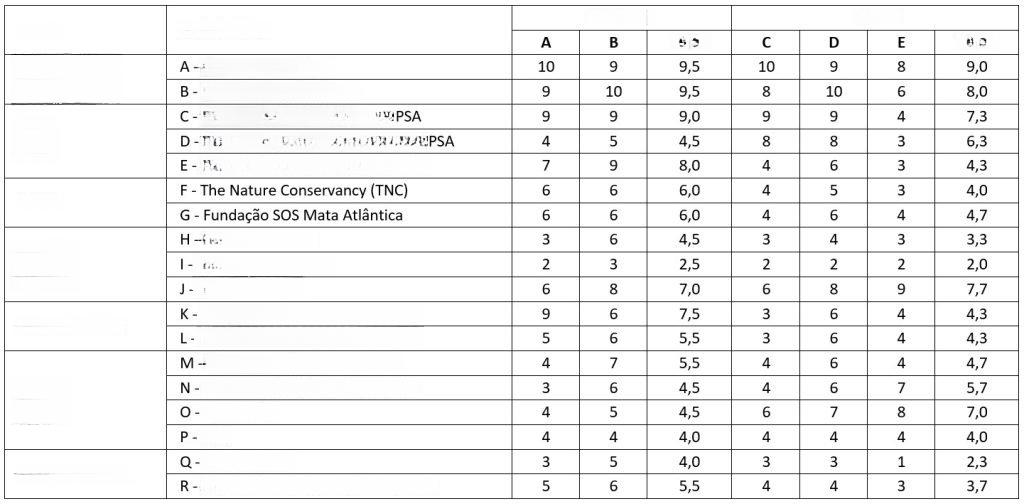
From the evaluation of interest and influence, the influence matrix was created, where it was then possible to reclassify the stakeholders based on their positioning on the graph (Figure 5), where each quadrant is related to values given by the interest and influence axis.
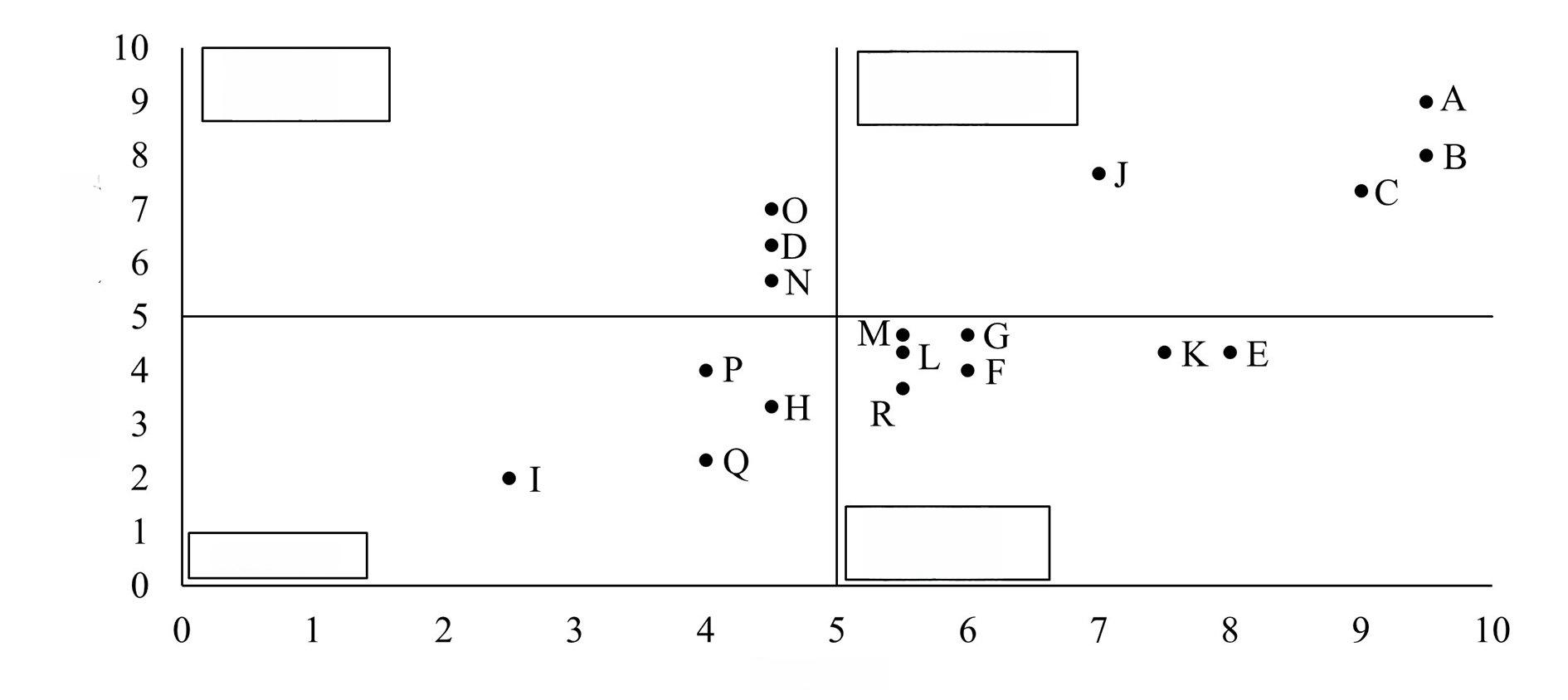
Source: Original survey data.
Using the matrix, it was determined which stakeholders should be prioritized or not, according to the suggested attitudes for the responsible program manager regarding each stakeholder (Table 4).
Tabela 4. Análise dos stakeholders envolvidos no Conservador das Águas e atitudes recomendadas para a gestão das partes interessadas
| Interested parties | Attitudes |
| Municipal government | Manage closely |
| Water Conservator – Representatives | |
| Owner – PSA Participants | |
| Industrial sector | |
| Owner – Non-PSA participants | Keep satisfied |
| Cantareira System Managers | |
| PCJ Committee | |
| Vacation home owners | Keep informed |
| Owner – Not covered (Potential) | |
| The Nature Conservancy (TNC) | |
| SOS Atlantic Forest Foundation | |
| Researchers from the universities | |
| Government technical bodies | |
| Municipal water company | |
| Tourism sector | Monitor |
| Local merchants | |
| ANA (National Water Agency) | |
| Local citizen |
This work achieved its objective of identifying the relevant stakeholders in the context of the Water Conservation program, combining two complementary methodological approaches: bibliometric analysis and exploratory research with specialists. Bibliometrics allowed mapping the scientific production related to the theme, revealing trends, gaps, and key authors, while the consultation with specialists brought a practical and contextualized perspective, aligned with the specificities of the program in Extrema (MG).
As a main outcome, a Stakeholder Interest and Influence Matrix was developed, an essential tool for Stakeholder Management, especially in socio-environmental projects with multiple actors involved. The generated matrix provides objective subsidies for the program managers to strategically direct their engagement actions, defining which stakeholders should be managed closely, kept satisfied, kept informed, or monitored.
With this, the study contributes not only to the improvement of the governance of the Water Conservator, but also offers a replicable model for other ecological restoration programs that require interinstitutional articulation and social participation.
References
[1] Bozelli, R.L.; Farias, D.S.; Lima, S.K.F.; Lira, R.T.S.; Nova, C.C.; Setubal, R.B.; Sodré, E.O. 2018. Pequenas áreas úmidas: importância para conservação e gestão da biodiversidade brasileira. Diversidade e Gestão. 2(2): 122–38.
[2] Yuan, Y.; Li, X.; Xiong, D.; Wu, H.; Zhang, S.; Liu, L.; Li, W. 2019. Effects of restoration age on water conservation function and soil fertility quality of restored woodlands in phosphate mined-out areas. Environmental Earth Sciences.78(23): 653.
[3] Blanco DE, Yellachich N. Our Wetland Restoration Track Record 2000-2022 [Internet]. Vol. 1, Wetland International. Buenos Aires; 2023 out [citado 22 de janeiro de 2025]. Disponível em: https://www.wetlands.org/publication/our-wetland-restoration-track-record-2000-2022/
[4] Kleinschmit D, Blum M, Brockhaus M, Karambiri M, Kröger M, Ramcilovic-Suominen S, et al. 2024. Restoring Forests and Trees for Sustainable Development. Katila, P.; Colfer, C.J.P.; Jong, W.; Galloway, G.; Pacheco, P.; Winkel, G. organizadores. Oxford University PressNew York, Nova Iorque, NY, Estados Unidos da América. Disponível em: https://academic.oup.com/book/58200
[5] Chiodi, R.E.; Puga, B.P.; Sarcinelli, O. 2014. Análise institucional do mecanismo de pagamento por serviços ambientais: o Projeto Conservador das Águas em Extrema – MG. Revista Políticas Públicas. 17(1): 37-47.
[6] Reis, L.C. 2018. Avaliação hidrobiogeoquímica na bacia do Ribeirão das Posses no âmbito do Programa Conservador das Águas, Extrema, MG. Dissertação em Ecologia Aplicada pelo Programa de Pós-graduação em Ciências. Piracicaba: Universidade de São Paulo.
[7] Reed, D. 1999. Stakeholder Management Theory: A Critical Theory Perspective. Business Ethics Quarterly. 9(3): 453–83.
[8] Gunton, T.I.; Day J.C. 2003. The theory and practice of collaborative planning in resource and environmental management. Environments [Internet]. 31(3). Disponível em: https://link.gale.com/apps/doc/A111855596/AONE?u=anon~91e73a58&sid=googleScholar&xid=90138086.
[9] Reed, M.S.; Vella, S.; Challies, E.; de Vente, J. 2017. A theory of participation: What makes stakeholder and public engagement in environmental management work?. Restoration Ecology: 26(S1). DOI: 10.1111/rec.12541.
[10] Shamseer, L.; Moher, D.; Clarke, M.; Ghersi, D.; Liberati, A.; Petticrew, M.; Shekelle, P.; Stewart, L.A.; the PRISMA-P Group. 2015. Preferred reporting items for systematic review and meta-analysis protocols (PRISMA-P) 2015: elaboration and explanation. BMJ – Research Methods & Reporting, 1-25.
[11] Amblard, L. 2019. Collective action for water quality management in agriculture: The case of drinking water source protection in France. Global environmental change-human and policy dimensions. 58.
[12] Brunacini, J.; Goralnik, L.; Rutty, M.; Keller, E. 2023. Industrial Transitions in Michigan: Stakeholder Perspectives on Water Resources Restoration and Community Vibrancy. Soc Nat Resour. 36(8): 928–46.
[13] Burrough,s R. 1999. When Stakeholders Choose: Process, Knowledge, and Motivation in Water Quality Decisions. Soc Nat Resour. 12(8): 797–809.
[14] Cho, S.J.; Klemz, C.; Barreto, S.; Raepple, J.; Bracale, H.; Acosta, E.A.; Rogéliz-Prada, C.A.; Ciasca, B.S. 2023. Collaborative Watershed Modeling as Stakeholder Engagement Tool for Science-Based Water Policy Assessment in Sao Paulo, Brazil. Water (Basel). 15(3): 1-28.
[15] Druschke, C.G.; Hychka. K.C. 2015. Manager perspectives on communication and public engagement in ecological restoration project success. Ecology and Society. 20(1).
[16] Goodspeed, R.; Babbitt, C.; Briones, A.L.G.; Pfleiderer, E.; Lizundia, C.; Seifert, C.M. 2020. Learning to Manage Common Resources: Stakeholders Playing a Serious Game See Increased Interdependence in Groundwater Basin Management. Water (Basel).12(7).
[17] Graversgaard, M.; Jacobsen, B.; Kjeldsen, C.; Dalgaard, T. 2017. Stakeholder Engagement and Knowledge Co-Creation in Water Planning: Can Public Participation Increase Cost-Effectiveness? Water (Basel). 9(3): 191.
[18] Es’haghi, S.R.; Karamidehkordi, E. 2023. Understanding the structure of stakeholders − projects network in endangered lakes restoration programs using social network analysis. Environ Sci Policy. 140: 172–88.
[19] Hassanzadeh, E.; Strickert, G.; Morales-Marin, L.; Noble, B.; Baulch, H.; Shupena-Soulodre, E.; Lindenschmidt, K. E. 2019. A framework for engaging stakeholders in water quality modeling and management: Application to the Qu’Appelle River Basin, Canada. Journal of environmental management, 231, 1117–1126. https://doi.org/10.1016/j.jenvman.2018.11.016.
[20] Heldt, S.; Budryte, P.; Ingensiep, H.W.; Teichgräber, B.; Schneider, U.; Denecke M. 2016. Social pitfalls for river restoration: How public participation uncovers problems with public acceptance. Environ Earth Science. 75(13).
[21] Henkel, T.K.; Freeman, A.M.; Lindquist, D.C.; Pahl, J.W.; Troutman, J.P. 2023. Lessons learned from 30-years of operation of the Caernarvon Freshwater Diversion, Louisiana. Ocean Coast Management. 244.
[22] Maioli, V.; Monteiro, L.M.; Tubenchlak, F.; Pepe, I.S.; de Carvalho, Y.B.; Gomes, F.D.; Strassburg, B.B.; Latawiec, A.E. 2021. Local Perception in Forest Landscape Restoration Planning: A Case Study From the Brazilian Atlantic Forest. Frontiers in Ecology and Evolution. 9.
[23] Neverre, N.; Surdyk, N.; Hérivaux, C.; Baran, N. 2022. Restoring groundwater quality at the drinking water catchment scale: A multidisciplinary and participatory approach. Journal of Environmental Management. 314.
[24] Palmer, C.G.; Fry, A.; Libala, N.; Ralekhetla, M.; Mtati, N.; Weaver, M.; Mtintsilana, Z.; Scherman, P.A. 2022. Engaging society and building participatory governance in a rural landscape restoration context. Anthropocene. 37.
[25] Shultz, S.; Soliz, B. 2007. Stakeholder willingness to pay for watershed restoration in rural Bolivia. J Am Water Resour Assoc. 43(4): 947–56.
[26] Supangat, A.B.; Basuki, T.M.; Indrajaya, Y.; Setiawan, O.; Wahyuningrum, N.; Purwanto, et al. 2023. Sustainable Management for Healthy and Productive Watersheds in Indonesia. Land (Basel). 12(11).
[27] Urcuqui-Bustamante, A.M.; Selfa, T.L.; Hirsch, P.; Ashcraft, C.M. 2021. Uncovering Stakeholder Participation in Payment for Hydrological Services (PHS) Program Decision Making in Mexico and Colombia. Sustainability.13(15).
[28] Besseau, P.; Graham, S.; Christophersen, T. 2018. Restoring forests and landscapes: the key to a sustainable future. Global Partnership on Forest and Landscape Restoration, Vienna, Austria.
[29] Chazdon R. 2015. Restoring Tropical Forests: A Practical Guide. Ecological Restoration. 33(1): 118–9.
Como citar
Reis, L.C.; Rodrigues, A.C.D. Identificação das partes interessadas no programa Conservador das Águas. Revista E&S. 2025; 6: e2025008
About the authors
 Lucas de Camargo Reis – Doctoral Candidate in Sciences. Center for Nuclear Energy in Agriculture of the University of São Paulo. Centenário Avenue, 303, Dimas Neighborhood, 13400-970, Piracicaba, São Paulo, Brazil Andrea Cristina Deis Rodrigues – Doctor in Administration. Top Leader Training. Alcides Ricardini Neves Street, 12, Suite 809, Monções Neighborhood, 04575-050, São Paulo/SP, Brazil