
Esg
August 25, 2025
Assessment of the maturity level in sustainability of a mining project
DOI: 10.22167/2675-6528-2025015
E&S 2025, 6: e2025015
Amanda do Nascimento Silva; Beatriz Cristina de Freitas
The development of civilizations is entirely linked to the history of mining. This activity is responsible for supplying mineral goods, raw materials, and essential inputs for progress[1]. Industrial advancement, especially in high-tech sectors and the transition to a low-carbon economy, has led to unprecedented demand for minerals[2,3]. The trend is for mineral production to continue to grow, driven by the accelerated pace of industrial development, which entails various socio-environmental and economic impacts associated with this activity[3,4].
Mineral resources are generally divided into two categories: metallic and non-metallic. Metallic resources are those that contain metals (such as gold and iron), while non-metallic resources encompass the others, such as sand and limestone[5]. These resources are found in mineral deposits and, when there is a presence of multiple metals, the deposit is classified as polymetallic[3].
The changes occurring in the mining sector result from growing social pressure for greater socio-environmental sustainability and technological advancement. Following the dam rupture tragedies in Mariana-MG, in 2015, and in Brumadinho-MG, in 2019, debates and demands regarding sustainability and safety in mining projects in Brazil intensified. These events exposed fragilities in socio-environmental risk management processes and highlighted the need for more responsible, transparent, and integrated action by companies in the sector[6]. Furthermore, environmental licensing became more rigorous and began to require mining companies to conduct a more in-depth analysis of tailings and waste disposal projects[7].
Thus, guided by the global need for more sustainable development, the leaders of the United Nations (UN) published, in 2015, the new agenda of Sustainable Development Goals (SDGs)[8]. In this context, the effective engagement of the mineral sector with the SDGs has the potential to generate decent jobs, reduce social inequality, boost economic growth, promote advances in innovation, and attract high investments in infrastructure. However, in the absence of this engagement, the expected consequence is the worsening of social inequality and the occurrence of major environmental disasters, as already observed in the past[9].
The measurement of metrics related to the SDGs constitutes a fundamental step for the effective implementation of regulatory governance in the mining sector. Without clear indicators and reliable data, it becomes unfeasible to assess the socio-environmental performance of companies, identify gaps, and guide public policies or institutional actions in a transparent and effective manner. The adoption of SDG-aligned metrics allows for the integration of global objectives into local practices, which strengthens accountability mechanisms, enables continuous monitoring, and guides evidence-based decision-making. Furthermore, the systematic use of these metrics contributes to the construction of an organizational culture focused on sustainability, by promoting greater alignment between public and private interests and by paving the way for more legitimate, participatory, and results-oriented governance.
In this context, the adoption of the framework from the Global Reporting Initiative (GRI) by the mining sector proves essential for robustly measuring the metrics associated with the SDGs and, consequently, enabling more effective and evidence-based Regulatory Governance (GR)[8].
The GRI provides a standardized set of indicators covering the environmental, social, economic, and governance dimensions, complemented by specific sectoral supplements, such as the one for mining and metals, which allows for the preparation of more consistent, comparable reports aligned with international best practices. Developed based on the concept of triple bottom line, the GRI integrates the pillars of sustainability — economic, social, and environmental — and promotes greater transparency and corporate responsibility. Its use has become consolidated among companies committed to sustainability and constitutes a strategic tool for guiding efforts, aligning initiatives with the SDGs, and strengthening dialogue with stakeholders[8].
In February 2024, the GRI launched a reporting standard for the mining sector[8]. Given its current global relevance, this standard has become vital for the internal assessment of mining companies’ sustainability maturity level and for the development of short, medium, and long-term strategies aimed at progressive alignment with these norms. Companies engaged in meeting GRI standards (and, consequently, aligned with the SDGs), as well as those that are not yet doing so, will feel increasingly profound economic effects[9]. The competitive advantages achieved by companies seeking compliance with these strategies are significant and can result in reduced production costs and increased profits in the medium and long term[10].
Thus, the alignment of a world-class mining company with the SDGs was analyzed, based on the three pillars of sustainability (economic, social, and environmental). This is an exploratory, descriptive research with a qualitative approach, of the case study type[11]. The work was conducted in a company headquartered in Canada, which operates polymetallic mines in several countries and was selected for convenience. Data collection occurred through documentary research[12], based on the sustainability report published in early 2023, which covers all production units.
To evaluate the mining company object of this study regarding its alignment with the SDGs, in the economic, social, and environmental aspects, the GRI 14, a sector standard for the mining sector, was used to determine the level of conformity with the SDGs. The report was examined, and all addressed themes were listed for comparison with the GRI requirements. The topics analyzed in the company’s report are presented in Table 1.
Table 1. Topics analyzed in the company’s report
| Section | Topics covered |
| Environmental Management | Tailings management and waste management |
| Water Management | |
| Decarbonization, climate resilience and energy | |
| Air Quality | |
| Biodiversity and property management | |
| Environmental compliance | |
| Prosperous communities | Development of the local economy |
| Community health and well-being | |
| Skilled workforce | Safety and health in the workplace |
| Industrial hygiene and occupational health | |
| Crisis management planning and emergency preparedness | |
| Talent attraction and retention | |
| Diversity and inclusion | |
| Good governance | Business integrity and transparency |
| Risk Management | |
| Human rights | |
| Recovery and closing | |
| Business Resilience | Economic performance |
| Responsible production and supply chain | |
| Innovation in mining |
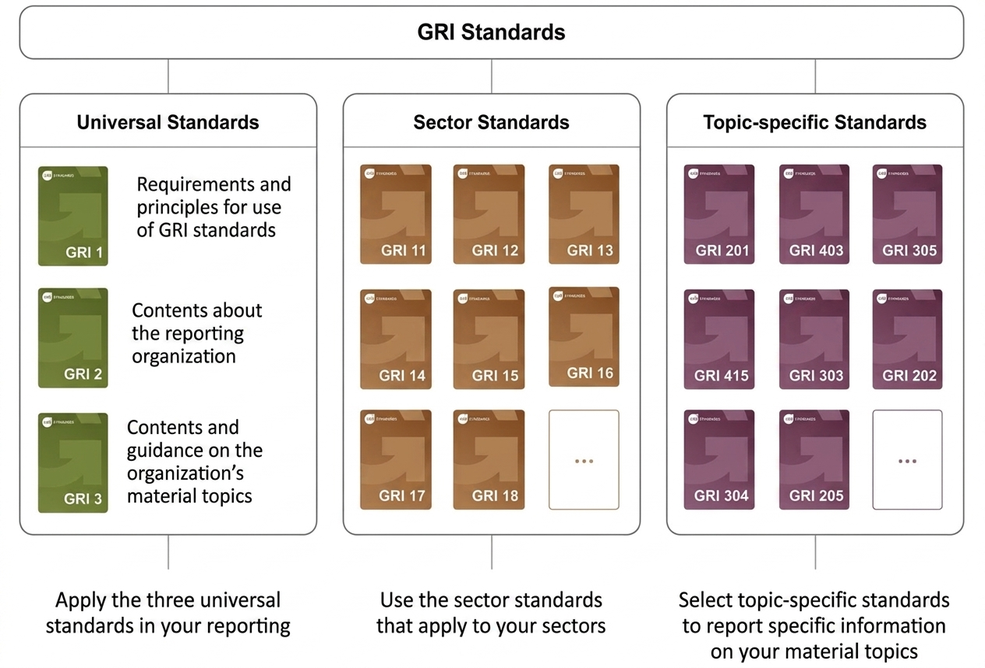
GRI makes all materials related to best practices in business sustainability reporting freely available on its website. These support resources are divided into three main categories: universal, sectoral, and thematic standards (Figure 1).
Source: Data extracted from the Global Report Initiative (GRI)[8].
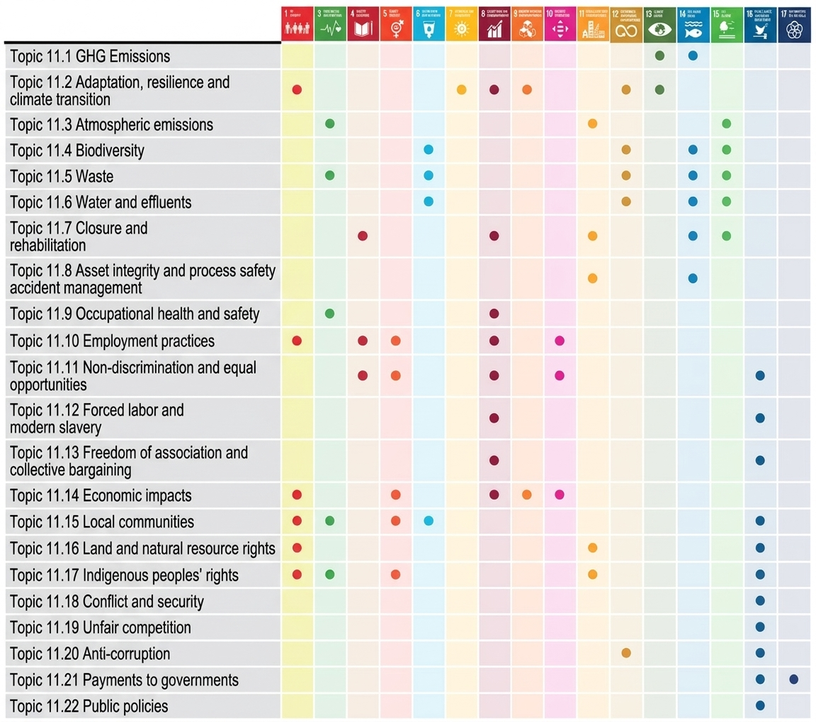
GRI 14 contains all the topics that should be addressed in the sustainability report of companies in the mining sector, and they are clearly linked to the SDGs, in order to facilitate the connection between GRI and the SDGs (Figure 2).
Source: Data extracted from the Global Report Initiative (GRI)[8].
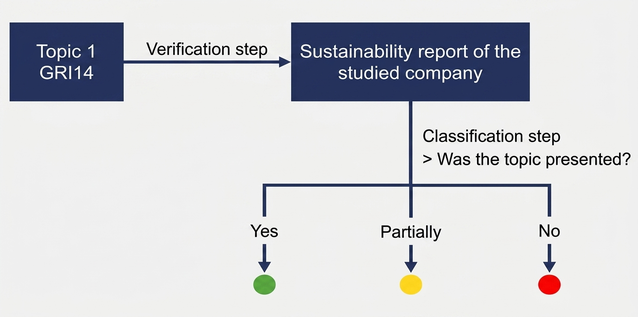
Based on the topics established by GRI 14 as best practices, it was verified whether the sustainability report met all of them. A color was assigned according to the level of adherence to the GRI topics, as illustrated in Figure 3.
Source: Prepared by the authors.
The results of the report analysis regarding compliance are presented in Table 1.
Table 1. Results of the analysis of the company’s sustainability report according to GRI 14
| GRI 14 Standard | Focus of the standard | Report Evaluation | Section | Report Topic |
| Greenhouse Gas (GHG) Emissions (14.1) | 1. Direct (scope 1) and indirect (scopes 2 and 3) GHG emissions 2. Methodologies used to calculate emissions 3. GHG emission reduction targets and actions taken 4. Information on climate risk management |  | Environmental Management | Decarbonization, climate resilience and energy |
| Climate adaptation and resilience (14.2) | 1. Climate risk assessment 2. Adaptation and mitigation plans 3. Measures to increase the resilience of operations and communities affected by climate change |  | Environmental Management | Decarbonization, climate resilience and energy |
| Atmospheric emissions (14.3) | 1. Non-GHG air pollutant emissions 2. Mitigation measures 3. Monitoring and control | | Environmental Management | Air Quality |
| Biodiversity (14.4) | 1. Protected areas or high biodiversity areas affected 2. Measures to mitigate impacts 3. Habitat restoration 4. Preservation of species and ecosystems | | Environmental Management | Biodiversity and property management |
| Waste (14.5) | 1. Quantity of waste generated 2. Reduction, recycling, reuse, and safe disposal practices 3. Management of tailings and hazardous waste 4. Compliance with regulations | | Environmental Management | Tailings management and waste management |
| Tailings (14.6) | 1. Waste management (dams, disposal, etc.) 2. Mitigation of related risks 3. Compliance with safety regulations | | Environmental Management | Tailings management and waste management |
| Water and effluents (14.7) | 1. Water intake and use management 2. Effluent treatment and disposal 3. Impacts on water sources and water quality 4. Mitigation of scarcity and contamination risks | | Environmental Management | Water Management |
| Closing and rehabilitation (14.8) | 1. Mine closure planning 2. Land rehabilitation and restoration 3. Post-closure monitoring 4. Regulatory compliance | | Good governance | Recovery and closing |
| Economic impacts (14.9) | 1. Economic performance 2. Local economic development 3. Community investments 4. Job creation and contribution to infrastructure | | Thriving Communities Business Resilience | Local community development Economic performance |
| Local communities (14.10) | 1. Local community engagement 2. Mitigation of negative impacts 3. Positive contributions 4. Community engagement and conflict resolution programs | | Prosperous communities | Community health and well-being |
| Indigenous Peoples’ Rights (14.11) | 1. Recognition and respect for cultural and territorial rights and self-determination 2. Engagement with indigenous communities 3. Mitigation of negative impacts 4. Free, Prior, and Informed Consent (FPIC) | | Good governance | Human rights |
| Land and resource rights (14.12) | 1. Respect for land and natural resource property 2. Prevention and mitigation of impacts related to land acquisition and use 3. Stakeholder engagement 4. Legal compliance and impact studies | | Environmental Management | Biodiversity and property management |
| Artisanal and small-scale mining (14.13) | 1. Recognition and management of impacts 2. Engagement and support for local communities 3. Mitigation of social, economic, and environmental risks 4. Promotion of responsible practices |  | – | – |
| Security practices (14.14) | 1. Workplace safety 2. Health and safety training 3. Risk prevention and mitigation 4. Safety performance reporting | | Skilled workforce Good governance | Occupational safety and health Risk Management |
| Critical Incident Management (14.15) | 1. Emergency response plan 2. Incident prevention and preparedness 3. Communication and coordination 4. Incident reporting | | Skilled workforce | Crisis management and emergency preparedness |
| Occupational health and safety (14.16) | 1. Protection of workers’ health and safety 2. Regular training 3. Risk monitoring 4. Reporting of safety incidents 5. Promotion of well-being | | Skilled workforce Good governance | Safety and health in the workplace – industrial hygiene and occupational health Risk Management |
| Employment practices (14.17) | 1. Fair working conditions 2. Hiring and retention policies 3. Labor relations and compliance 4. Employee well-being | | Skilled workforce | Talent attraction and retention |
| Child labor (14.18) | 1. Policies and practices for prevention 2. Monitoring and auditing 3. Corrective actions | | Good governance | Human rights |
| Forced labor and modern slavery (14.19) | 1. Policies and practices for prevention 2. Monitoring, auditing, and due diligence 3. Corrective actions and support 4. Compliance with international standards | | Good governance | Human rights |
| Freedom of association and collective bargaining (14.20) | 1. Policies and Practices 2. Measures to prevent discrimination 3. Engagement with unions 4. Compliance with international labor standards | | Good governance | Human rights |
| Non-discrimination and equal opportunities (14.21) | 1. Policies and Practices 2. Measures to prevent discrimination 3. Monitoring and corrective actions 4. Promotion of diversity | | Skilled workforce | Diversity and inclusion |
| Anti-corruption (14.22) | 1. Policies and practices for prevention 2. Employee training 3. Audits and monitoring 4. Corrective measures | | Environmental management Good governance Business resilience | Environmental Compliance Business Integrity and Transparency Responsible Production and Supply Chain |
| Payments to governments (14.23) | 1. Financial payments to the government 2. Financial transparency 3. Reports by country or project | | Business Resilience | Responsible production and supply chain |
| Public policy (14.24) | 1. Involvement in public policies and advocacy 2. Positioning on regulations 3. Participation in associations and groups 4. Transparency on political contributions | | Environmental management Good governance Business resilience | Environmental Compliance Business Integrity and Transparency Responsible Production and Supply Chain |
| Areas affected by conflict and high-risk (14.25) | 1. Operations in conflict and high-risk areas 2. Due diligence measures 3. Engagement with local communities 4. Risk prevention and mitigation | | Thriving communities Good governance | Community health and well-being Human rights and risk management |
The analysis of the company’s sustainability report indicates that 20 out of the 25 topics established by GRI 14 were addressed and discussed clearly, according to the requirements demanded by this standard.
Of the five topics not addressed, three were mentioned, but the company did not deepen the discussion, which made it impossible to meet the GRI requirements. The topic “climate adaptation and resilience” was cited, but the company could present greater specificity in measures to increase the resilience of operations and communities affected by climate change, which would strengthen the report. Climate adaptation and resilience are central themes in the 2030 Agenda for Sustainable Development, especially in SDG 13: Climate Action. This SDG recognizes the urgency of combating climate change and its impacts; adaptation and resilience are crucial components of this action[8,13].
The topic “indigenous peoples’ rights” was also mentioned; however, the right to Free, Prior, and Informed Consent (FPIC) was not detailed, although this aspect is required by the GRI. The inclusion of the theme in a sustainability compliance analysis in the mining sector represents an important advance. However, the absence of information on FPIC constitutes a significant gap that demands further investigation. This is a fundamental right of indigenous peoples and traditional communities, recognized by international instruments such as Convention No. 169 of the International Labour Organization (ILO) and the United Nations Declaration on the Rights of Indigenous Peoples (UNDRIP). This right guarantees these populations the power to grant or refuse consent to projects or activities with the potential to impact their lands, territories, resources, and livelihoods[13,14].
Furthermore, actions and policies directed at indigenous peoples were not duly detailed. This guideline highlights the need for companies to recognize and respect the rights of these peoples, with attention to territorial, cultural, and social aspects. The topic “right to lands and resources” was also mentioned; however, the company did not present specific information on land and resource ownership rights, nor on the management of property rights — topics required by GRI 14.
Dois tópicos não foram contemplados pela empresa. O primeiro, “Mineração Artesanal e de Pequena Escala (MAPE)” não foi considerado conforme a GRI 14. Embora o relatório mencione a relação com a comunidade, não há discussão específica sobre o MAPE. A relevância desse tópico se justifica pela sua complexidade e impacto em dimensões sociais, ambientais e econômicas, o que torna sua inclusão essencial nos relatórios de sustentabilidade.
A similar situation was observed in the topic “areas affected by high-risk conflict”; however, the company states in its report that it does not operate in regions under such conditions, which justifies the absence of a specific approach. The topic of “innovation in mining”, although not listed in GRI 14, was included in the company’s sustainability report, which highlights its own initiative to showcase innovative practices in the sector.
The application of each GRI standard to the three aspects of sustainability (triple bottom line) was also analyzed to evaluate the mining company’s report in the social, environmental, and economic spheres, as presented in Table 2.
Table 2. Correlation between GRI 14 and the three sustainability pillars
| GRI 14 Topics | Economic | Societal | Environmental | Report Evaluation |
| GHG Emissions (14.1) |  | | ||
| Climate adaptation and resilience (14.2) | | | | |
| Atmospheric emissions (14.3) | | | ||
| Biodiversity (14.4) | | | ||
| Waste (14.5) | | | ||
| Tailings (14.6) | | | ||
| Water and effluents (14.7) | | | ||
| Closing and rehabilitation (14.8) | | | | |
| Economic impacts (14.9) | | | | |
| Local communities (14.10) | | |||
| Indigenous Peoples’ Rights (14.11) | | | ||
| Land and resource rights (14.12) | | | ||
| Artisanal and small-scale mining (14.13) | | | ||
| Security practices (14.14) | | | ||
| Critical Incident Management (14.15) | | | ||
| Occupational health and safety (14.16) | | | ||
| Employment practices (14.17) | | | | |
| Child labor (14.18) | | | ||
| Forced labor and modern slavery (14.19) | | | ||
| Freedom of association and collective bargaining (14.20) | | | ||
| Non-discrimination and equal opportunities (14.21) | | | ||
| Anti-corruption (14.22) | | | ||
| Payments to governments (14.23) | | | ||
| Public policy (14.24) | | | ||
| Areas affected by conflict and high-risk (14.25) | | |
Note. *The black markings indicate the sustainability aspects (economic, social, and environmental) to which the GRI 14 topics are related. The green, yellow, and red markings correspond to the summarized evaluation presented in Table 1.
It can be observed that none of the three strands were fully met in the report, with emphasis on the social dimension, identified as the least contemplated. This result highlights deficiencies in how the company communicates or manages sustainability impacts. The situation suggests that the report lacks sufficiently comprehensive or detailed information, or that the mining company still needs to advance significantly in its sustainable practices. For a company in the sector, the social pillar is of extreme importance, given that its operations usually have a direct impact on local communities, indigenous peoples, workers, and society in general.
Of the topics covered in GRI 14, thirteen deal with social sustainability, eight with environmental sustainability, and seven with economic sustainability. This data reinforces that the environmental dimension is no longer the sole focus within the theme. Furthermore, the greater number of topics focused on social issues highlights the impact that mining projects have not only on internal stakeholders, but on society as a whole, which seeks support[5].
The topics “land and resource rights”, “indigenous peoples’ rights”, and “artisanal and small-scale mining” deal with sensitive issues in the mining sector, which still generate discussions about the performance of mining companies worldwide[2]. The fact that the company shows a deficit in depth in its approaches related to the social field indicates that this is the area with the greatest need for development so that the company meets international best practices in sustainability.
Societal consent for the opening of a mine, also known as social license, has been gaining increasing importance. Communities near mining projects demand from mining companies a management that goes beyond traditional standards, in which decision-making power was concentrated in the company and the government. The absence of community acceptance can result in the halting and, consequently, the unviability of these projects[10].
Considering that the objective of this research was to analyze a world-class mining company regarding its alignment with the SDGs, based on the topics required by the GRI 14 and the three pillars of sustainability (economic, social, and environmental), it can be stated that the mining company’s report is, in part, aligned with the SDGs.
It can be concluded that the analysis of the mining company’s sustainability report, in light of the SDGs and GRI 14 guidelines, points to a partial alignment, with the identification of areas requiring strategic improvement.
Although the research shows that the mining company has met 20 out of 25 GRI topics, with detailed data, pertinent discussions, and, where applicable, impact mitigation measures, the lack of compliance in five topics deserves attention. Of these, three failed to address the expected content, while two presented no relevant information, indicating gaps in reporting or in the underlying practices.
The main conclusion is that, despite the efforts and the established foundation, none of the three pillars of the Triple Bottom Line (economic, environmental, and social) were fully met in the report. In particular, the social dimension stood out as the most neglected. For a world-class mining company, whose operations generate direct and significant impacts on communities and human rights, this fragility in the social pillar represents an important warning sign.
It is recommended that the company prioritize the review and strengthening of its practices and reporting regarding the social dimension of sustainability. This includes, but is not limited to, special attention to unmet topics, so that the CLPI and other critical social issues are not just mentioned, but addressed with depth, transparency, and evidence of effective management. Continuous improvement in this aspect is fundamental for the mining company to not only meet global sustainability expectations but also to strengthen its social license to operate, reduce future risks, and advance towards a more solid alignment with the SDGs and best market practices.
REFERENCES
[1] Almeida, I.T. 1999. A poluição atmosférica por material particulado na mineração a céu aberto. Dissertação de mestrado. Escola Politécnica da Universidade de São Paulo, São Paulo, SP, Brasil. 194p.
[2] Ministério de Minas e Energia. Nota Técnica nº 11/2024/DTTM/SNGM. disponível em: https://antigo.mme.gov.br/c/document_library/get_file?uuid=fdfc17a1-b167-25e7-e13f-8de24ea3fa92&groupId=36108. Acesso em: 06 jul.2025.
[3] Ministério de Minas e Energia. Caderno: Minerais críticos e estratégicos para a transição energética – EPE. Disponível em: https://www.epe.gov.br/sites-pt/publicacoes-dados-abertos/publicacoes/PublicacoesArquivos/publicacao-877/Caderno_Minerais_Final.pdf). Acesso em: 06 jul.2025.
[4] Church, C.; Crawford, A. 2020. Minerals and the metals for the energy transition: exploring the conflict implications for mineral-rich, fragile states. In: Hafner, M.; Tagliapietra, S. (orgs). The geopolitics of the global energy transition. 279-304. Springer, Londres, Inglaterra. https://link.springer.com/chapter/10.1007/978-3-030-39066-2_12.
[5] Johnson, C.; Affolter, M.D.; Inkenbrandt, P.; Mosher, C. 2017. An Introduction to Geology. 1ed. Salt Lake City, UT, EUA: Salt Lake Community College.
[5] Fernandez-Feijoo, B.; Romero, S.; Ruiz, S. 2014. Commitment to corporate social responsibility me asured through global reporting initiative reporting: factors affecting the behavior of companies. Journal of Cleaner Production 81: 244-254. DOI: 10.1016/j.jclepro.2014.06.034.
[6] Braga, M.C.R.; Fonseca, A.F. C. 2021. Aperfeiçoamentos reativos de políticas ambientais: lições dos desastres de Mariana e Brumadinho. Sustainability in Debate. 12(3): 197-213. https://doi.org/10.18472/SustDeb.v12n1.2021.39412.
[7] Melo, L.C.F.; Vieira, F.A. 2019. Licenciamento ambiental brasileiro e a reedificação de lugares como Brumadinho. Revista Internacional Consinter de Direito. 5(9): 177–196. https://doi.org/10.19135/revista.consinter.00009.09.
[8] Global Reporting Initiative (GRI). 2024. Diretrizes para relatório de sustentabilidade. Disponível em: <https://www.globalreporting.org/>. Acesso em: 09 abr. 2024.
[9] Oliveira, G.D.; Morong, F.F. 2020. A mineração brasileira à luz dos objetivos de desenvolvimento sustentável. Colloquium Socialis. 4(1): 31-45. 10.5747/cs.2020.v04.n1.s088.
[10] Tachizawa, T. 2022. Gestão Ambiental e responsabilidade social corporativa: estratégias de negócios focadas na realidade brasileira. 8ed. São Paulo, SP, Brasil: Atlas.
11 Gil, A. C. 2008. Métodos e técnicas de pesquisa social. 6ed. São Paulo, SP, Brasil: Atlas.
12 Prodanov, C.C.; Freitas, E.C. 2013. Metodologia do trabalho científico: métodos e técnicas da pesquisa e do trabalho acadêmico. 2ed. Novo Hamburgo, RS, Brasil: Feevale.
[13] Prno, J.; Slocombe, D.S. 2012. Exploring the origins of ‘social license to operate’ in the mining sector: perspectives from governance and sustainability theories. Resources Policy. 37(3): 346–357. https://doi.org/10.1016/j.resourpol.2012.04.002.
[14]Organização Internacional do Trabalho (OIT). Convenção nº 169 sobre Povos Indígenas e Tribais em Países Independentes. Genebra, 1989. Disponível em: https://www.ilo.org/wcmsp5/groups/public/—americas/—ro-lima/—sro-brasilia/documents/publication/wcms_246029.pdf. Acesso em: 01 jul. 2025.
COMO CITAR
Silva, A.M.; Freitas, B.C. Avaliação do nível de maturidade em sustentabilidade de um projeto de mineração. Revista E&S. 2025; 6: e2025015.
ABOUT THE AUTHORS
Amanda do Nascimento Silva – Project Management Specialist. Mining Planning Engineer. Centrumvägen 1, 696 76, Zinkgruvan, Örebro, Sweden.
 Beatriz Cristina de Freitas – Doctor of Dentistry. Specialist in Project Management. Supervising Professor. Rua Cezira Giovanoni Moretti, 580, Santa Rosa, 13414-157, Piracicaba, São Paulo.