
Micro And Small Enterprises
Tax Planning
Business Survival
June 28, 2024
Relationship between tax planning and the survival of micro and small enterprises in Brazil
DOI: 10.22167/2675-6528-20230073
E&S 2024, 5: e202300073
William Freitas Alves Barroso; Vinícius Medeiros Magnani
Tax planning is an unknown activity, sometimes seen as unnecessary or burdensome by many business owners and entrepreneurs. Some of them, however, end up paying unnecessary taxes due to a lack of knowledge and clear official information or, still, as a consequence of constant changes in legislation.
According to Chiavenato[1], it is crucial for organizations to engage in continuous planning, establishing goals, defining objectives, and identifying the resources and tasks necessary to achieve them. This process begins with the choice of business and extends to effective market entry. The path to success as an entrepreneur in Brazil is not easy, but those who succeed stand out for their boldness, creativity, innovation, and persistence, qualities that commonly accompany these individuals[2].
According to the Brazilian Institute of Geography and Statistics (IBGE)[3], the slowdown in economic growth in the 1980s encouraged the opening of micro and small enterprises (MSE), which became alternatives for those suffering from the unemployment reality of the time. This fact is again observed today, as pointed out by the report “Doing Business Subnational Brazil 2021”[17].
The current National Tax Code (CTN)[4] was introduced through Law No. 5,172, of 1966, with 218 articles, according to data from the Brazilian Institute of Planning and Taxation (IBPT)[5]. Since its creation, the code has not undergone profound changes and, because of this, has not kept pace with the changes in the profile of society and the economy, which have evolved drastically over time. Coelho[6] states that, for this reason, the CTN is a document in which there are several legal contradictions.
SMEs are fundamental to the Brazilian economy, playing an important role in job and income generation[7]. Data from Sebrae[8] and IBGE[9] show that this economic segment represents 51% of jobs generated and 30% of the country’s Gross Domestic Product (GDP). All this influence, however, is impacted by the high mortality rate of these companies, and one of the reasons is the tax burden, according to the authors.
The IBPT[10] shows that, since the enactment of the current Federal Constitution until the year 2018, 390,726 tax regulations were issued. Given a scenario with so many norms and changes, the importance of the role of tax planning is perceived.
Maggi[11] affirms that tax planning aims to achieve savings in tax management, adopting procedures summarily within legal norms. The author describes the practice as a preventive business activity, responsible for analyzing taxable events and their effects and comparing probable results for various possible procedures and scenarios, in order to enable the choice of the least burdensome alternative within the law.
Based on the studies and data analyzed, we sought to verify the influence of tax planning on the survival rate of MSEs in Brazil. We also sought to contextualize such data with the scenario of the covid-19 pandemic and to ascertain the impacts on the economic context of the period when this study was conducted.
The hypothesis raised by this research is that tax planning practices by entrepreneurs, business owners, or managers of MSMEs positively impact the perpetuity principle of companies, helping them to remain active in the market for a long time, as they optimize the use of financial resources, previously allocated to tax obligations, sometimes mistakenly, for use in their expansion and wealth generation for their partners. As stated by Fabretti[12], the objective is to achieve the maximum viable fiscal economy, reducing the tax burden to the amount strictly required by legislation.
In this way, it is essential to analyze all legal options pertinent to each case and the gaps in legislation that allow the execution of the desired operation in a less costly manner for the taxpayer, provided it is in compliance with the law. In essence, the research suggested that effective tax management could contribute to the longevity and continued success of SMEs in the market.
This work was conducted through hypothetical-deductive research. According to Gil[13], this method was created by Karl Popper, based on criticisms of induction brought in the work “The Logic of Scientific Discovery”, published in 1935; induction is a reasoning process that starts from particular observations to reach general conclusions. Popper argued that this is not a reliable method for arriving at scientific knowledge, as there is no guarantee that future observations will confirm the general conclusions drawn from past observations.
The hypothetical-deductive method begins with the determination of a problem or a gap in scientific knowledge. It is then followed by the formulation of hypotheses and a process of deductive inference, in which the prediction of phenomena covered by the aforementioned hypothesis is tested. Lakatos and Marconi[14] state that Popper’s method is based on error elimination.
This method was used in the research for its ability to organize thought, ensure the testability of hypotheses, and allow for generalizations and the refutability of ideas, offering a systematic and rigorous approach to scientific investigation.
The data were collected in surveys conducted by the Brazilian Micro and Small Business Support Service (Sebrae), with data from the period between 2008 and 2020, and by the World Bank, for comparability and evolution analysis purposes. The present study was based on the report “Company Survival in Brazil 2020”[15], the result of a Sebrae survey published in 2021, which aimed to calculate the survival and mortality rate of companies in Brazil and identify the determining factors for the results.
Another historical series, “Company Survival in Brazil 2016”[16], was used to extract data regarding companies established between 2008 and 2012, obtained through the processing of databases from the Federal Revenue Secretariat (SRF), covering the period from 2008 to 2014. The study, also from Sebrae, also included a telephone survey with 2,006 interviews, conducted between July and August 2016 nationwide.
The report “Doing Business Subnacional Brasil 2021”[17], from the World Bank, provided information about business regulation and the impacts of taxes on the profit of Brazilian companies. The statistical calculation of Pearson’s correlation coefficient, a statistical measure that quantifies the strength and direction of the linear relationship between two continuous variables, obtained using the data collected above, showed the strength between the total tax burden on profit and company survival rates; after being tested and in line with the hypothetical-deductive method, this data provided sufficient information for the analysis of the hypothesis raised.
Fabretti[18] classifies tax planning as the prior study done before the occurrence of the tax-generating administrative fact, considering its legal and economic effects and the less burdensome available legal alternatives. According to Borges[19], tax planning begins with the collection of data related to the company’s segment, obeying the operational particularities of each organization.
In the words of Malkowski[20], for tax planning not to be characterized as tax evasion, it must be formalized before the taxable event, as, if it occurs later, it may generate this interpretation. Globalization, the extremely competitive market, and the heavy tax burden on organizations require effective management practices to lead companies; therefore, seeking lawful ways to reduce tax payments and, concurrently, keeping up with legislative changes are essential actions to maximize profits, perpetuate businesses, and improve employment levels[11].
Maggi[11] states that tax planning has been carried out by companies, however, it is of utmost importance to perform an administrative analysis based on the organizations’ strategy, aiming to minimize costs and, mainly, deepen the knowledge of an important practice for market competitiveness. Costa et al.[21] report that some regions have tax benefits, however, where they do not exist, entrepreneurs must pay attention to tax and financial planning, so that they can maintain a good level of profitability.
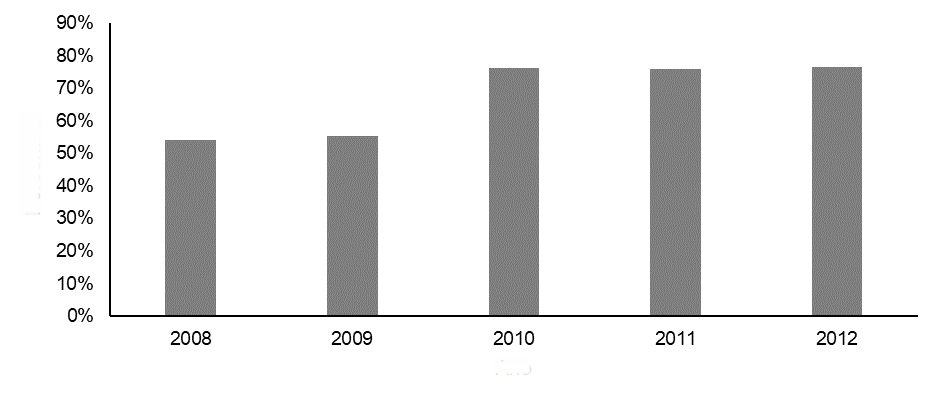
According to the research “Survival of Companies in Brazil 2016”[16], based on Brazilian firms established in 2012 and with information collected from the SRF database until 2014, the survival rate of Brazilian companies with up to two years of activity was 76.6%, the highest for this group in the entire analyzed period (2008 to 2012). It should be noted that some macroeconomic factors and policies of the time contributed to this improvement in the researched scenario, the main one being the institution of the legal status of the individual micro-entrepreneur (MEI) in 2008, which caused the number of businesses to increase by 6 million between 2009 and 2016[15].
The macroeconomic characteristics of the period from 2008 to 2014 included GDP growth, a decrease in unemployment and interest rates, growth in average income and minimum wage, and positive changes in some SME laws, as in the cases of the General Law, from 2006, and the Simples Nacional Law, from 2007[22],[23]. Figure 1 shows the evolution of the two-year business survival rate in Brazil between 2008 and 2012.
Source: Brazilian Micro and Small Business Support Service (Sebrae)[16].
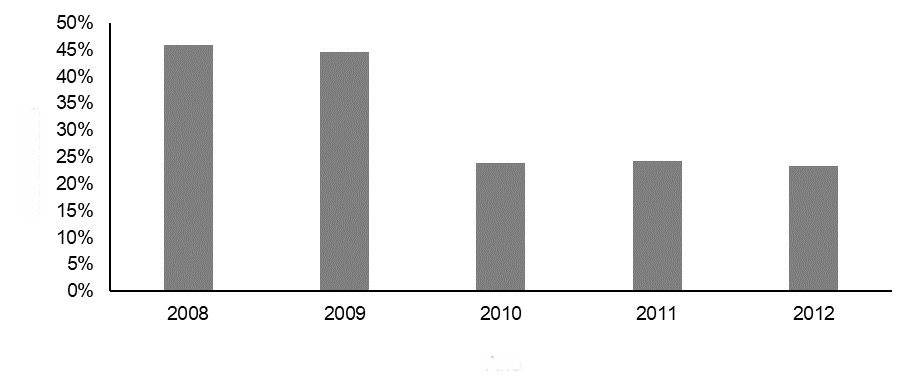
Considering that the mortality rate is complementary to the survival rate, it is assumed that the mortality rate of companies with up to two years of activity has fallen from 45.8% in companies established in 2008 to 23.4% in companies established in 2012 (Figure 2). Such an improvement is also evidenced by the macroeconomic factors and policies that occurred during the period. The contribution of MEI to the reduction of business mortality in the same period analyzed stands out.
Source: Brazilian Micro and Small Business Support Service (Sebrae)[16].
Table 1. Mortality rate of companies within five years of their opening
| State | Mortality (%) | |||||
| t = 0 | t = 1 | t = 2 | t = 3 | t = 4 | t = 5 | |
| AC | 0 | 11 | 17 | 20 | 23 | 25 |
| LAIA | 0 | 12 | 18 | 22 | 26 | 28 |
| AM | 0 | 10 | 14 | 17 | 20 | 22 |
| AP | 0 | 12 | 16 | 19 | 22 | 23 |
| BA | 0 | 11 | 16 | 21 | 24 | 26 |
| EC | 0 | 11 | 17 | 22 | 26 | 28 |
| DF | 0 | 13 | 19 | 23 | 27 | 29 |
| ES | 0 | 11 | 17 | 22 | 26 | 28 |
| GO | 0 | 11 | 18 | 22 | 26 | 28 |
| MA | 0 | 9 | 14 | 17 | 21 | 23 |
| MG | 0 | 12 | 18 | 23 | 27 | 30 |
| MS | 0 | 10 | 15 | 19 | 23 | 25 |
| MT | 0 | 11 | 17 | 21 | 25 | 27 |
| PA | 0 | 10 | 15 | 19 | 22 | 24 |
| GNP | 0 | 11 | 17 | 21 | 24 | 26 |
| PE | 0 | 11 | 17 | 21 | 25 | 27 |
| GDP | 0 | 9 | 14 | 17 | 20 | 22 |
| PR | 0 | 11 | 18 | 22 | 26 | 28 |
| RJ | 0 | 10 | 15 | 19 | 22 | 23 |
| RN | 0 | 11 | 17 | 21 | 24 | 26 |
| RO | 0 | 13 | 19 | 23 | 27 | 29 |
| RR | 0 | 11 | 17 | 20 | 24 | 26 |
| RS | 0 | 11 | 18 | 23 | 27 | 29 |
| SC | 0 | 11 | 18 | 23 | 27 | 29 |
| IF | 0 | 11 | 17 | 22 | 26 | 28 |
| SP | 0 | 11 | 17 | 21 | 25 | 27 |
| TO | 0 | 11 | 18 | 22 | 26 | 28 |
Table 2. Reasons alleged by entrepreneurs for the company to cease operations,
| Reason | Percentage (%) |
| Taxes/costs/expenses/interest | 31 |
| Sales/low demand, demand, customers/strong competition | 29 |
| Financial problems/default/lack of credit/working capital | 25 |
| Management/administrative problems/incapacity/society/logistics | 25 |
| Got another opportunity/didn’t need it anymore | 13 |
| Labor/employees/preparation | 12 |
| Crisis (economic/country/financial) | 10 |
| Bureaucracy | 5 |
| Personal/family problems | 4 |
| Location/point | 3 |
| Other miscellaneous reasons | 3 |
| Time (workload/incompatibility) | 3 |
| Force majeure/illness/retirement | 2 |
| Lack of support | 2 |
The research also found a strong sentiment regarding the impact of the high Brazilian tax burden on the failure of SMEs (Table 3).
Table 3. Factors that would have prevented the company’s closure, according to entrepreneurs
| Reason | Percentage (%) |
| Less charges and taxes | 52 |
| More clients | 28 |
| Facilitated credit | 21 |
| Business Planning | 18 |
| Skilled labor | 15 |
| Effective financial management | 13 |
| Business consulting | 10 |
| None | 6 |
| Agreement between partners | 5 |
To deduce the hypothesis raised in this work from the data above, the research “Relationship of SMEs with Accountants”, conducted by Sebrae and released in 2016, was used. This research aimed to identify how SMEs related to accounting service providers. The methodology used was telephone interviews, conducted between December 18, 2015, and February 03, 2016, with 6,054 responding companies. The topic in question addressed the services that could be most offered to micro and small enterprises, highlighting the importance of tax planning for this segment.
It was found that 84% of respondents believed that accountants and/or accounting firms could offer more tax planning services in order to assist in decision-making (Table 4).
Table 4. Which services are adequate, relevant, and could be offered by accounting firms?
| Reason | Percentage (%) |
| Tax planning | 84 |
| Recommendations for improvements | 79 |
| Performance reports and diagnostics | 77 |
| Support in financial management | 73 |
| Support for accessing credit lines | 70 |
| Business plan development | 67 |
| Resolve overdue debts/payments | 66 |
| Implementation of computerized systems | 63 |
| Support for participating in bids/exports | 57 |
The report “Doing Business Subnacional Brasil 2021”[17], produced by the World Bank at the request of the General Secretariat of the Presidency of the Republic of Brazil and sponsored by the National Confederation of Goods, Commerce and Tourism (CNC), the Brazilian Federation of Banks (Febraban), and Sebrae, presented a comparative analysis of the business environment in 27 Brazilian federative units. The data were collected in a standardized way, to ensure they were comparable over time with different locations and economies. A questionnaire was sent to more than 1,500 local specialists, in areas relevant to the business environment, such as lawyers, accountants, engineers, architects, and other professionals with technical and practical knowledge about the regulatory and bureaucratic processes related to opening companies, obtaining building permits, registering properties, paying taxes, and enforcing contracts. Subsequently, it was submitted to several checks for review or expansion of the collected information.
The impact of the total tax burden was calculated through the amount of mandatory taxes and contributions due by the respondent companies in the year 2019. The value corresponded to the sum of all taxes due after accounting for tax deductions and exemptions. Withholding taxes, but not owed by the company, were excluded from the calculation. This study aimed to provide a comprehensive indicator of the cost of all taxes for companies. The survey data, based on each capital of the 26 Brazilian states and the Federal District, are presented in Table 5.
Table 5. Total tax burden (as a percentage of profits)
| Location | Total tax burden (%) |
| Brazil Average | 65,3 |
| AC | 66,0 |
| LAIA | 64,6 |
| AM | 64,9 |
| AP | 64,8 |
| BA | 65,7 |
| EC | 66,0 |
| DF | 65,0 |
| ES | 64,4 |
| GO | 64,8 |
| MA | 65,1 |
| MG | 65,6 |
| MS | 65,0 |
| MT | 64,4 |
| PA | 66,0 |
| GNP | 65,3 |
| PE | 66,0 |
| GDP | 65,2 |
| PR | 65,7 |
| RJ | 66,4 |
| RN | 65,1 |
| RO | 64,5 |
| RR | 64,7 |
| RS | 65,1 |
| SC | 65,2 |
| IF | 66,3 |
| SP | 65,8 |
| TO | 64,4 |
It is also noteworthy that the average time spent on tax obligations in Brazil is 1,493 hours annually, according to the same study. Based on the information from the Doing Business study[17] and the data from Tables 1 and 5, Pearson’s correlation coefficient was calculated to discover the resulting index and test the hypothesis raised for this work. Thus, the correlation between the total tax burden on profit in the year 2019 and the mortality rate of companies with five years of existence, with data from the year 2020, was determined.
The Pearson correlation coefficient (ρ) measures the statistical relationship between two continuous variables and shows how much the variability of one is related to the variability of the other. This coefficient ranges from -1 to +1, and results close to -1 and +1 indicate a strong linear correlation. Values close to zero suggest the absence of linear correlation, as shown in Formula (1).

where, px,y: is the Pearson correlation coefficient of the x-axis and y-axis data;  : is the sum of occurrences of the x and y axis data; and S is the standard deviation of the x and y axis data.
Equation (1) shows the result of the calculation:

where, px,y: is the value of the correlation coefficient calculated for the analyzed data.
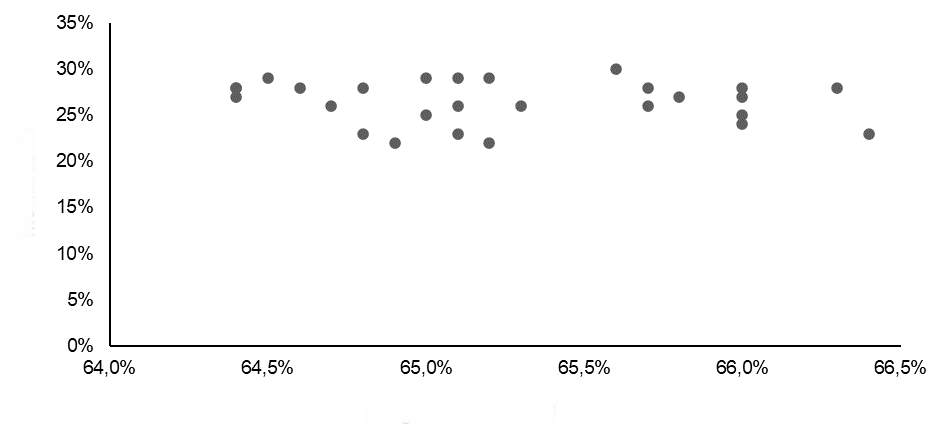
The result found above for the ρ coefficient, equal to -0.13481, indicates that there was a weak negative correlation between the analyzed indices. Figure 3, which shows the data scatter, clarifies the issue.
Source: Original research results.
In Figure 3, it is possible to observe that there was a null correlation between the variables, whereas, numerically, the ρ coefficient demonstrated a weak negative correlation between the variables under study. Initially, it was interpreted that the higher the tax burden on companies’ profits, the lower the mortality rates. Contrasting the above result, the authors of the consulted literature and the hypothesis presented in this work suggested the opposite: more taxes resulted in higher company mortality.
To verify if the obtained result occurred by chance, the hypotheses were tested. The null hypothesis (H0) assumes that a given statistical result was obtained only by chance, due to probabilistic variations of the measured events, and not due to a real effect that caused that result. When working with a hypothesis to explain a given phenomenon, the possibility of the existence of at least one competing hypothesis is considered. In this case, the competing hypothesis is called the alternative hypothesis (HA), demonstrating that the correlation is significant.

where, H0: is the null hypothesis to be tested; HA: is the alternative hypothesis to be tested; and ρ: is the correlation coefficient to be tested.
The significance level (α) refers to a tolerable error margin that supports the rejection of the null hypothesis. For the hypothesis test presented in this work, a significance level equal to 5% was used, and considering the data from the 27 Brazilian UFs (n = 27), the Student’s t was calculated, with n – 2 degrees of freedom. Student’s t is a probability distribution used in hypothesis testing to verify whether the difference between the means of two samples is statistically significant. It is especially useful when the sample size is small (generally less than 30) or when the population variance is unknown.
In this context, the Student’s t-test was used to verify if the correlation between two variables — for example, the time spent on tax obligations and the level of economic development of a region — was statistically significant. In other words, it helped to determine if the correlation observed in the sample was strong enough to be generalized to the population, or if it could be just a result of chance. If the t value of t0 was higher than the critical t value, the null hypothesis would be rejected. If the null hypothesis at the significance level α was rejected, it would be possible to conclude that there was indeed a significant relationship between the analyzed variables. This calculation is demonstrated in Formula (2):

where, t0: is the value found after the statistical test; r: is the value of the correlation coefficient to be tested; and n: is the number of data pairs in the analyzed sample.
Equation (2) presents the result of the hypothesis test for the tested correlation coefficient:
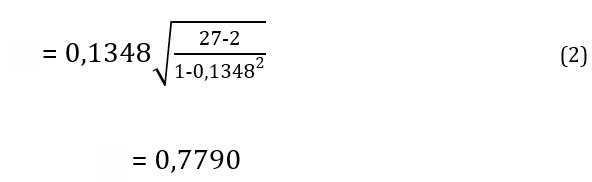
where, t0: is the value found after the statistical test.
It is understood that, if t0 > t(α – 2) or t0 < −t(α – 2), H0 is rejected and, otherwise, H0 is not rejected. This range is called the critical region. According to Table T of Student’s t-distributions, a statistical tool used to determine the probability of obtaining a certain Student’s t-value (or a more extreme value) under the null hypothesis, which helps to assess whether the observed difference between the means of two samples is statistically significant or can be attributed to chance, for n = 25 degrees of freedom and considering a significance level (α) of 5%, the critical value is 2.0595. The significance test of the coefficient will always be two-tailed. Considering that the found t0 value, equal to 0.7790, was outside the critical region determined for this test, i.e., within the interval [-2.0595; 2.0595], H0 was not rejected.
In light of the results shown above, the hypothesis was not rejected, confirming that there was no correlation between the mortality rate of Brazilian companies and the percentage of the total tax burden levied on them. It was presumed that the lower the tax incidence on companies, the lower their mortality rate would be.
With the above results, it was possible to assume that high tax burdens could impact companies’ survival rates, based on the researched data, the statistical test, and the related literature, which confirmed the hypothesis initially raised in this research.
It was found that the covid-19 pandemic was a severe blow to the survival of companies. According to Sebrae[15], 41% of companies that closed during the year 2020 ended due to the difficulties imposed by the global pandemic that began in March of that year. The need for planning in all aspects of the business, especially tax, for the survival and continuity of companies was further accentuated.
The lack of prior business knowledge on the part of entrepreneurs; the non-hiring of a professional or a dedicated area in the company for taxes; the unstable scenario experienced by MSEs in Brazil regarding the legal aspect; and the sometimes abrupt changes in macroeconomic scenarios and policies, among other factors, led to the assumption that tax planning impacted the survival of MSEs.
It is important to emphasize, also, the importance of governments protecting this group, which is so important for the Brazilian economy and families. Additionally, further studies on the subject are suggested.
References
[1] Chiavenato I. Empreendedorismo: dando asas ao espírito empreendedor. São Paulo: Saraiva; 2004.
[2] Dornelas J.C.A. Empreendedorismo: transformando ideias em negócios. 2ed. Rio de Janeiro: Elsevier; 2005.
[3] Instituto Brasileiro de Geografia e Estatística (IBGE). As micro e pequenas empresas comerciais e de serviços no Brasil. 2003. Disponível em: https://biblioteca.ibge.gov.br/visualizacao/livros/liv1898.pdf. Acesso em: 19 abr. 2021.
[4] Brasil. Lei n. 5.172, de 25 de outubro de 1966. Dispõe sobre o Sistema Tributário Nacional e institui normas gerais de direito tributário aplicáveis à União, Estados e Municípios. Diário Oficial da União. 1966 out. 27. Disponível em: http://www.planalto.gov.br/ccivil_03/leis/l5172compilado.htm. Acesso em: 17 jul. 2021.
[5] Instituto Brasileiro de Planejamento e Tributação (IBPT). Causas de desaparecimento das micros e pequenas empresas. 2013. Disponível em: http://www.acsaraiva.com.br/wordpress/wp-content/uploads/2016/06/CausasDeDesaparecimentoDasMicrosEPequenasEmpresas.pdf. Acesso em: 23 abr. 2021.
[6] Coelho S.C.N. Curso de direito tributário brasileiro. 9ed. Rio de Janeiro: Editora Forense; 2006.
[7] Barroso M.F.C.M.; Silveira J.C. O super simples: o impacto dessa nova forma de tributação sobre as microempresas e empresas de pequeno porte. Perspectivas Online. 2009; 3(10): 12-25. Disponível em: https://www.perspectivasonline.com.br/revista_antiga/article/view/359. Acesso em: 04 abr. 2021.
[8] Serviço Brasileiro de Apoio às Micro e Pequenas Empresas (Sebrae). Participação das micro e pequenas empresas na economia brasileira. 2014. Disponível em: https://www.sebrae.com.br/Sebrae/Portal%20Sebrae/Estudos%20e%20Pesquisas/Participacao%20das%20micro%20e%20pequenas%20empresas.pdf. Acesso em: 18 abr. 2021.
[9] Instituto Brasileiro de Geografia e Estatística (IBGE). Demografia das Empresas: em 2018, taxa de sobrevivência das empresas foi de 84,1%. 2020. Disponível em: https://agenciadenoticias.ibge.gov.br/agencia-sala-de-imprensa/2013-agencia-de-noticias/releases/29206-demografia-das-empresas-em-2018-taxa-de-sobrevivencia-das-empresas-foi-de-84-1. Acesso em: 17 abr. 2021.
[10] Instituto Brasileiro de Planejamento e Tributação (IBPT). 2012. Quantidade de normas editadas no Brasil: 24 anos da Constituição Federal de 1988. Governança Tributária, Curitiba, 1:36.
[11] Maggi L. Planejamento contábil e tributário. Belo Horizonte: Editora Fumarc; 2009.
[12] Fabretti L.C. Contabilidade tributária. São Paulo: Atlas; 2005.
[13] Gil A.C. Métodos e técnicas de pesquisa social. São Paulo: Atlas; 2008.
[14] Lakatos E.M.; Marconi M.A. Metodologia do trabalho científico. São Paulo: Atlas; 1991.
[15] Serviço Brasileiro de Apoio às Micro e Pequenas Empresas (Sebrae). Sobrevivência de Empresas. 2021. Disponível em: https://datasebrae.com.br/wp-content/uploads/2021/06/Apresenta%C3%A7%C3%A3o-Sobreviv%C3%AAncia_2020_Web_Final.pdf. Acesso em: 28 ago. 2021.
[16] Serviço Brasileiro de Apoio às Micro e Pequenas Empresas (Sebrae). Relação das MPE com os contadores. 2016. Disponível em: http://www.bibliotecas.sebrae.com.br/chronus/ARQUIVOS_CHRONUS/bds/bds.nsf/b8dff2e0d5a98dba529637637e3ff24e/%24File/7478.pdf. Acesso em: 27 abr. 2021.
[17] Banco Mundial. Doing Business Subnacional Brasil 2021. 2021. Disponível em: https://portugues.doingbusiness.org/content/dam/doingBusiness/media/Subnational/DB2021_SNDB_Brazil_Full-report_Portuguese.pdf. Acesso em: 19 ago. 2021.
[18] Fabretti L.C. Contabilidade tributária. São Paulo: Atlas; 2007.
[19] Borges H.J. Gerência de impostos: IPI, ICMS e ISS. São Paulo: Atlas; 2010.
[20] Malkowski A. Planejamento tributário e a questão da elisão fiscal. Leme: LED Editora de Direito; 2000.
[21] Costa D.F.; Silva A.C.M.; Moreira B.C.M.; Costa M.F.; Andrade L.P. Proposta de um modelo de previsão do resultado para o planejamento tributário de pequenas empresas. Enfoque Reflexão Contábil. 2018; 37(3): 93-110. DOI: 10.4025/enfoque.v37i3.33607.
[22] Brasil. Lei Complementar n. 139, de 10 de novembro de 2011. Altera dispositivos da Lei Complementar n. 123, de 14 de dezembro de 2006, e dá outras providências. Diário Oficial da União. 2011 nov. 10. Disponível em: http://www.planalto.gov.br/ccivil_03/leis/lcp/lcp139.htm. Acesso em: 19 jul. 2021.
[23] Brasil. Lei Complementar n. 128, de 19 de dezembro de 2008. Altera a Lei Complementar n. 123, de 14 de dezembro de 2006, altera as Leis n. 8.212, de 24 de julho de 1991, n. 8.213, de 24 de julho de 1991, n. 10.406, de 10 de janeiro de 2002 (Código Civil), n. 8.029, de 12 de abril de 1990, e dá outras providências. Diário Oficial da União. 2008 dez. 22. Disponível em: https://www.planalto.gov.br/ccivil_03/leis/lcp/lcp128.htm. Acesso em: 17 jun. 2024.
How to cite
Barroso W.F.A.; Magnani V.M. Relationship between tax planning and the survival of micro and small enterprises in Brazil. E&S Journal. 2024; 5: e20230073.
About the authors
William Freitas Alves Barroso  , Specialist in Finance and Controlling – Rua Beco das Flores,115 – Cachoeira do Brumado Postal Code 35429-400 – Mariana/MG, Brazil.
Vinícius Medeiros Magnani , Doctor in Controllership and Accounting from FEA-RP/USP. Rua Alexandre Herculano, 120 – Vila Monteiro; 13418445, Piracicaba/SP, Brazil.