
Pedagogical Coordinator
December 09, 2025
Continuing education and time management: challenges and priorities of the pedagogical coordinator
Authors: Camille Maria Vitalino Rampani and Milena Pedroso Ruella Martins
DOI: 10.22167/2675-6528-2025028
E&S 2025, 6: e2025028
The Brazilian educational landscape is characterized by a great diversity of institutions, which vary in size, segments served, and market insertions. In this context, the pedagogical coordinator plays a strategic role in the organizations where they work. Their responsibilities focus on the articulation between school management and teaching practice, encompassing functions such as conflict mediation, pedagogical guidance, and the promotion of continuous teacher training[1]. This multiplicity of tasks frequently overloads the coordinator, who must reconcile administrative activities, pedagogical training, and individual teacher support. This accumulation of duties limits the time available for their own training during the workday.
The Law of Directives and Bases of National Education[2] defines that the education system must ensure teachers continuous education, professional development, and constant qualification. Literature also points out that teacher training needs to be continuous, linked to practice, and reconfigured throughout the career[3].
In this sense, the pedagogical coordinator must not only organize occasions for collective exchange, in order to encourage teacher training, but also invest in their own updating, so as to be prepared to promote truly enriching, transformative, and formative moments. Almeida and Placco[4] emphasize that, in the school routine, the coordinator is often absorbed by bureaucratic and assistance demands, which limits their time to fully exercise their formative role. This reality, at times, places them in the position of a “firefighter,” by dedicating themselves only to solving small daily urgencies that consume time and hinder the implementation of reflective and innovative practices with their school teams.
Formosinho[5] emphasizes training as a collective and collaborative action, which requires planning and time dedicated to innovative practices. For the author, the transformation of the school is only possible when pedagogical work is based on collective and reflective projects, in order to integrate innovation and teaching action in the same movement. These moments need to be duly thought out, prepared and structured. In this way, it becomes urgent to reflect on how the coordinator can be institutionally supported to exercise this role.
Although the LDB[2] and Resolution CNE/CP No. 2/2015[6] ensure continuing education for teachers, these norms do not directly address pedagogical coordinators, creating a regulatory gap. In this situation, professionals need to promote training opportunities but lack clear guidance for adequate preparation. The absence of guidelines for pedagogical managers compromises the consolidation of policies that guarantee formal spaces for their own training, as the system recognizes the importance of teacher development but neglects who is responsible for inducing it.
Given the above, the question arises: do pedagogical coordinators have time to adequately prepare themselves as trainers? And how do they balance daily urgencies and their own professional development? This study aims to investigate how time management challenges impact the continuous training of pedagogical coordinators. By answering these questions based on empirical research conducted with professionals with more than two years of experience working in private schools, as well as presenting critical reflections on the scenario of continuing education in Brazil.
The study used a qualitative-descriptive approach, with the application of a structured questionnaire via Google Forms. The instrument included eight questions, the first corresponded to the Free and Informed Consent Term (TCLE), which guaranteed voluntary and conscious participation. Participants received prior information about the objectives of the investigation and the possible risks of their participation.
Fourteen pedagogical coordinators from the private sector were invited, and eleven effectively participated, all with more than two years of experience in the role. The subjects were distributed across six Brazilian capitals: Natal (RN) (18.1%), João Pessoa (PB) (9.1%), Fortaleza (CE) (9.1%), and São Paulo (SP) (63.6%). The coordinators, at the time of the research, worked in private institutions of different sizes and profiles, such as school networks and independent units. The questions investigated: (I) training actions promoted, (II) training modalities adopted, (III) workload hours, and (IV) possible time dedicated to training within and outside of working hours.
Online data collection facilitated reaching professionals in different regions and ensured practicality in the data analysis process. The responses were organized and arranged in graphs and tables to allow clear visualization of the trends, contradictions, and challenges faced by the research participants, as shown in Table 1.
Table 1. Continuous training induction actions carried out by the teaching staff
| Teacher training activities managed by coordinators in Brazil | Answers | Percentage (%) |
| It facilitates interpersonal relationships and reflections among professors, promoting a collaborative learning environment. | 3 | 27,3 |
| Implements new educational practices, promoting changes in the school environment, involving teachers in the construction of pedagogical projects. | 5 | 45,5 |
| It stimulates reflection on teaching practices, allowing teachers to become protagonists of their professional development. | 6 | 54,5 |
| It measures and promotes moments for continuous teacher training, aiding in the innovation and transformation of pedagogical practices. | 7 | 63,6 |
| It integrates those involved in the teaching-learning process, valuing collaboration and the exchange of knowledge to improve the quality of education. | 7 | 63,6 |
| I cannot currently carry out teacher development actions with my team. | 0 | 0,0 |
The initial data reveal that coordinators recognize their role as drivers of teacher training, with actions focused on mediating training meetings, encouraging critical reflection, and collaboration among teachers[1]. However, the low occurrence of actions focused on integration and innovation is a warning sign and highlights the importance of evaluating how these dynamics impact the practice of the pedagogical coordinator and, consequently, the quality of teacher training and the school environment. If there is no room for innovation and care in interpersonal relationships, what is the work environment of these teachers like? Is there room for the exercise of truly collaborative work?
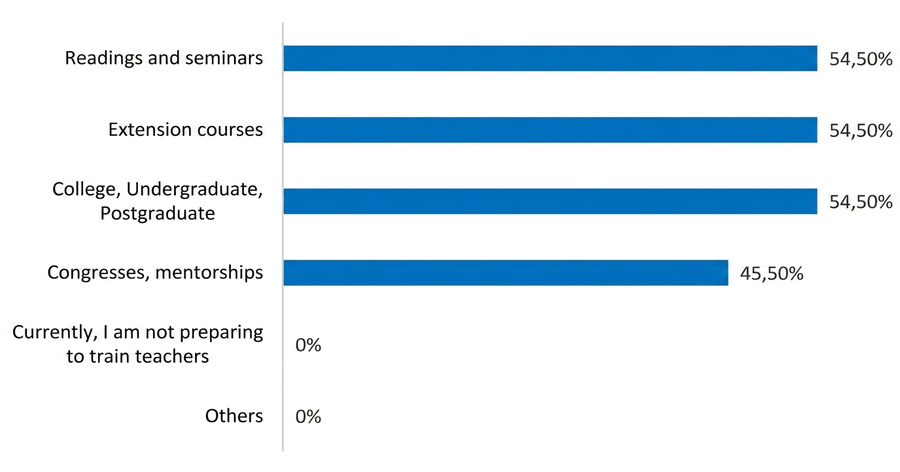
The subsequent question checked the modalities chosen by pedagogical coordinators for their own continuing education. The professionals were asked about how they carry out their professional development or, in some cases, face difficulties in carrying out this training. Although the response options are varied, there is a certain balance in the choices made by the interviewees, which suggests a constant search for updating, even in the face of possible challenges or limitations, as observed in Figure 1.
Source: Original research results.
Figure 1 shows that the professionals’ choices reflect a clear need for flexibility, as the most selected learning modalities are commonly offered in the Distance Learning (EAD) format or carried out autonomously. This preference for self-management of routine reflects the reality of the limited time that pedagogical coordinators have to dedicate to their own training, while simultaneously fulfilling their professional duties and maintaining the need for constant updating, as revealed by the studies of Almeida and Placco[4].
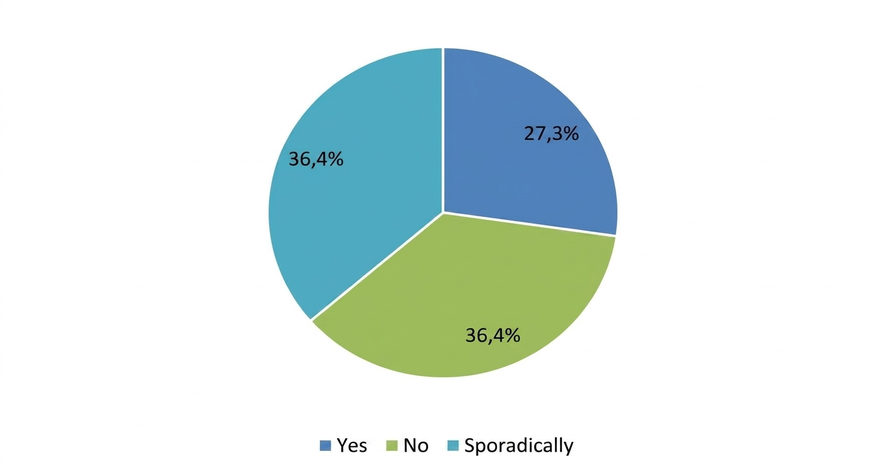
The subsequent steps investigate the relationship of professionals with the time dedicated to their own training and how they manage this resource. The graph presents the results of the survey conducted with the coordinators regarding the possibility of continuous training according to their worked workload. In this question, the standards and norms established by the Consolidation of Labor Laws (CLT) were considered, as illustrated in Figure 2.
Source: Original research results.
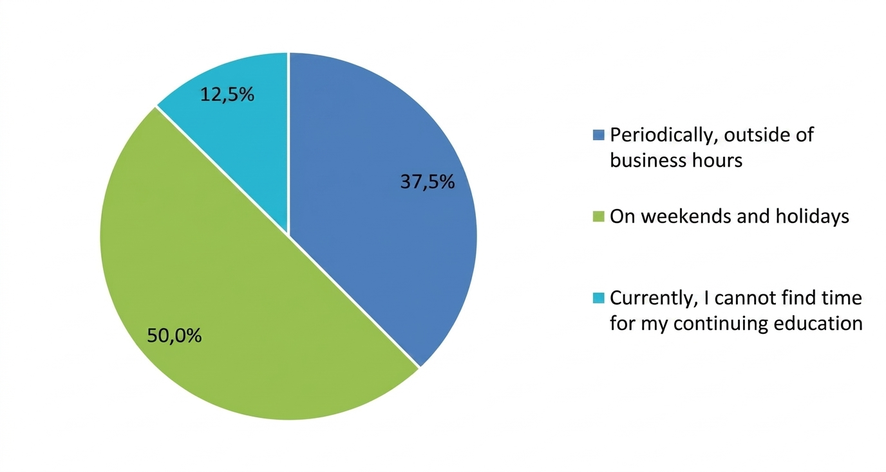
The data present considerable heterogeneity; however, it is evident that most professionals face a reality in which they do not have the time, incentive, or adequate space to dedicate themselves to training during their regular workday. In a second moment, the professionals who responded that they could not dedicate themselves to training during their workload were asked when they carry out this action, as shown in Figure 3.
Source: Original research results.
In addition to relying mostly on distance learning and autonomous practices, the coordinators’ responses confirm the need for flexibility in the face of an overload of assignments[7]. Many indicated that they use weekends and rest periods to study, which compromises their personal-professional balance. This finding reinforces that the absence of institutional policies transfers the individual responsibility of finding time for professional development to the professional, generating emotional overload, and increasing the risk of illness.
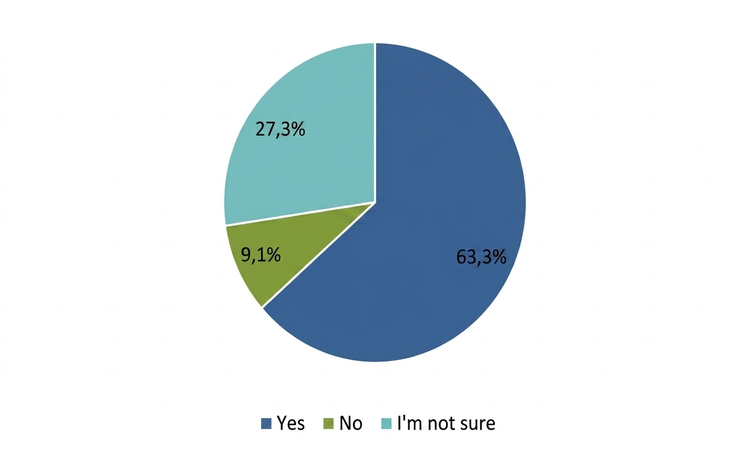
The last question investigates the perception and feeling of professionals regarding their own aptitude for the role of trainers, when some demonstrate clear uncertainty and insecurity about their preparation to train the teaching teams under their management, as illustrated in Figure 4.
Source: Original research results.
Most respondents consider themselves capable of training teachers; however, 36.4% report insecurity or lack of preparation. This data reveals that, even with individual efforts, there are still gaps in the training process for coordinators, which generates occasional uncertainties and weaknesses.
Zeichner[8] reinforces that critical and revisited reflection must be structuring and permanent in teacher training; however, without political and legislative support, this practice tends to be restricted to isolated initiatives, dependent on internal norms and cultures established by the educational institutions themselves. Furthermore, 9.1% of coordinators reported that they do not feel comfortable or capable of fully performing the role of trainers, which highlights the need for greater support and training to develop their competencies in this area.
The results indicate a central tension: on the one hand, the recognition of the importance of continuous training; on the other, the absence of institutionalized time for this practice. The pedagogical coordinator faces a paradox, as they need to be a trainer, but do not find space to train themselves. This contradiction compromises not only their individual performance but also the process of pedagogical innovation within the school. Formosinho[5] emphasizes that training needs to be collective and planned; however, when it depends solely on personal and sporadic efforts, it loses its transformative power.
The continuing education of the coordinator is a fundamental element for them to fully play their role as a facilitator in the development of teachers. Without adequate time to update and improve their practices, the coordinator faces difficulties in leading innovative and critical training processes.
This study shows that the biggest challenge faced by pedagogical coordinators is the lack of time and institutional space to invest in their own training. Without this foundation, their performance as a training leader tends to be limited, which affects teacher development and, consequently, the overall quality of education. Furthermore, the absence of specific regulations for the continuous training of these professionals increases the difficulties and creates a scenario where the responsibility for updating falls mainly on the individual.
Although the study is centered on only one level of basic education in Brazil — private education — the similarity in the coordinators’ responses in various Brazilian capitals reflects the reality pointed out by previous studies. The survey also opens paths for future research, which can question and compare the quality of the training provided by the coordinators, considering the relationship these professionals have with the time available to prepare their training, whether this time occurs inside or outside of working hours, and by investigating their personal and professional well-being and balance.
Therefore, the creation of policies that ensure the continuous training of coordinators within working hours, with adequate conditions for updating and innovation, becomes essential and even urgent. It is fundamental to understand that valuing the coordinator as a trainer means recognizing their centrality in the school ecosystem and their direct influence on learning outcomes. Strengthening continuous training should not be seen as an investment solely in the individual, but as a commitment to educational quality in its collective and transformative dimension.
REFERENCES
[1] Coutinho, J. D., Costa, J. C., Silva, S. G. 2020. The role of the pedagogical coordinator as an inducer of continuing education. Brazilian Journal of Development, 6(10), 84087–84101. DOI:10.34117/bjdv6n10-737.
[2] Brasil. 1996. Lei nº 9.394, de 20 de dezembro de 1996. Estabelece as diretrizes e bases da educação nacional. Brasília, DF. Disponível em: http://www.planalto.gov.br/ccivil_03/leis/l9394.htm.
[3] Tardif, M., Lessard, C., Lahaye, L. 1991. Os professores face ao saber: esboço de uma problemática do saber docente. Teoria e Educação, 4, 215–233.
[4] Almeida, R.L.; Placco, M.V. 2003. O coordenador pedagógico e o cotidiano da escola. São Paulo, SP: Loyola.
[5] Formosinho, J. 2009. Formação de Professores: Aprendizagem Profissional e Ação Docente. Portugal: Porto Editora.
[6] Brasil. 2015. Resolução CNE/CP nº 2, de 1º de julho de 2015. Define as Diretrizes Curriculares Nacionais para a formação inicial em nível superior e para a formação continuada dos profissionais do magistério da educação básica. Brasília, DF: Conselho Nacional de Educação. Disponível em: http://portal.mec.gov.br/docman/agosto-2017-pdf/70431-res-cne-cp-002-03072015-pdf/file.
[7] Estrada, R.J.; Flores, T.G.; Schimith, D.C. 2011. Gestão do tempo como apoio ao planejamento estratégico pessoal. Revista de Administração da UFSM. 4(2): 315–332. Recuperado de: https://www.redalyc.org/articulo.oa?id=273419420009.
[8] Zeichner, K. 2008. Uma análise crítica sobre a “reflexão” como conceito estruturante na formação docente. Educação e Sociedade, 29(103), 535–554. http://dx.doi.org/10.1590/S0101-73302008000200012.
COMO CITAR
Rampani, C.M.V.; Martins, M.P.R. Formação contínua e gestão do tempo: desafios e prioridades do coordenador pedagógico. Revista E&S. 2025; 6: e2025028.
ABOUT THE AUTHORS
Camille Maria Vitalino Rampani – Specialist in School Management. Customer Success Consultant at International School Education. Rua Ribeirópolis, 532, Jardim Independência, 03225-010, São Paulo, SP, Brazil.
Milena Pedroso Ruella Martins – Advisor professor. Rua Cezira Giovanoni Moretti, 580, Santa Rosa, 13414-157, Piracicaba, São Paulo.